Kirjojen hintavertailu. Mukana 12 246 623 kirjaa ja 12 kauppaa.

Kirjailija

Eric V. Larson

Kirjat ja teokset yhdessä paikassa: 19 kirjaa, julkaisuja vuosilta 1996-2021, suosituimpien joukossa Air Power as a Coercive Instrument. Vertaile teosten hintoja ja tarkista saatavuus suomalaisista kirjakaupoista.

Mukana myös kirjoitusasut: Eric V Larson

19 kirjaa

Kirjojen julkaisuhaarukka 1996-2021.

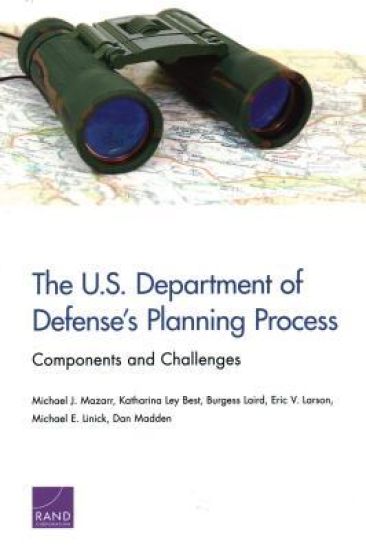
The U.S. Department of Defense's Planning Process

The U.S. Department of Defense's Planning Process

Michael J Mazarr; Katharina Ley Best; Burgess Laird; Eric V Larson; Michael E Linick; Dan Madden

RAND
2019
nidottu
This report--Phase Two of a three-phase project--describes the current defense planning process used by the U.S. Department of Defense, with a focus on how scenarios are developed and employed to support defense planning. It examines and critiques how scenarios are used in current planning processes, based on an assessment of unclassified documents and dialogues with current and former participants in the process.
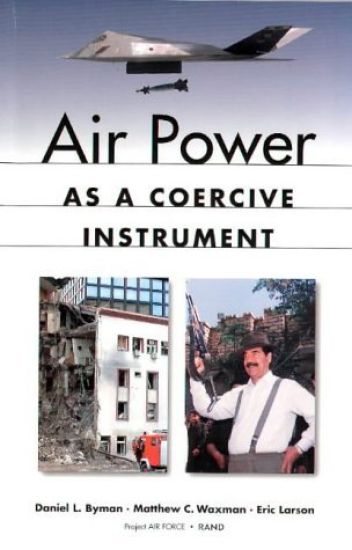
Air Power as a Coercive Instrument

Air Power as a Coercive Instrument

Daniel L. Byman; Matthew C. Waxman; Eric V. Larson

RAND
1999
pokkari
Coercion--the use of threatened force to induce an adversary to change its behavior--is a critical function of the U.S. military. U.S. forces have recently fought in the Balkans, the Persian Gulf, and the Horn of Africa to compel recalcitrant regimes and warlords to stop repression, abandon weapons programs, permit humanitarian relief, and otherwise modify their actions. Yet despite its overwhelming military might, the United States often fails to coerce successfully. This report examines the phenomenon of coercion and how air power can contribute to its success. Three factors increase the likelihood of successful coercion: (1) the coercer's ability to raise the costs it imposes while denying the adversary the chance to respond (escalation dominance); (2) an ability to block an adversary's military strategy for victory; and (3) an ability to magnify third-party threats, such as internal instability or the danger posed by another enemy. Domestic political concerns (such as casualty sensitivity) and coalition dynamics often constrain coercive operations and impair the achievement of these conditions. Air power can deliver potent and credible threats that foster the above factors while neutralizing adversary countercoercive moves. When the favorable factors are absent, however, air power--or any other military instrument--will probably fail to coerce. Policymakers' use of coercive air power under inauspicious conditions diminishes the chances of using it elsewhere when the prospects of success would be greater.
Defense Planning in a Time of Conflict

Defense Planning in a Time of Conflict

Eric V Larson; Derek Eaton; Michael E Linick

RAND
2021
nidottu
This Executive Summary highlights findings from a comparative historical analysis of the four Quadrennial Defense Reviews conducted after 1997 (in 2001, 2006, 2010, and 2014), identifying trends, implications, and recommendations for the Army and Defense Department in order to shape the conduct of and improve future reviews.
Force Planning Scenarios, 1945-2016
This report describes the forces that shaped conventional ground force planning during the 1945-2016 period, with an emphasis on the strategic concepts and contingency scenarios used. It identifies broader lessons that are likely to be of interest to contemporary force planners. Finally, the report identifies potential opportunities for the U.S. Army to influence the future selection of defense planning scenarios.
Defense Planning in a Time of Conflict

Defense Planning in a Time of Conflict

Eric V Larson; Derek Eaton; Michael E Linick

RAND
2018
nidottu
This report presents a comparative historical analysis of the four Quadrennial Defense Reviews (QDRs) conducted after 1997 (in 2001, 2006, 2010, and 2014) and identifies trends, implications, and recommendations for the Army and U.S. Department of Defense in order to shape the conduct of and improve future reviews.
Considerations for Integrating Women into Closed Occupations in U.S. Special Operations Forces

Considerations for Integrating Women into Closed Occupations in U.S. Special Operations Forces

Thomas S. Szayna; Eric V. Larson; Angela O'Mahony; Sean Robson; Agnes Gereben Schaefer; Miriam Matthews; J.Michael Polich; Lynsay Ayer; Derek Eaton; William Marcellino; Lisa Miyashiro; Marek Posard; James Syme; Zev Winkelman; Cameron Wright; Megan Zander-Cotugno; William Welser

RAND
2016
pokkari
Integrating women into special operations forces poses potential challenges for unit cohesion. The integration of women raises issues of effectiveness, in terms of physical standards and ensuring the readiness, cohesion, and morale essential to high-performing teams. This report assesses those challenges and provides analytical support for validating occupational standards for positions controlled by U.S. Special Operations Command.
Strategy-Policy Mismatch

Strategy-Policy Mismatch

Timothy M. Bonds; Eric V. Larson; Derek Eaton; Richard E. Darilek

RAND
2014
pokkari
Although two successive presidents have determined that weapons of mass destruction (WMD) pose the greatest threat to the American people and have listed countering their proliferation as a top strategic priority, neither administration has followed through by allocating appropriate budgetary resources to it. This report addresses and analyzes the ground force capacity and capabilities needed to perform WMD elimination missions and tasks.
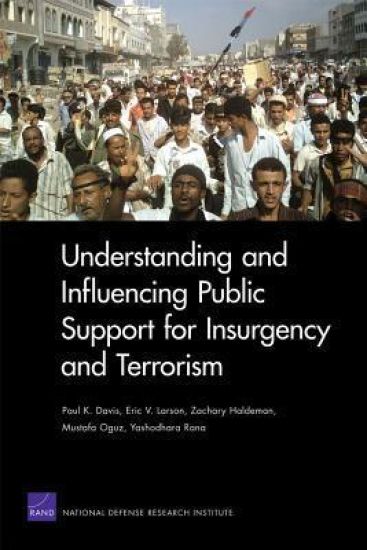
Understanding and Influencing Public Support for Insurgency and Terrorism

Understanding and Influencing Public Support for Insurgency and Terrorism

Paul K. Davis; Eric V. Larson; Zachary Haldeman; Mustafa Oguz; Yashodhara Rana

RAND
2012
pokkari
Using and testing a conceptual model that draws on social science and particularly social movement theory, this volume examines public support for al-Qa'ida's transnational jihadist movement, the Taliban insurgency in Afghanistan, the Kurdistan Workers' Party (PKK) in Turkey, and the Maoist insurgency in Nepal. The authors discuss which factors were most salient across cases, how their importance varied in each case, and how this understanding can inform strategy.
China and India, 2025: A Comparative Assessment

China and India, 2025: A Comparative Assessment

Charles Wolf; Siddhartha Dalal; Julie S. DaVanzo; Eric V. Larson; Alisher Akhmedjonov; Harun Dogo; Meilinda Huang; Silvia Montoya

RAND
2011
pokkari
China and India, the world's two most populous countries, will exercise increasing influence in international affairs in the coming decades. This document assesses the relative prospects of China and India through 2025 in four domains: demography, macroeconomics, science and technology, and defense spending and procurement. In each domain, the authors try to answer the following questions: Who is ahead? By how much? and Why? Assesses the relative prospects of India and China through 2025 in four domains: demography, macroeconomics, science and technology, and defense spending and procurement.
Understanding Commanders' Information Needs for Influence Operations
Documents a study whose goals were to develop an understanding of commanders' information requirements for cultural and other "soft" factors in order to improve the effectiveness of combined arms operations, and to develop practical ways for commanders to integrate information and influence operations activities into combined arms planning/assessment in order to increase the usefulness to ground commanders of such operations.
Misfortunes of War

Misfortunes of War

Eric V. Larson; Bogdan Savych

RAND
2006
pokkari
In January 2004, the U.S. Department of Homeland Security inaugurated a new system for tracking foreign visitors at Ports of entry to the United States, the United States Visitor and Immigrant Status Indicator Technology (US-VISIT) program. Building on previous RAND research and a case study of similar requirements in France in The 1980s and 1990s, this paper discusses policy issues raised by US-VISIT,including its effects on national security, privacy, and trade and tourism.
Ambivalent Allies?

Ambivalent Allies?

Eric V. Larson; Norman D. Levin; Seonhae Baik; Bogdan Savych

RAND
2004
pokkari
Have South Korean attitudes toward the United States deteriorated? To answer this question, RAND researchers compiled and analyzed South Korean public opinion data from the past decade. Have South Korean attitudes toward the United States deteriorated? To answer this question, RAND researchers compiled and analyzed public opinion data on those attitudes and examined selected periods in U.S.-South Korean relations to identify the sources of anti-U.S. sentiment. They found evidence of a downturn in favorable sentiment toward the U.S. but also of a more recent recovery. They recommend ways to improve South KoreansO perceptions of the U.S. and address their long-standing grievances.
Building a New Foundation for Innovation

Building a New Foundation for Innovation

Eric V. Larson; Irene T. Brahmakulam

RAND
2002
pokkari
This study reports the efforts of a workshop to build partnerships between universities, industry, and governments. In 2000, the National Science Foundation (NSF) created the Partnerships for Innovation (PFI) program. The PFI is part of a larger NSF effort to build a new foundation for innovation based upon partnerships between university, industry, and local and regional governments that also will be responsive to emerging economic and social challenges facing the nation. In June 2001, a workshop held in Arlington, Virginia, brought together PFI grantees and representatives from university and industry to consider the roles of the PFI and the NSF in the larger national innovation enterprise. This report synthesizes workshop discussions regarding innovation and sustainable partnerships. The workshop revealed strong support for a formal evaluation of the PFI program and endorsed both an expanded NSF role in promoting innovation and partnerships through the PFI and other programs and continued efforts by NSF to further diversify and better exploit synergies between its innovation-supporting programs.(PB) The National Science Foundation created the Partnerships for Innovation program in 2000. This report synthesizes workshop discussions regarding innovation and sustainable partnerships between universities, industry, and government, and participants' strong endorsement of an expanded NSF role promoting these activities.
Defense Planning in a Decade of Change

Defense Planning in a Decade of Change

Eric V. Larson; David T. Orletsky; Kristin Leuschner

RAND
2001
pokkari
One liner: Each of the three defense reviews of the last decade fell short of fully apprehending the demands of the emerging threat environment, and the budgets that would be needed and afforded, resulting in a growing imbalance between strategy, forces, and resources over the decade. The end of the Cold War ushered in an era of profound change in the international arena and hence in the policymaking environment as well. Yet the changes that have characterized the post-Cold War era have often proceeded at different paces and have at times moved in opposing directions, placing unprecedented strain on policymakers seeking to shape a new national security and military strategy. This report describes the challenges policymakers have faced as seen through the lens of the three major force structure reviews that have taken place over the past decade; the 1990 Base Force, the 1993 Bottom-Up Review, and the 1997 Quadrennial Defense Review. The report focuses on the assumptions, decisions, and outcomes associated with these reviews as well as the planning and execution of each.It concludes that all three reviews fell short of fully apprehending the demands of the emerging threat environment, and the budgets that would be needed and afforded, resulting in a growing imbalance between strategy, forces, and resources over the decade. Accordingly, the report recommends that future defense planners adopt an assumption-based approach in which key planning assumptions are continually reassessed with a view toward recognizing--and rapidly responding to--emerging gaps and shortfalls. [AF]
Preparing the U.S. Army for Homeland Security

Preparing the U.S. Army for Homeland Security

Eric V. Larson; John E. Peters

RAND
2001
pokkari
Although military policy seems focused on overseas threats, defending the homeland is, of course, the ultimate objective. This guide examines emergent threats to the USA homeland such as speciality weapons, cyber attacks and ballistic missiles and delineates the army's responsibilities.
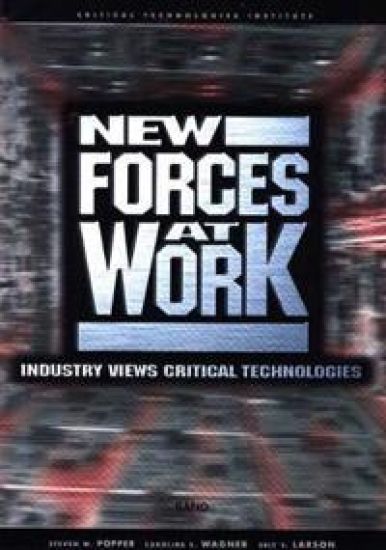
New Forces at Work

New Forces at Work

Steven W. Popper; Caroline S. Wagner; Eric V. Larson

RAND
1998
pokkari
In this age of rapidly advancing technology, what will it take for the United States to remain competitive in the world economy? What new technologies are essential to build new industries, to drive economic growth, to improve the health and quality of life of our people, to ensure national security, and to protect the environment? Since 1991, the federal government has sponsored reports to address these questions and gain insights into key technologies or technological areas. New Forces at Work: Industry Views Critical Technologies, explores this set of issues surrounding this area of policy from an industry perspective. The authors engaged and solicited the views of presidents, CEOs, and Chief Technology Officers from 39 firms representing a cross section of industries. The result is a revealing look at the state of five major technology sectors that U.S. industry cited as essential: software, microelectronics and telecommunications technologies, manufacturing technologies, materials, and sensor and imaging technologies.
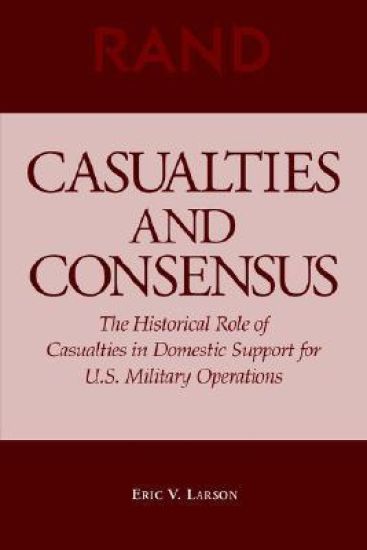
Casualties and Consensus

Casualties and Consensus

Eric V. Larson

RAND
1996
pokkari
It is often said that the Vietnam War taught us that the American public is no longer willing to tolerate American casualties in U.S. wars and military operations. There are also two contradictory corollaries: one that the first deaths in a conflict will spark demands for immediate withdrawal, the other that casualties lead to an inexorable demand for escalation to victory. The truth is far more subtle and sensible. The simplest explanation consistent with the data is that public support for U.S. military operations and public tolerance for casualties are based upon a sensible weighing of benefits and costs that is influenced heavily by consensus (or its absence) among political leaders. When such agreement is missing, even low costs can erode public support for the intervention. In the end, most Americans do not want lives to be sacrificed for any but the most compelling and promising causes, and they rely on their leaders to illuminate just how compelling and promising these causes are.