Kirjojen hintavertailu. Mukana 12 657 676 kirjaa ja 12 kauppaa.

Kirjailija

Erich Heller

Kirjat ja teokset yhdessä paikassa: 12 kirjaa, julkaisuja vuosilta 1975-2013, suosituimpien joukossa Mistral: Studies in Modern European Literature and Thought. Vertaile teosten hintoja ja tarkista saatavuus suomalaisista kirjakaupoista.

12 kirjaa

Kirjojen julkaisuhaarukka 1975-2013.

Lorca: An Appreciation of His Poetry

Lorca: An Appreciation of His Poetry

Roy Campbell; Erich Heller

Literary Licensing, LLC
2013
sidottu
Lorca: An Appreciation Of His Poetry is a book written by Roy Campbell that delves into the life and work of Spanish poet Federico Garc������a Lorca. The book provides a comprehensive analysis of Lorca's poetry, exploring the themes, language, and imagery used by the poet. The author examines Lorca's life and the cultural and political context in which he lived, providing insights into the influences that shaped his work. The book also includes translations of some of Lorca's most famous poems, allowing readers to experience the beauty and power of his words firsthand. Overall, Lorca: An Appreciation Of His Poetry is a must-read for anyone interested in Spanish literature or the life and work of one of the most significant poets of the 20th century.Studies In Modern European Literature And Thought.This scarce antiquarian book is a facsimile reprint of the old original and may contain some imperfections such as library marks and notations. Because we believe this work is culturally important, we have made it available as part of our commitment for protecting, preserving, and promoting the world's literature in affordable, high quality, modern editions, that are true to their original work.
The Importance of Nietzsche

The Importance of Nietzsche

Erich Heller

University of Chicago Press
1988
nidottu
In this book, one of the most distinguished scholars of German culture collects his essays on a figure who has long been one of his chief preoccupations. Erich Heller's lifelong study of modern European literature necessarily returns again and again to Friedrich Nietzsche. Nietzsche prided himself on having broken with all traditional ways of thinking and feeling, and once even claimed that he would someday be recognized for having ushered in a new millennium. While acknowledging Nietzsche's radicalism, Heller also insists on the continuity of the story in which he does indeed occupy a central place. By considering Nietzsche in relation to Goethe, Rilke, Wittgenstein, Yeats, and others, Heller shows the philosopher's ambivalence toward the tradition he inherited as well as his profound effect on the thought and sensibility of those who followed him. It is hardly an exaggeration to say, as Heller does in his first essay, that Nietzsche is to many modern writers and thinkers—including Mann, Musil, Kafka, Freud, Heidegger, Jaspers, Gide, and Sartre—what St. Thomas Aquinas was to Dante: the categorical interpreter of a world, which they contemplate imaginatively and theoretically without ever much upsetting its Nietzschean structure. Thus it is Nietzsche's thought, so pervasively present in the themes of modernity, that gives coherence and unity to Heller's essays. What emerges from them is that, despite his iconoclastic declarations and unorthodox philosophical practices, Nietzsche deals with the human spirit's persistent concerns. His questions remain urgent, and even the answers, in all their contradictoriness, possess the commanding force of his inquiry. An example is the incompatibility of the famous extremes, the teaching of the Übermensch and the Eternal Recurrence of All Things. These cancel each other out and yet grow from the same intellectual and spiritual roots, as is shown lucidly and cogently by one of Heller's most forceful essays, "Nietzsche's Terrors: Time and the Inarticulate." In fathoming the depth of this contradiction, Heller at the same time reveals the importance of Nietzsche for those who seek to understand the wellsprings of the epoch's disquiet, turmoil, and creativity.
Disinherited Mind: Essays in Modern German Literature and Thought
Since first publication in 1952, The Disinherited Mind has been in continuous demand, recognized as a work whose significance extends far beyond the subject of German letters. The noted critic and poet Edwin Muir has written of it, "The condition it describes is our condition, and I can think of no other modem book in which it is described so clearly."The unifying theme is the sense of values embodied in the works of key German poets, writers, and thinkers from Goethe to Kafka, particularly the consciousness of life's deprecation. While earlier poets and philosophers were preoccupied with the marvelous, Professor Heller writes, their modem successors try desperately to ward off "the predominance of the prosaic." He deals with this problem most directly in the central essay, "Rilke and Nietzsche." Other essays discuss Goethe's Faust, his opposition to Newtonian science, Burckhardt's philosophy of history, Kafka's The Castle, Spengler's historical imagination, and Karl Kraus's satire. To this expanded edition Professor Heller has added a new preface and two essays that belong thematically -- one discussing Nietzsche's effect on Yeats, and the second, the metamorphoses in Nietzsche's Thus Spoke Zarathustra.
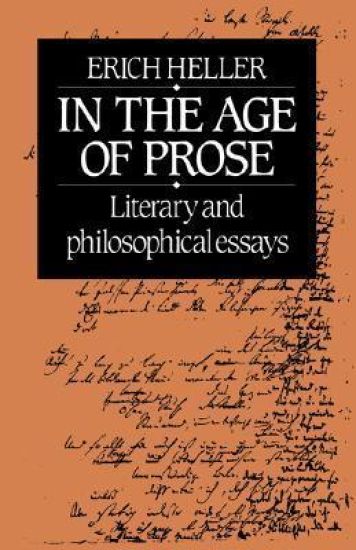
In the Age of Prose

In the Age of Prose

Erich Heller

Cambridge University Press
1984
pokkari
The guiding theme of these essays is the fate of the imagination and the condition of art in the modern world, where both appear to be enfeebled by scientific hubris, undermined by psychological self-questioning and compromised by political disaster. Erich Heller traces this predicament with subtlety and profundity, from Hegel’s and Nietzsche’s diagnoses to the various truces and manoeuvres through which remarkable victories have nonetheless been achieved - such as the comic triumphs of Wilhelm Busch. As elsewhere in Professor Heller’s work, Thomas Mann’s attempt to outwit and redeem his circumstances through art - ‘despite’ them, as he said himself - occupies a central place. Three of the present essays are devoted to him. Others consider Kleist, Fontane, Hamsun, Karl Kraus and the crucial figures of Hölderlin (who plays such a central role in Heidegger’s later philosophical writings) and Rilke. Written with feeling, and the distinctive elegance and wit that have characterized all of Professor Heller’s work, the essays here reaffirm the vital interdependence of literature and human values.
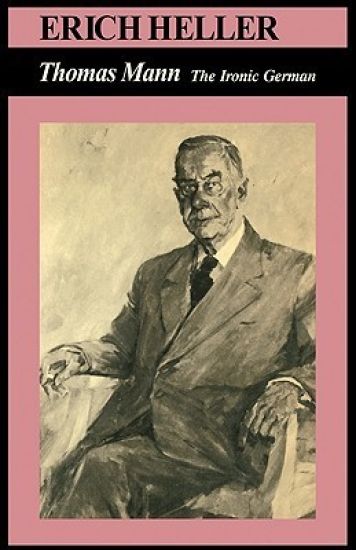
Thomas Mann

Thomas Mann

Thomas Mann; Erich Heller

Cambridge University Press
1981
pokkari
In this book, which was first published in 1958 and reissued in 1981, Professor Heller sees Mann as the late heir of the central tradition of modern German literature and also as one of the most ironic writers within that tradition. He offers a detailed study of the major works of fiction, Buddenbrooks, Tonio Kröher, Death in Venice, The Magic Mountain, Joseph and His Brothers, Doctor Faustus and Felix Krull, as well as a discussion of Mann's most significant political essay, 'Meditations of a Non-Political Man'. Beyond this, Heller's book is a profound commentary on Mann by a mind attuned to (and mouded by) precisely the intellectual and cultural traditions which are so much part of Mann's creative make-up.
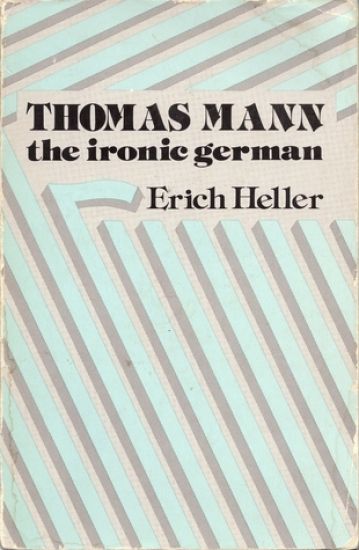
Thomas Mann: The Ironic German

Thomas Mann: The Ironic German

Erich Heller

Regnery Publishing
1979
nidottu
In this book, which was first published in 1958 and reissued in 1981, Professor Heller sees Mann as the late heir of the central tradition of modern German literature and also as one of the most ironic writers within that tradition. He offers a detailed study of the major works of fiction, Buddenbrooks, Tonio Kroher, Death in Venice, The Magic Mountain, Joseph and His Brothers, Doctor Faustus and Felix Krull, as well as a discussion of Mann's most significant political essay, 'Meditations of a Non-Political Man'. Beyond this, Heller's book is a profound commentary on Mann by a mind attuned to (and mouded by) precisely the intellectual and cultural traditions which are so much part of Mann's creative make-up.