Kirjojen hintavertailu. Mukana 12 595 353 kirjaa ja 12 kauppaa.

Kirjailija

Erich L. Lehmann

Kirjat ja teokset yhdessä paikassa: 10 kirjaa, julkaisuja vuosilta 1998-2013, suosituimpien joukossa Fisher, Neyman, and the Creation of Classical Statistics. Vertaile teosten hintoja ja tarkista saatavuus suomalaisista kirjakaupoista.

10 kirjaa

Kirjojen julkaisuhaarukka 1998-2013.

Fisher, Neyman, and the Creation of Classical Statistics

Fisher, Neyman, and the Creation of Classical Statistics

Erich L. Lehmann

Springer-Verlag New York Inc.
2011
nidottu
Classical statistical theory—hypothesis testing, estimation, and the design of experiments and sample surveys—is mainly the creation of two men: Ronald A. Fisher (1890-1962) and Jerzy Neyman (1894-1981). Their contributions sometimes complemented each other, sometimes occurred in parallel, and, particularly at later stages, often were in strong opposition. The two men would not be pleased to see their names linked in this way, since throughout most of their working lives they detested each other. Nevertheless, they worked on the same problems, and through their combined efforts created a new discipline.This new book by E.L. Lehmann, himself a student of Neyman’s, explores the relationship between Neyman and Fisher, as well as their interactions with other influential statisticians, and the statistical history they helped create together. Lehmann uses direct correspondence and original papers to recreate an historical account of the creation of the Neyman-Pearson Theory as well as Fisher’s dissent, and other important statistical theories.
Basic Concepts of Probability and Statistics, Part 1: Probability

Basic Concepts of Probability and Statistics, Part 1: Probability

J. L. Hodges Jr; Erich L. Lehmann

Literary Licensing, LLC
2013
sidottu
""Basic Concepts of Probability and Statistics, Part 1: Probability"" by J.L. Hodges Jr. is a comprehensive guide to understanding the fundamental concepts of probability. The book provides a clear and concise introduction to probability theory, including topics such as probability spaces, random variables, and probability distributions. It also covers important concepts such as conditional probability, Bayes' theorem, and the law of large numbers.The book is designed for both students and professionals who are looking to gain a deeper understanding of probability theory. It includes numerous examples and exercises to help readers apply the concepts they have learned. Additionally, the book includes a section on statistical inference, which covers topics such as hypothesis testing and confidence intervals.Overall, ""Basic Concepts of Probability and Statistics, Part 1: Probability"" is an essential resource for anyone looking to gain a solid foundation in probability theory. Its clear and concise explanations, along with its numerous examples and exercises, make it an ideal textbook for students and a valuable reference for professionals in a wide range of fields.This scarce antiquarian book is a facsimile reprint of the old original and may contain some imperfections such as library marks and notations. Because we believe this work is culturally important, we have made it available as part of our commitment for protecting, preserving, and promoting the world's literature in affordable, high quality, modern editions, that are true to their original work.
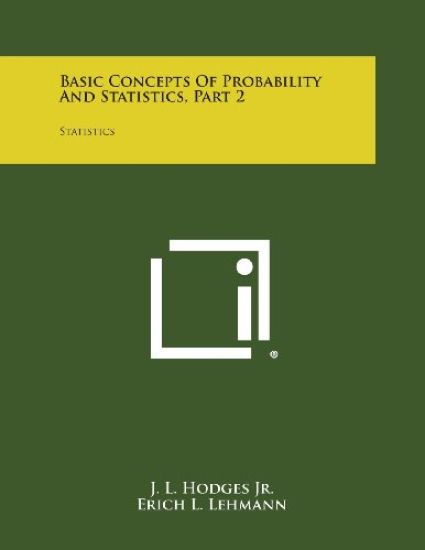
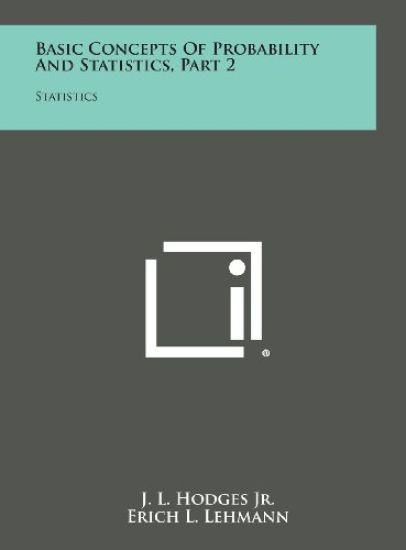
Basic Concepts of Probability and Statistics, Part 2: Statistics

Basic Concepts of Probability and Statistics, Part 2: Statistics

J. L. Hodges Jr; Erich L. Lehmann

Literary Licensing, LLC
2013
sidottu
Basic Concepts of Probability and Statistics, Part 2: Statistics is a comprehensive textbook written by J.L. Hodges Jr. that explores the fundamental concepts of statistics. The book is designed for students and professionals who are interested in learning about statistical methods and their applications in various fields.The book starts with an introduction to probability and then proceeds to cover topics such as sampling, estimation, hypothesis testing, regression analysis, and analysis of variance. The author uses real-world examples and case studies to illustrate the concepts and make them more accessible to the reader.The book is divided into several chapters, each of which covers a specific topic in statistics. The chapters are organized in a logical sequence, starting with the basics and progressing to more advanced topics. The author provides clear explanations of the concepts and includes numerous examples and exercises to help readers understand and apply the material.Overall, Basic Concepts of Probability and Statistics, Part 2: Statistics is an excellent resource for anyone who wants to learn about statistical methods and their applications. The book is well-written, easy to follow, and provides a solid foundation for further studies in statistics.This scarce antiquarian book is a facsimile reprint of the old original and may contain some imperfections such as library marks and notations. Because we believe this work is culturally important, we have made it available as part of our commitment for protecting, preserving, and promoting the world's literature in affordable, high quality, modern editions, that are true to their original work.
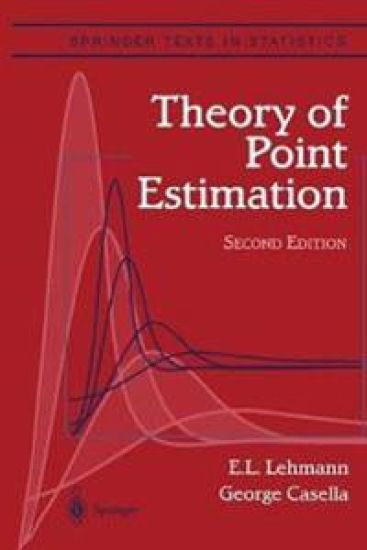
Theory of Point Estimation

Theory of Point Estimation

Erich L. Lehmann; George Casella

Springer-Verlag New York Inc.
2011
nidottu
Since the publication in 1983 of Theory of Point Estimation, much new work has made it desirable to bring out a second edition. The inclusion of the new material has increased the length of the book from 500 to 600 pages; of the approximately 1000 references about 25% have appeared since 1983. The greatest change has been the addition to the sparse treatment of Bayesian inference in the first edition. This includes the addition of new sections on Equivariant, Hierarchical, and Empirical Bayes, and on their comparisons. Other major additions deal with new developments concerning the information in equality and simultaneous and shrinkage estimation. The Notes at the end of each chapter now provide not only bibliographic and historical material but also introductions to recent development in point estimation and other related topics which, for space reasons, it was not possible to include in the main text. The problem sections also have been greatly expanded. On the other hand, to save space most of the discussion in the first edition on robust estimation (in particu lar L, M, and R estimators) has been deleted. This topic is the subject of two excellent books by Hampel et al (1986) and Staudte and Sheather (1990). Other than subject matter changes, there have been some minor modifications in the presentation.
Testing Statistical Hypotheses

Testing Statistical Hypotheses

Erich L. Lehmann; Joseph P. Romano

Springer-Verlag New York Inc.
2010
nidottu
The Third Edition of Testing Statistical Hypotheses brings it into consonance with the Second Edition of its companion volume on point estimation (Lehmann and Casella, 1998) to which we shall refer as TPE2. We won’t here comment on the long history of the book which is recounted in Lehmann (1997) but shall use this Preface to indicate the principal changes from the 2nd Edition. The present volume is divided into two parts. Part I (Chapters 1–10) treats small-sample theory, while Part II (Chapters 11–15) treats large-sample theory. The preface to the 2nd Edition stated that “the most important omission is an adequate treatment of optimality paralleling that given for estimation in TPE.” We shall here remedy this failure by treating the di?cult topic of asymptotic optimality (in Chapter 13) together with the large-sample tools needed for this purpose (in Chapters 11 and 12). Having developed these tools, we use them in Chapter 14 to give a much fuller treatment of tests of goodness of ?tthan was possible in the 2nd Edition, and in Chapter 15 to provide an introduction to the bootstrap and related techniques. Various large-sample considerations that in the Second Edition were discussed in earlier chapters now have been moved to Chapter 11.
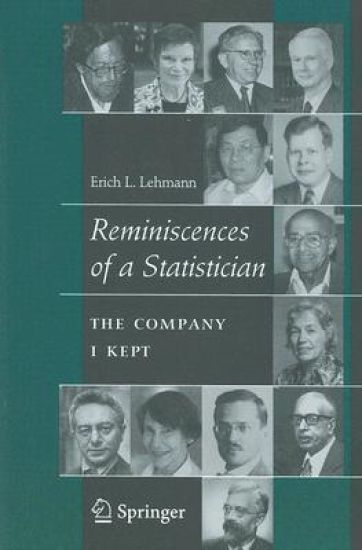
Reminiscences of a Statistician

Reminiscences of a Statistician

Erich L. Lehmann

Springer-Verlag New York Inc.
2007
nidottu
It has been my good fortune to meet and get to know many remarkable people, mostly statisticians and mathematicians, and to derive much pleasure and benefit from these contacts. They were teachers, colleagues and students, and the following pages sketch their careers and our interactions. Also included are a few persons with whom I had little or no direct contact but whose ideas had a decisive influence on my work. To provide some coherence, the account is largely chronological and follows the steps of my own career. Taken together, these sketches provide a very personal picture of the dev- opment of statistical theory from the 1930s to the 1970s. It is the period between two revolutions: that of Fisher, Neyman, and Pearson, which laid the foundations for the classical statistical theory of that period; and the second revolution, forty years later, brought about by the advent of the computer, which turned statistics in new directions. The present account of this history is a highly selective one, which emphasizes the persons, institutions, and statistical topics that were close to my interests. One narrowing effect of this perspective stems from the fact that my career took place in the United States. As a consequence, the book focuses on American statisticians and institutions. Only the last two ch- ters discuss, briefly and very incompletely, developments in some other countries.
Nonparametrics

Nonparametrics

Erich L. Lehmann

Springer-Verlag New York Inc.
2006
nidottu
Rank tests form a class of statistical procedures that have the advantage of great simplicity combined with surprising power. Since their development in the 1940s and 1950s, they have taken their place as strong competitors of the more classical normal theory methods. Rank tests apply only to relatively simple solutions, such as one-, tw0-, and s-sample problems, and testing for independence and randomness, but for these situations they are often the method of choice. This reprint of a classic reference book describes these tests and the estimating procedures derived from them, and gives an account of their properties. Even though the field of rank tests has undergone little change, important new methodologies have sprung up that also serve the purpose of freeing statistics from the unrealistic model assumptions that so frequently invalidate its applications. All the tests discussed here are now available in a variety of statistical packages. E.L. Lehmann is Professor of Statistics Emeritus at the University of California, Berkeley. He is a member of the National Academy of Sciences and the American Academy of Arts and Sciences, and the recipient of honorary degrees from the University of Leiden, The Netherlands and the University of Chicago. He is the author of Elements of Large-Sample Theory, Theory of Point Estimation, Second Edition (with George Casella), and Testing Statistical Hypotheses, Third Edition (with Joseph P. Romano).
Theory of Point Estimation

Theory of Point Estimation

Erich L. Lehmann; George Casella

Springer-Verlag New York Inc.
1998
sidottu
The second edition of this classic book will serve as a reference on mathematical statistics for graduate students and researchers in mathematical statistics. Many topics are presented which have been available only in journal form.