Kirjojen hintavertailu. Mukana 12 555 245 kirjaa ja 12 kauppaa.

Kirjailija

Erik Cuevas

Kirjat ja teokset yhdessä paikassa: 43 kirjaa, julkaisuja vuosilta 2015-2026, suosituimpien joukossa Optimization in Industrial Engineering. Vertaile teosten hintoja ja tarkista saatavuus suomalaisista kirjakaupoista.

43 kirjaa

Kirjojen julkaisuhaarukka 2015-2026.

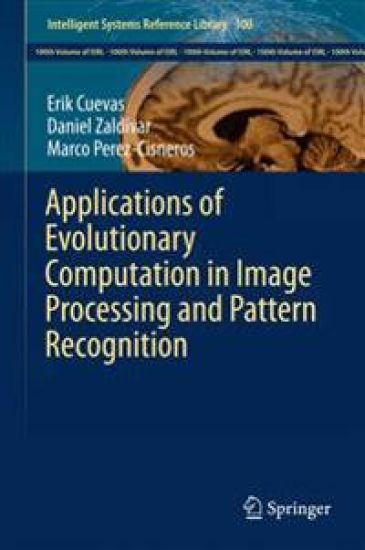
Applications of Evolutionary Computation in Image Processing and Pattern Recognition

Applications of Evolutionary Computation in Image Processing and Pattern Recognition

Erik Cuevas; Daniel Zaldívar; Marco Perez-Cisneros

Springer International Publishing AG
2016
nidottu
This book presents the use of efficient Evolutionary Computation (EC) algorithms for solving diverse real-world image processing and pattern recognition problems. It provides an overview of the different aspects of evolutionary methods in order to enable the reader in reaching a global understanding of the field and, in conducting studies on specific evolutionary techniques that are related to applications in image processing and pattern recognition. It explains the basic ideas of the proposed applications in a way that can also be understood by readers outside of the field. Image processing and pattern recognition practitioners who are not evolutionary computation researchers will appreciate the discussed techniques beyond simple theoretical tools since they have been adapted to solve significant problems that commonly arise on such areas. On the other hand, members of the evolutionary computation community can learn the way in which image processing and pattern recognition problems can be translated into an optimization task. The book has been structured so that each chapter can be read independently from the others. It can serve as reference book for students and researchers with basic knowledge in image processing and EC methods.
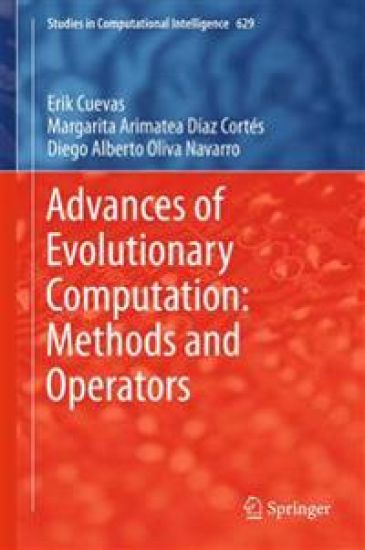
Advances of Evolutionary Computation: Methods and Operators

Advances of Evolutionary Computation: Methods and Operators

Erik Cuevas; Margarita Arimatea Díaz Cortés; Diego Alberto Oliva Navarro

Springer International Publishing AG
2016
sidottu
The goal of this book is to present advances that discuss alternative Evolutionary Computation (EC) developments and non-conventional operators which have proved to be e?ective in the solution of several complex problems. The book has been structured so that each chapter can be read independently from the others. The book contains nine chapters with the following themes: 1) Introduction, 2) the Social Spider Optimization (SSO), 3) the States of Matter Search (SMS), 4) the collective animal behavior (CAB) algorithm, 5) the Allostatic Optimization (AO) method, 6) the Locust Search (LS) algorithm, 7) the Adaptive Population with Reduced Evaluations (APRE) method, 8) the multimodal CAB, 9) the constrained SSO method.
Applications of Evolutionary Computation in Image Processing and Pattern Recognition

Applications of Evolutionary Computation in Image Processing and Pattern Recognition

Erik Cuevas; Daniel Zaldívar; Marco Perez-Cisneros

Springer International Publishing AG
2015
sidottu
This book presents the use of efficient Evolutionary Computation (EC) algorithms for solving diverse real-world image processing and pattern recognition problems. It provides an overview of the different aspects of evolutionary methods in order to enable the reader in reaching a global understanding of the field and, in conducting studies on specific evolutionary techniques that are related to applications in image processing and pattern recognition. It explains the basic ideas of the proposed applications in a way that can also be understood by readers outside of the field. Image processing and pattern recognition practitioners who are not evolutionary computation researchers will appreciate the discussed techniques beyond simple theoretical tools since they have been adapted to solve significant problems that commonly arise on such areas. On the other hand, members of the evolutionary computation community can learn the way in which image processing and pattern recognition problems can be translated into an optimization task. The book has been structured so that each chapter can be read independently from the others. It can serve as reference book for students and researchers with basic knowledge in image processing and EC methods.