Kirjojen hintavertailu. Mukana 12 459 402 kirjaa ja 12 kauppaa.

Kirjailija

Erik Seedhouse

Kirjat ja teokset yhdessä paikassa: 33 kirjaa, julkaisuja vuosilta 2008-2026, suosituimpien joukossa Human Factors in Air Transport. Vertaile teosten hintoja ja tarkista saatavuus suomalaisista kirjakaupoista.

33 kirjaa

Kirjojen julkaisuhaarukka 2008-2026.

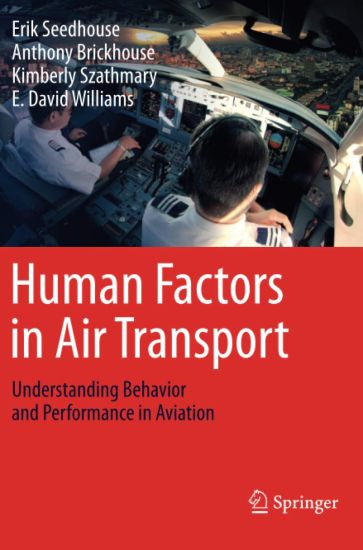
Human Factors in Air Transport

Human Factors in Air Transport

Erik Seedhouse; Anthony Brickhouse; Kimberly Szathmary; E. David Williams

Springer Nature Switzerland AG
2019
sidottu
This textbook provides students and the broader aviation community with a complete, accessible guide to the subject of human factors in aviation. It covers the history of the field before breaking down the physical and psychological factors, organizational levels, technology, training, and other pivotal components of a pilot and crew's routine work in the field.The information is organized into easy-to-digest chapters with summaries and exercises based on key concepts covered, and it is supported by more than 100 full-color illustrations and photographs. All knowledge of human factors required in aviation university studies is conveyed in a concise and casual manner, through the use of helpful margin notes and anecdotes that appear throughout the text.

Commercial Astronauts

Commercial Astronauts

Erik Seedhouse

Springer International Publishing AG
2024
sidottu
The beginning of the 2020’s witnessed dozens of commercial astronauts fly to space on a variety of vehicles. These spacecraft included SpaceX’s Crew Dragon, which supported the Inspiration4 and Axiom Space missions, Virgin Galactic’s SpaceShipTwo, which supported several suborbital science flights, and Blue Origin’s New Shepard spacecraft, which not only flew celebrities but also its fair share of commercial astronauts. The story of this new breed of spacefarer has only just begun. As evidenced by these missions, commercial spaceflight has grown beyond passengers simply traveling to space just for the ride. With orbital flights involving commercial astronauts staying in space for several days and weeks, companies such as Sierra Space, Axiom Space and Blue Origin are preparing for the next steps in commercial space travel which include the construction of orbiting habitats. But how will the opportunities for commercial astronauts develop, how will they be trained, and will this new group of astronauts evolve? This book describes how the commercial spaceflight industry is evolving, how it will continue to evolve as barriers to entry are reduced, competition grows, and costs are lowered, and how, because of these efforts, opportunities for commercial astronauts will increase.
SpaceX

SpaceX

Erik Seedhouse

Springer Nature Switzerland AG
2022
nidottu
Learn about commercial spaceflight’s most successful startup in this fully updated book, which follows the extraordinary feats of engineering and human achievement that have placed SpaceX at the forefront of the launch industry and positioned it as the most likely candidate for transporting humans to Mars. This second edition emphasizes SpaceX's much-hyped manned mission to the Red Planet. With a plethora of new material gathered from 2013 to the present, the text offers the most up-to-date portrait of the maverick band of scientists and engineers producing some of the most spectacular aviation triumphs of the 21st century. Topics covered in this book include: all CRS flights, the challenges of developing retro-propulsion, and the pathway towards realizing the Falcon Heavy and BFR. In addition, the chapters describe SpaceX’s emphasis on simplicity, low-cost, and reliability, and the methods the company employs to reduce its costs while speeding up decision-making and delivery. Detailing the Falcon 1, Falcon 9 and Falcon Heavy launch vehicles, the book shows how SpaceX is able to offer a full spectrum of light, medium, and heavy lift launch capabilities to its customers and how it is able to deliver spacecraft into any inclination and altitude, from low Earth orbit to geosynchronous orbit to planetary missions. This book is the perfect go-to guide on SpaceX for anybody working or interested in the commercial space arena.
Human Factors in Air Transport

Human Factors in Air Transport

Erik Seedhouse; Anthony Brickhouse; Kimberly Szathmary; E. David Williams

Springer Nature Switzerland AG
2020
nidottu
This textbook provides students and the broader aviation community with a complete, accessible guide to the subject of human factors in aviation. It covers the history of the field before breaking down the physical and psychological factors, organizational levels, technology, training, and other pivotal components of a pilot and crew's routine work in the field.The information is organized into easy-to-digest chapters with summaries and exercises based on key concepts covered, and it is supported by more than 100 full-color illustrations and photographs. All knowledge of human factors required in aviation university studies is conveyed in a concise and casual manner, through the use of helpful margin notes and anecdotes that appear throughout the text.

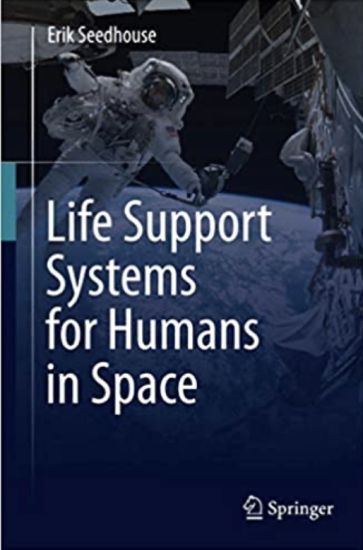
Life Support Systems for Humans in Space

Life Support Systems for Humans in Space

Erik Seedhouse

Springer Nature Switzerland AG
2020
nidottu
Life support systems are an integral part of crewed spacecraft designs and habitation systems. This textbook introduces the LSS capabilities that sustain humans who live and work in space, and it is written at a level appropriate for both undergraduate and postgraduate students.The book begins with the basics of space physiology before detailing the features that make up different kinds of life support systems. It includes concise descriptions of how atmospheric pressure is monitored, how oxygen levels are maintained, how waste management is achieved and how water is recycled, and also describes the processes of fire detection and suppression. Several chapters are devoted to chronicling the evolution of life support systems through the decades. Each chapter includes a list of learning objectives, summary sections and review questions. Additionally, various analogs for spaceflight life support systems are examined, including nuclear submarines and our natural life support system here on Earth! Overall, this book serves as an approachable primer for any student seeking to understand the intricacies of spacecraft life support systems.
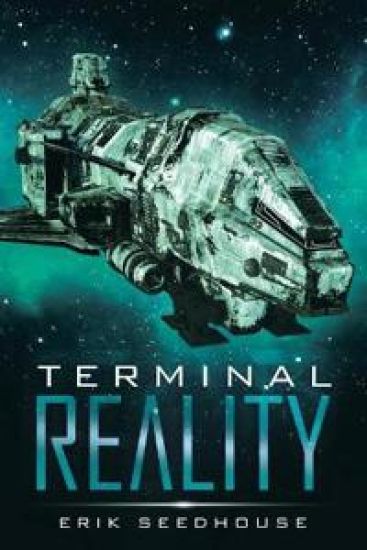
Terminal Reality

Terminal Reality

Erik Seedhouse

Xlibris Us
2020
pokkari
The spaceship is the Halo Genera. Its occupants, which include four humans, two bio-engineered synthetics, and an obstreperous robotic assistant named Larry, represent mankind's last-ditch, desperate but bold attempt to save the human race from extinction. Their destination: Despond 5, a planet light-years away from what was once home. But, as so often happens when manned spaceflight is matched with cutting-edge exploration, things don't go according to plan. Plagued by system malfunctions, subterfuge, sabotage and malevolent aliens, the Genera's crew race towards their destination. But can they reach it in time to save the human race?
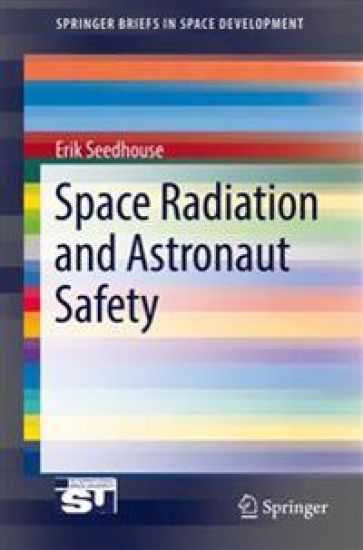
Space Radiation and Astronaut Safety

Space Radiation and Astronaut Safety

Erik Seedhouse

Springer International Publishing AG
2018
nidottu
This brief explores the biological effects of long-term radiation on astronauts in deep space. As missions progress beyond Earth's orbit and away from the protection of its magnetic shielding, astronauts risk constant exposure to higher levels of galactic cosmic rays and solar particle events. The text concisely addresses the full spectrum of biomedical consequences from exposure to space radiation and goes on to present possible ways to mitigate such dangers and protect astronauts within the limitations of existing technologies.
TIM PEAKE and BRITAIN'S ROAD TO SPACE

TIM PEAKE and BRITAIN'S ROAD TO SPACE

Erik Seedhouse

Springer International Publishing AG
2017
nidottu
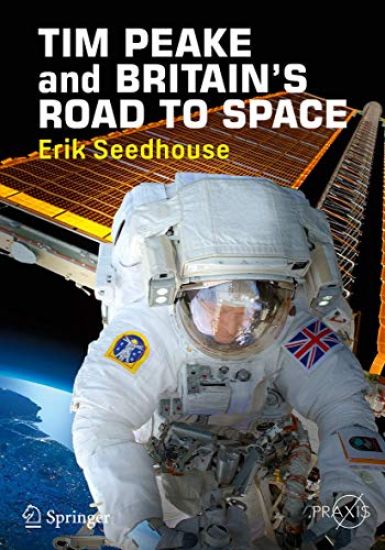
For centuries the British developed a reputation as a nation of explorers. From Francis Drake’s circumnavigation of the globe to the ascent of Everest, British explorers crossed oceans and continents and ventured where few, if any, had gone before. Until very recently, that legacy of exploration had not extended to space. For decades, successive governments chose to stay out of the human spaceflight programme, but in 2008 there were signs of optimism when ESA selected a new class of six astronauts, including, for the first time, a British representative: Timothy Peake. This book puts the reader in the flight suit of Britain’s first male astronaut. In addition to delving into the life of Tim Peake, this book discusses the learning curves required in astronaut and mission training and the complexity of the technologies required to launch an astronaut and keep them alive for months on end. This book underscores the fact that technology and training, unlike space, do not exist in a vacuum; complex technical systems, like the ISS, interact with the variables of human personality, and the cultural background of the astronauts. But ultimately, this is the story of Tim Peake and the Principia mission and the down-to-the-last-bolt descriptions of life aboard the ISS, by way of the hurdles placed by the British government and the rigors of training at Russia’s Star City military base.
To Mars and Beyond, Fast!

To Mars and Beyond, Fast!

Franklin Chang Díaz; Erik Seedhouse

Springer International Publishing AG
2017
nidottu
As advanced in-space propulsion moves from science fiction to reality, the Variable Specific Impulse Magnetoplasma Rocket, or VASIMR® engine, is a leading contender for making 'Mars in a month' a possibility. A paradigm shift in space transportation, this book is an in-depth and compelling story co-written by its inventor. It traces the riveting history of the development of the VASIMR® engine. This landmark technology is grounded in concepts of advanced plasma physics. It cross-pollinates ideas and disciplines to offer a new, practical, and sustainable solution for in-space transportation beyond low Earth orbit in the decades to come. Invented by the co-holder of the world’s spaceflight record, astronaut Franklin Chang Díaz, the VASIMR® engine is developed by Ad Astra Rocket Company in its Texas facilities with NASA as part of the NextSTEP VASIMR® partnership. With adequate funding, the first spaceflight of the VASIMR® engine is imminent. Plasma rockets feature exhaust velocities far above those achievable by conventional chemical rockets. The VASIMR® engine is the most advanced high-power plasma propulsion system operating in the world today and it may place long, fast interplanetary journeys withinour reach in the near future.
Spaceports Around the World, A Global Growth Industry

Spaceports Around the World, A Global Growth Industry

Erik Seedhouse

Springer International Publishing AG
2017
nidottu
This brief presents a concise description of the existing spaceport market, the technologies being tested and developed at them, and the private companies that are making them possible. While NASA has its own plan for the future of space exploration, one that includes a new shuttle, an interplanetary spacecraft, and astronauts going to Mars, many people believe that the real future of space exploration is currently centered around dozens of commercial spaceports, financed by entrepreneurs inspired not only by profit but by the dream of creating a new space age, one not limited by bureaucracies or by budget allocations.Commercial spaceports in Florida, Texas, Oklahoma, Virginia and Alaska, as well as in countries like Curaçao and Sweden, are becoming home to dozens of private aerospace companies and provide a place where cutting-edge technology can be developed, tested and launched into space. Based on original interviews with principles at the various companiesinvolved and on-site observations at the Mojave Air and Space Port, the author traces the early days of the spaceport movement and outlines what lies ahead.
Mars One

Mars One

Erik Seedhouse

Springer International Publishing AG
2016
nidottu
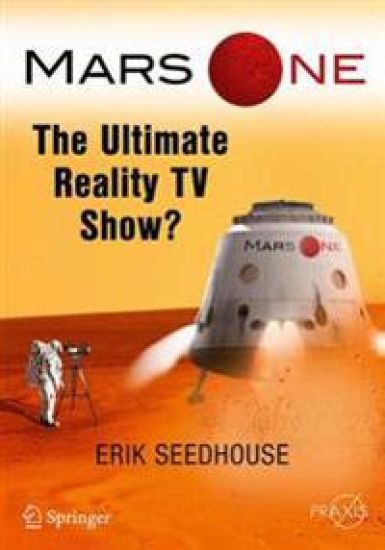
This book dissects the hype and hubris of the Mars One venture. Every aspect of the mission design is scrutinized, from the haphazard selection process to the unproven mission architecture. A controversial project, many professional astronauts consider Mars One a reckless attempt, yet it gained popular attention.This go-to reference guide provides the reader with insights into the myriad issues arising from the project's loss of funding, loss of sponsorship, loss of TV rights. It explains what contributed to an overly optimistic assessment of Mars One's mission-specific technology, and what captivated the public and the many willing candidates despite these flaws. From the author of Survival and Sacrifice in Mars Exploration (2015) among many more books on spacefaring, this is yet another up-to-the-minute account of an emerging player in the private space market from an expert on the subject.
XCOR, Developing the Next Generation Spaceplane

XCOR, Developing the Next Generation Spaceplane

Erik Seedhouse

Springer International Publishing AG
2016
nidottu
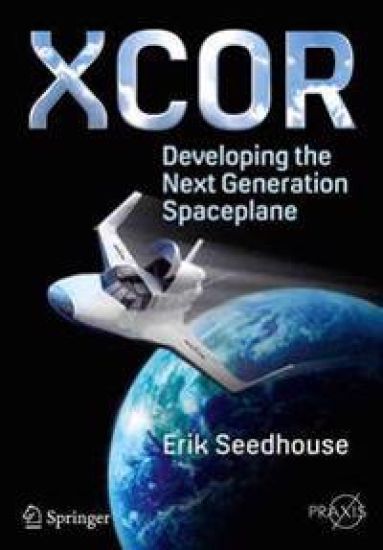
Employing the same informational approach Erik Seedhouse used in "SpaceX" and "Bigelow Aerospace", this new book familiarizes space enthusiasts with the company XCOR Aerospace and examines the design of the two-seater Lynx. The new spaceplane's low weight and high octane fuel confer important advantages, such as direct runway launches and the ability to fly several times per day. Over the last 15 years, XCOR has developed and built 13 different rocket engines, built and flown two manned rocket-powered aircraft and has accumulated over 4,000 engine firings and nearly 500 minutes of run time on their engines. This book serves as a go-to reference guide for suborbital scientists and those seeking to learn how one company has found success. Additionally, it describes the medical and training requirements for those flying on board the Lynx and the related critical roles of the astronaut trainers and a newbreed of commercial space pilots. The end result is a thorough chronicle of the development of rocket propulsion, avionics, simulator and ground support operations being put into play by XCOR with the Lynx.
Mars via the Moon

Mars via the Moon

Erik Seedhouse

Springer International Publishing AG
2015
nidottu
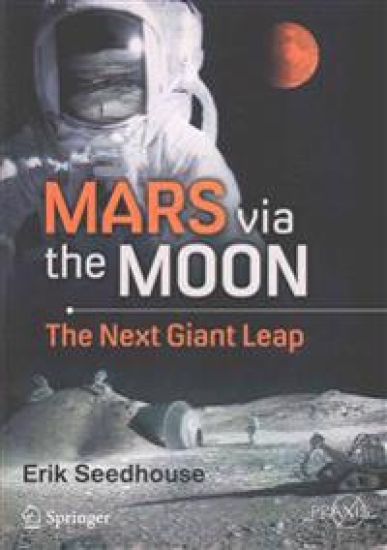
MOMENTUM IS BUILDING for a return to the Moon. NASA’s international partners on the International Space Station are in favor of returning to the lunar surface, as are India and China. The horizon goal may be Mars, but the political, funding and the technological and medical infeasibility of such an objective means the next logical step is a return to the Moon. While much has been learned about the Moon over the years, we don’t understand its resource wealth potential and the technologies to exploit those resources have yet to be developed, but there are a number of companies that are developing these capabilities. And, with the discovery of water in the lunar polar regions, plans are in the works to exploit these resources for fuel for transportation operations in cis-lunar space and in low Earth orbit (LEO). The time has come for commercial enterprise to lead the way back to the lunar surface. Embarking on such a venture requires little in the way of new technologies. We don’t need to develop super-fast propulsion systems like those required to get us to Mars safely, nor do we need hundreds of billions of dollars that the experts reckon it will cost to transport humans to the Red Planet. What we do need is a place to test the technologies and deep space experience that will enable us to build a pathway that will lead us to Mars. That place is the Moon and this book explains why.
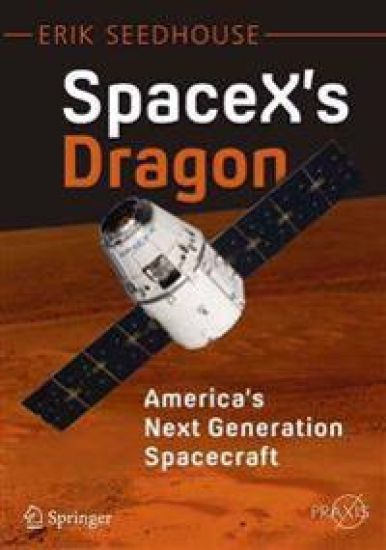
SpaceX's Dragon: America's Next Generation Spacecraft

SpaceX's Dragon: America's Next Generation Spacecraft

Erik Seedhouse

Springer International Publishing AG
2015
nidottu
Dragon V2 is a futuristic vehicle that not only provides a means for NASA to transport its astronauts to the orbiting outpost but also advances SpaceX’s core objective of reusability. A direct descendant of Dragon, Dragon V2 can be retrieved, refurbished and re-launched. It is a spacecraft with the potential to completely revolutionize the economics of an industry where equipment costing hundreds of millions of dollars is routinely discarded after a single use. It was presented by SpaceX CEO Elon Musk in May 2014 as the spaceship that will carry NASA astronauts to the International Space Station as soon as 2016.SpaceX’s Dragon – America’s Next Generation Spacecraft describes the extraordinary feats of engineering and human achievement that have placed this revolutionary spacecraft at the forefront of the launch industry and positioned it as the precursor for ultimately transporting humans to Mars. It describes the design and development of Dragon, provides mission highlights of the first six Commercial Resupply Missions, and explains how Musk hopes to eventually colonize Mars.
Microgravity and Vision Impairments in Astronauts

Microgravity and Vision Impairments in Astronauts

Erik Seedhouse

Springer International Publishing AG
2015
nidottu
Recent missions on board the International Space Station have revealed previously unreported physiological consequences of long duration space flight, particularly in eyesight, and in this Brief Dr. Seedhouse reviews the existing theories on what causes this degeneration and how long it will last. Notably, 60% of long-duration crews have reported subjective degradation in vision, a clear indication that further study is necessary before astronauts embark on even longer-term space missions. Decreased near-visual acuity was reported in 46% of ISS/Mir crewmembers, resulting in a change of up to 2 dioptres in their refractive correction. It is possible that ophthalmic changes have been present since the first days of spaceflight, but had been attributed to other causes; this approach to the issue as well as other hypotheses are all presented in full to give a broad foundation of the existing knowledge on the topic. The changes have occurred at various times during a mission with varying degrees of visual degradation. Some cases resolved on return to Earth, but several crewmembers have not regained pre-flight visual acuity, indicating the damage may be permanent. One explanation of the syndrome has been attributed to hyperopic shift due to aging, but onboard analysis techniques, including visual acuity assessments, retinal imagery, and ultrasound examination of the eye, has led to the acceptance of a wider syndrome. In addition to vision changes, studies have reported flattening of the globe, swelling of the optic disc (papilledema), choroidal folds in the retina, swelling of the optic nerve sheath, and visual field defects. It is widely hypothesized that this spectrum of symptoms may be explained by an elevation of intracranial pressure (ICP). Establishing the provenance of this medical problem, monitoring its occurrence and resolving the symptoms for future long term space missions is a key challenge for space medicine. With this book, readers have an entrypoint for understanding the full scope of the problem and its possible origins.
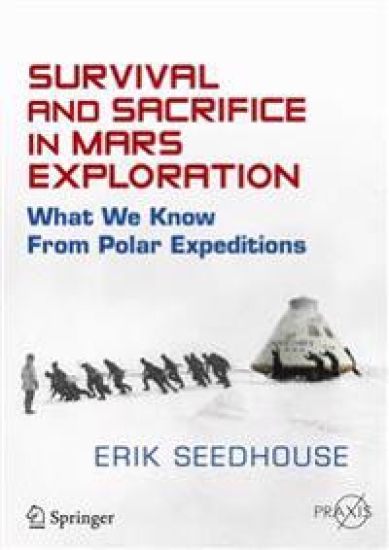
Survival and Sacrifice in Mars Exploration

Survival and Sacrifice in Mars Exploration

Erik Seedhouse

Springer International Publishing AG
2015
nidottu
With current technology, a voyage to Mars and back will take threeyears. That’s a lot of time for things to go wrong. But sooner or latera commercial enterprise will commit itself to sending humans to Mars.How will the astronauts survive? Some things to consider are:ith current technology, a voyage to Mars and back will take threeyears. That’s a lot of time for things to go wrong. But sooner or latera commercial enterprise will commit itself to sending humans to Mars.How will the astronauts survive? Some things to consider are:• Who decides what medical resources are used for whom?Who decides what medical resources are used for whom?• What is the relative weight of mission success and the health of thecrew?What is the relative weight of mission success and the health of thecrew?• Do we allow crewmembers to sacrifi ce their lives for the good of themission?Do we allow crewmembers to sacrifi ce their lives for the good of themission?• And what if a crewmember does perish? Do we store the body forreturn to Earth or give the member a burial in space?Questions like these, and hundreds of others, have been explored byscience fi ction, but scant attention has been paid by those designingmissions. Fortunately, the experience gained in polar exploration morethan 100 years ago provides crews and mission planners with a frameworkto deal with contingencies and it is this that forms the core of this book.Why the parallels between polar and space exploration? Because polarexploration offers a better analogy for a Mars mission today than thoseinvoked by the space community. Although astronauts are routinelycompared to Lewis and Clark, Mars-bound astronauts will be closer in theirroles to polar explorers. And, as much as space has been described as aNew Frontier, Mars bears greater similarity to the polar regions, which iswhy so much can be learned from those who ventured there.And what if a crewmember does perish? Do we store the body forreturn to Earth or givethe member a burial in space?Questions like these, and hundreds of others, have been explored byscience fi ction, but scant attention has been paid by those designingmissions. Fortunately, the experience gained in polar exploration morethan 100 years ago provides crews and mission planners with a frameworkto deal with contingencies and it is this that forms the core of this book.Why the parallels between polar and space exploration? Because polarexploration offers a better analogy for a Mars mission today than thoseinvoked by the space community. Although astronauts are routinelycompared to Lewis and Clark, Mars-bound astronauts will be closer in theirroles to polar explorers. And, as much as space has been described as aNew Frontier, Mars bears greater similarity to the polar regions, which iswhy so much can be learned from those who ventured there.
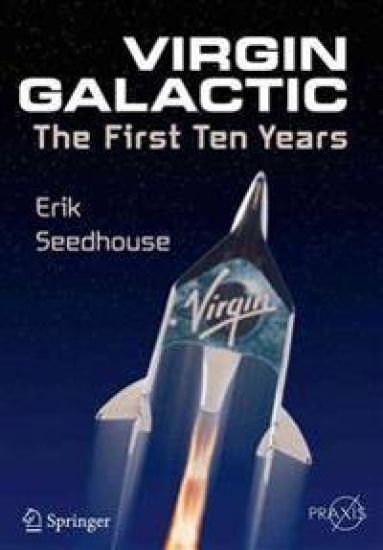
Virgin Galactic

Virgin Galactic

Erik Seedhouse

Springer International Publishing AG
2015
nidottu
Thirty years ago when Sir Richard Branson called up Boeing and asked if they had a spare 747, few would have predicted the brash entrepreneur would so radically transform the placid business of air travel. But today, Branson flies airlines on six continents, employs hundreds of jets and, in 2014, was predicting that his spaceship company – Virgin Galactic – would soon open the space frontier to commercial astronauts, payload specialists, scientists and space tourists. With more than 600 seats sold at $250,000 each, what started off as a dream to send people just for the excitement to look back and marvel at Earth, was on the cusp of finally being turned into a business. Then, on October 21, 2014, tragedy struck. SpaceShipTwo was on its most ambitious test flight to date. Seconds after firing its engine, Virgin Galactic’s spaceship was breaking through the sound barrier. In just the three seconds that it took for the vehicle to climb from Mach 0.94 to Mach 1.02, co-pilot Mike Alsbury made what many close to the event believe was a fatal mistake that led to his death and the disintegration of SpaceShipTwo. Miraculously, the pilot, Peter Siebold, survived the 16-km fall back to Earth. Soon after the event Branson vowed to continue his space tourism venture in spite of this. Already a second SpaceShipTwo is being built, and ticket-holders eagerly await the day when Virgin Galactic offers quick, routine and affordable access to the edge of space. This book explains the hurdles Virgin Galactic had and still has to overcome en route to developing suborbital space travel as a profitable economic entity, and describes the missions that will be flown on board SpaceShipTwo Mk II, including high-altitude science studies, astronomy, life sciences, and microgravity physics.
Bigelow Aerospace

Bigelow Aerospace

Erik Seedhouse

Springer International Publishing AG
2014
nidottu
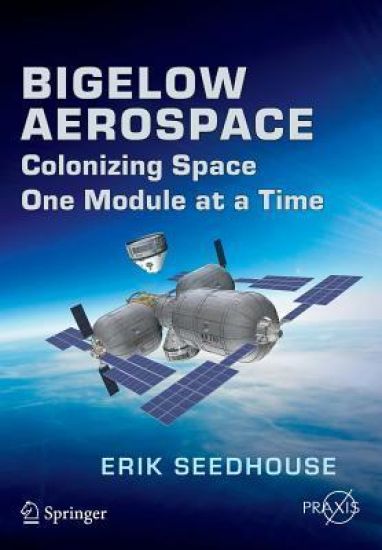
Here for the first time you can read:how a space technology start-up is pioneering work on expandable space station moduleshow Robert Bigelow licensed the TransHab idea from NASA, and how his company developed the technology for more than a decadehow, very soon, a Bigelow expandable module will be docked with the International Space Station.At the core of Bigelow's plan is the inflatable module technology. Tougher and more durable than their rigid counterparts, these inflatable modules are perfectly suited for use in the space, where Bigelow plans to link them together to form commercial space stations. This book describes how this new breed of space stations will be built and how the link between Bigelow Aerospace, NASA and private companies can lead to a new economy—a space economy. Finally, the book touches on Bigelow's aspirations beyond low Earth orbit, plans that include the landing of a base on the lunar surface and the prospect of missions to Mars.
Beyond Human

Beyond Human

Erik Seedhouse

Springer-Verlag Berlin and Heidelberg GmbH Co. K
2014
nidottu
Beyond Human is an informative and accessible guide for all those interested in the developing sciences of genetic engineering, bio printing and human cloning. Illustrating the ideas with reference to well-known science fiction films and novels, the author provides a unique insight into and understanding of how genetic manipulation, cloning, and other novel bio-technologies will one day allow us to redesign our species. It also addresses the legitimate concerns about “playing God”, while at the same time embracing the positive aspects of the scientific trajectory that will lead to our transhuman future.