Kirjojen hintavertailu. Mukana 12 295 354 kirjaa ja 12 kauppaa.

Kirjailija

Erika Cudworth

Kirjat ja teokset yhdessä paikassa: 7 kirjaa, julkaisuja vuosilta 2002-2024, suosituimpien joukossa Animal Entanglements. Vertaile teosten hintoja ja tarkista saatavuus suomalaisista kirjakaupoista.

7 kirjaa

Kirjojen julkaisuhaarukka 2002-2024.

Animal Entanglements

Animal Entanglements

Erika Cudworth

BLOOMSBURY PUBLISHING PLC
2024
sidottu
This book provides an insight into the everyday lives and experiences of people who live with dogs as companions; and glimpses aspects of the lives of the dogs who share their homes. It is framed sociologically and as such, considers the various forms of power relations which shape the lives of those kept as ‘pets’ and their human ‘owners’. In recounting stories of companion humans and dogs, the co-constituted quality of life is clear. However, while dogs – as agential beings with needs, desires and a point of view – are able to shape outcomes and change aspects of their lived experience, the world they inhabit is profoundly geared to human inhabitants; and the most privileged ones at that. The book revisits the notion of ‘pet keeping’ as the interplay between domination and affection arguing that these do not exist as a continuum, but a mesh of complex relations played out in the use of homespace, in the kitchen, the bedroom, the in the public world of park and the street. Those living with dog companions, as well as the dogs themselves, find their lives are muddied, both literally and figuratively; boundaries are tested and recast and the complications of inter-species cohabitation negotiated by all parties. Through an innovative theoretical contribution, Cudworth conceptualizes human relations with companion dogs in terms of complex social relations that involve both systemic forms of domination as well as nonhuman agency in shaping social relations and social forms.
The Emancipatory Project of Posthumanism

The Emancipatory Project of Posthumanism

Erika Cudworth; Stephen Hobden

Taylor Francis Ltd
2021
nidottu
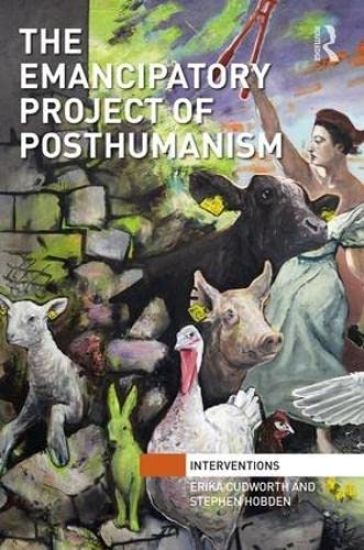
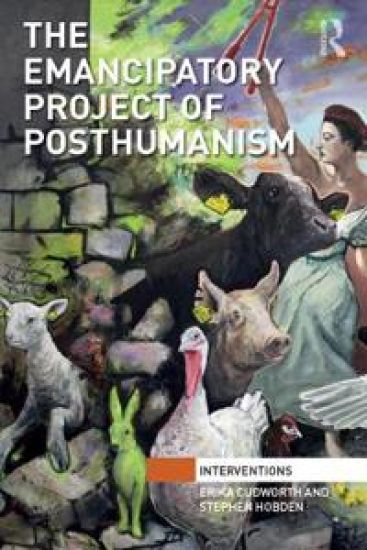
This is the first book to make the argument for an emancipatory project from within a posthuman framework. Responding to critics, Cudworth and Hobden argue that while some posthumanisms may be less critical, it is possible to develop a political programme from a posthuman perspective.Cudworth and Hobden develop such issues by addressing the following questions: How have ideas about emancipation been developed, and does the notion of emancipation still hold relevance for the contemporary world order? Is it possible to have a non-Utopian form of emancipation? What are the implications of differing posthuman/new materialist viewpoints for an emancipatory project? In a world typified by complexity, how is it possible to pursue political projects? The chapters consider various interpretations of the term ‘emancipation’, looking at work that has appeared within the posthumanist framework such as Bruno Latour, William Connolly, and Jane Bennett.The authors develop their own account of posthumanism, demonstrating how it avoids the problems that have been found within this framework, and considering the possibilities for emancipatory projects and public policy. It will be of great interest to postgraduates and scholars of International Relations, Political Theory, Environmental Studies, and Sociology.
The Emancipatory Project of Posthumanism

The Emancipatory Project of Posthumanism

Erika Cudworth; Stephen Hobden

Routledge
2017
sidottu
This is the first book to make the argument for an emancipatory project from within a posthuman framework. Responding to critics, Cudworth and Hobden argue that while some posthumanisms may be less critical, it is possible to develop a political programme from a posthuman perspective.Cudworth and Hobden develop such issues by addressing the following questions: How have ideas about emancipation been developed, and does the notion of emancipation still hold relevance for the contemporary world order? Is it possible to have a non-Utopian form of emancipation? What are the implications of differing posthuman/new materialist viewpoints for an emancipatory project? In a world typified by complexity, how is it possible to pursue political projects? The chapters consider various interpretations of the term ‘emancipation’, looking at work that has appeared within the posthumanist framework such as Bruno Latour, William Connolly, and Jane Bennett.The authors develop their own account of posthumanism, demonstrating how it avoids the problems that have been found within this framework, and considering the possibilities for emancipatory projects and public policy. It will be of great interest to postgraduates and scholars of International Relations, Political Theory, Environmental Studies, and Sociology.
The Modern State

The Modern State

Erika Cudworth; Timothy Hall; John McGovern

Edinburgh University Press
2007
sidottu
Broad ranging in its coverage of the liberal democratic state and other, non-democratic state formations, the book offers chapters on each of the core theories of the modern state. Each chapter is structured in the same way to allow for ease of cross-referencing and for comparisons to be drawn between theories, with parts on Context, Definition, Theorists and Practical Politics. There are chapters on: *The Emergence of the Modern State *Liberalism *Elite Theories *Marxism *Socialism *Anarchism *Conservatism *Fascism *Feminisms *The New Right *Fundamentalism *Futures The authors work on the premise that theory is relevant to everyday life, helping us to understand current political transitions and institutional formations and practices. Taking a practical view of politics, each chapter illustrates how state theory has been deployed in recent historical contexts and policy initiatives, using examples to bring the theory to life. Key Features: *Unique in considering the liberal democratic state and other, non-democratic state formations *Includes a wide range of examples, such as Marxist states in Eastern Europe and non-secular, militarist and emergent democratic states in the developing world *Covers a wide theoretical range and includes less well-known ideas and approaches such as those of fundamentalism, fascism and anarchism *Shows how different theories of the state have affected the framing and implementation of policies, or the history of political parties and movements
The Modern State

The Modern State

Erika Cudworth; Timothy Hall; John McGovern

Edinburgh University Press
2007
nidottu
Broad ranging in its coverage of the liberal democratic state and other, non-democratic state formations, the book offers chapters on each of the core theories of the modern state. Each chapter is structured in the same way to allow for ease of cross-referencing and for comparisons to be drawn between theories, with parts on Context, Definition, Theorists and Practical Politics. There are chapters on: *The Emergence of the Modern State *Liberalism *Elite Theories *Marxism *Socialism *Anarchism *Conservatism *Fascism *Feminisms *The New Right *Fundamentalism *Futures The authors work on the premise that theory is relevant to everyday life, helping us to understand current political transitions and institutional formations and practices. Taking a practical view of politics, each chapter illustrates how state theory has been deployed in recent historical contexts and policy initiatives, using examples to bring the theory to life. Key Features: *Unique in considering the liberal democratic state and other, non-democratic state formations *Includes a wide range of examples, such as Marxist states in Eastern Europe and non-secular, militarist and emergent democratic states in the developing world *Covers a wide theoretical range and includes less well-known ideas and approaches such as those of fundamentalism, fascism and anarchism *Shows how different theories of the state have affected the framing and implementation of policies, or the history of political parties and movements
Environment and Society

Environment and Society

Erika Cudworth

Routledge
2002
sidottu
At the start of the twenty-first century, it can be argued that human societies have a greater impact on the environment than ever before. We have always been dependent upon, and interacted with, the 'natural' environment. However, the dramatic social changes of the past three centuries, have altered the form of our relationship with non-human nature to the extent that some would see people/planet relations as in a situation of crisis.Environment and Society provides a comprehensive and critical account of the ways in which we can think about the relationship between human societies and the environments with which they interact. It argues that human societies are ecologically embedded, and that environments are often socially embedded and constituted. It makes the different theoretical positions and empirical studies accessible to students, and includes chapter outlines and summaries, annotated further reading, boxed case-studies and discussion points.
Environment and Society

Environment and Society

Erika Cudworth

Routledge
2002
nidottu
At the start of the twenty-first century, it can be argued that human societies have a greater impact on the environment than ever before. We have always been dependent upon, and interacted with, the 'natural' environment. However, the dramatic social changes of the past three centuries, have altered the form of our relationship with non-human nature to the extent that some would see people/planet relations as in a situation of crisis.Environment and Society provides a comprehensive and critical account of the ways in which we can think about the relationship between human societies and the environments with which they interact. It argues that human societies are ecologically embedded, and that environments are often socially embedded and constituted. It makes the different theoretical positions and empirical studies accessible to students, and includes chapter outlines and summaries, annotated further reading, boxed case-studies and discussion points.