

Kirjailija
Ernest Fenollosa
Kirjat ja teokset yhdessä paikassa: 15 kirjaa, julkaisuja vuosilta 1963-2025, suosituimpien joukossa Das chinesische Schriftzeichen als poetisches Medium. Vertaile teosten hintoja ja tarkista saatavuus suomalaisista kirjakaupoista.
15 kirjaa
Kirjojen julkaisuhaarukka 1963-2025.



Das chinesische Schriftzeichen als poetisches Medium
Ernest Fenollosa
Matthes Seitz Verlag
2019
nidottu

Instigations of Ezra Pound, together with an essay on the Chinese written character
Ernest Fenollosa
Alpha Edition
2019
pokkari
The Chinese Written Character as a Medium for Poetry
Ernest Fenollosa; Ezra Pound
Literary Licensing, LLC
2011
nidottu
First published in 1919 by Ezra Pound, Ernest Fenollosa's essay on the Chinese written language has become one of the most often quoted statements in the history of American poetics. As edited by Pound, it presents a powerful conception of language that continues to shape our poetic and stylistic preferences: the idea that poems consist primarily of images; the idea that the sentence form with active verb mirrors relations of natural force. But previous editions of the essay represent Pound's understanding-it is fair to say, his appropriation-of the text. Fenollosa's manuscripts, in the Beinecke Library of Yale University, allow us to see this essay in a different light, as a document of early, sustained cultural interchange between North Americaand East Asia.Pound's editing of the essay obscured two important features, here restored to view: Fenollosa's encounter with Tendai Buddhism and Buddhist ontology, and his concern with the dimension of sound in Chinese poetry.This book is the definitive critical edition of Fenollosa's important work. After a substantial Introduction, the text as edited by Pound is presented, together with his notes and plates. At the heart of the edition is the first full publication of the essay as Fenollosa wrote it, accompanied by the many diagrams, characters, and notes Fenollosa (and Pound) scrawled on the verso pages. Pound's deletions, insertions, and alterations to Fenollosa's sometimes ornate prose are meticulously captured, enabling readers to follow the quasi-dialogue between Fenollosa and his posthumous editor. Earlier drafts and related talks reveal the developmentof Fenollosa's ideas about culture, poetry, and translation. Copious multilingual annotation is an important feature of the edition.This masterfully edited book will be an essential resource for scholars and poets and a starting point for a renewed discussion of the multiple sources of American modernist poetry.
The Chinese Written Character as a Medium for Poetry
Ernest Fenollosa; Ezra Pound
Literary Licensing, LLC
2011
sidottu
The Chinese Written Character As A Medium For Poetry is a book written by Ernest Fenollosa. It is an in-depth exploration of the Chinese language and its written characters, with a specific focus on their use in poetry. The book delves into the history and evolution of the Chinese language, as well as the unique characteristics of its written characters. Fenollosa argues that the Chinese written character is a particularly effective medium for poetry, as it allows for a level of precision and nuance that is not possible with other languages. He provides numerous examples of Chinese poetry and analyzes the ways in which the written characters contribute to their beauty and meaning. The book is considered a seminal work in the field of Chinese language and literature, and has been influential in shaping Western understanding and appreciation of Chinese culture.This scarce antiquarian book is a facsimile reprint of the old original and may contain some imperfections such as library marks and notations. Because we believe this work is culturally important, we have made it available as part of our commitment for protecting, preserving, and promoting the world's literature in affordable, high quality, modern editions, that are true to their original work.
The Chinese Written Character As a Medium for Poetry
Ernest Fenollosa; Ezra Pound; Jonathan Stalling; Lucas Klein
Fordham University Press
2011
pokkari
First published in 1919 by Ezra Pound, Ernest Fenollosa's essay on the Chinese written language has become one of the most often quoted statements in the history of American poetics. As edited by Pound, it presents a powerful conception of language that continues to shape our poetic and stylistic preferences: the idea that poems consist primarily of images; the idea that the sentence form with active verb mirrors relations of natural force. But previous editions of the essay represent Pound's understanding—it is fair to say, his appropriation—of the text. Fenollosa's manuscripts, in the Beinecke Library of Yale University, allow us to see this essay in a different light, as a document of early, sustained cultural interchange between North America and East Asia. Pound's editing of the essay obscured two important features, here restored to view: Fenollosa's encounter with Tendai Buddhism and Buddhist ontology, and his concern with the dimension of sound in Chinese poetry. This book is the definitive critical edition of Fenollosa's important work. After a substantial Introduction, the text as edited by Pound is presented, together with his notes and plates. At the heart of the edition is the first full publication of the essay as Fenollosa wrote it, accompanied by the many diagrams, characters, and notes Fenollosa (and Pound) scrawled on the verso pages. Pound's deletions, insertions, and alterations to Fenollosa's sometimes ornate prose are meticulously captured, enabling readers to follow the quasi-dialogue between Fenollosa and his posthumous editor. Earlier drafts and related talks reveal the developmentof Fenollosa's ideas about culture, poetry, and translation. Copious multilingual annotation is an important feature of the edition. This masterfully edited book will be an essential resource for scholars and poets and a starting point for a renewed discussion of the multiple sources of American modernist poetry.
The Chinese Written Character As a Medium for Poetry
Ernest Fenollosa; Ezra Pound; Jonathan Stalling; Lucas Klein
Fordham University Press
2008
sidottu
First published in 1919 by Ezra Pound, Ernest Fenollosa's essay on the Chinese written language has become one of the most often quoted statements in the history of American poetics. As edited by Pound, it presents a powerful conception of language that continues to shape our poetic and stylistic preferences: the idea that poems consist primarily of images; the idea that the sentence form with active verb mirrors relations of natural force. But previous editions of the essay represent Pound's understanding—it is fair to say, his appropriation—of the text. Fenollosa's manuscripts, in the Beinecke Library of Yale University, allow us to see this essay in a different light, as a document of early, sustained cultural interchange between North America and East Asia. Pound's editing of the essay obscured two important features, here restored to view: Fenollosa's encounter with Tendai Buddhism and Buddhist ontology, and his concern with the dimension of sound in Chinese poetry. This book is the definitive critical edition of Fenollosa's important work. After a substantial Introduction, the text as edited by Pound is presented, together with his notes and plates. At the heart of the edition is the first full publication of the essay as Fenollosa wrote it, accompanied by the many diagrams, characters, and notes Fenollosa (and Pound) scrawled on the verso pages. Pound's deletions, insertions, and alterations to Fenollosa's sometimes ornate prose are meticulously captured, enabling readers to follow the quasi-dialogue between Fenollosa and his posthumous editor. Earlier drafts and related talks reveal the developmentof Fenollosa's ideas about culture, poetry, and translation. Copious multilingual annotation is an important feature of the edition. This masterfully edited book will be an essential resource for scholars and poets and a starting point for a renewed discussion of the multiple sources of American modernist poetry.

CLASSIC NOH THEATRE JAPAN PA
Ezra Pound; Ernest Fenollosa
New Directions Publishing Corporation
1979
nidottu
"First published in the United States in 1917 by Alfred A. Knopf. Inc., as Noh or Accomplishment, a study of the classical stage of Japan"--T.p. verso.
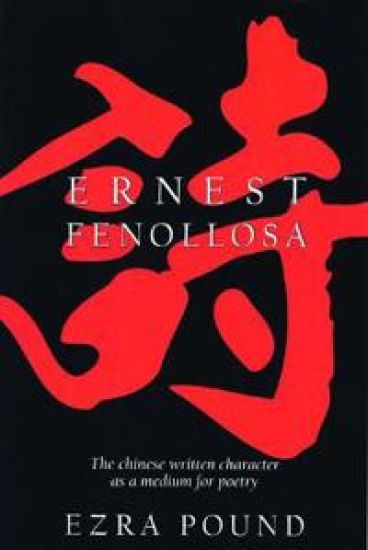
The Chinese Written Character as a Medium for Poetry
Ernest Fenollosa
CITY LIGHTS BOOKS
1963
nidottu
This important and much-disputed essay edited by Ezra Pound from the manuscript of Ernest Fenollosa (and published in Instigations, London, 1920) has since gone through several editions, despite the ridicule of such sinologists as Professor George Kennedy of Yale, who called it "a small mass of confusion." The old theory as to the nature of the Chinese written character (which Pound and Fenollosa followed) is that the written character is ideogrammic--a stylized picture of the thing or concept it represents. The opposing theory (which prevails today among scholars) is that the character may have had pictorial origins in prehistoric times but that these origins have been obscured in all but a few very simple cases, and that in any case native writers don't have the original pictorial meaning in mind as they write. Whether Pound proceeded on false premises remains an academic question. Let the pedants rave. An important extension of imagist technique in poetry was gained by Pound's perception of the essentially poetic nature of the Chinese character as it is still written. "Scholarly edition that combines the first full publication of Fenollosa's essay as he wrote it, along with the 1919 version of the essay as altered by Ezra Pound."--The Chronicle of Higher Education "How can we come to a new understanding of Chinese classical literature when our inherited view of it is so powerfully shaped and conditioned by a 'strong misreading, ' which is a vital part of our own poetic language? This question afflicts Haun Saussy in his extraordinary introduction to a new critical edition of The Chinese Written Character as a Medium for Poetry, which presents both the edited and original versions of Fenollosa's essay."--The Threepenny Review "Fenollosa's critical assessment of what could evolve from a blending of the East and West is perhaps more relevant today than when it was written."--Oyster Boy Review "This book--indispensable to anyone following modern poetics--reminds us that one of the four most influential modern essays on poetry (the others are T.S. Eliot's) was the product of a scholar-translator, writing in 1903, well before there was any modern poetry in English. Fenollosa's belief that the Chinese language is profoundly suited to poetry is well known, but because of Pound's editing, we had no way of knowing what Fenollosa made of the music of poetry. Least of all could we have imagined that he thought the music of this poetry was better preserved by Japanese phonics than by living Chinese speakers. Fenollosa was an idealistic advocate of Anglo-American empire fused with pan-Asian 'humanity, ' by which he meant roughly what is covered by the term 'humanities.' He saw the approach of a peaceful east/west fusion, economic, military, and cultural, and sought to guide its arrival by elucidating the art of classical Chinese poetry, without any expectation that his essay would alter the ways that Anglo-American poets shape sentences. This handsome edition is a major contribution to the history of modern poetics. Until now we have known little of the intellectual, political, and religious context of this great essay on diction and syntax. Haun Saussy, Jonathan Stalling, and Lucas Klein reveal the range and growth of Fenollosa's still appealing conviction that modern poetry has to go far beyond national borders."--Robert von Hallberg, University of Chicago