Kirjailija
Ernest Nagel
Kirjat ja teokset yhdessä paikassa: 14 kirjaa, julkaisuja vuosilta 1934-2023, suosituimpien joukossa Godel's Proof. Vertaile teosten hintoja ja tarkista saatavuus suomalaisista kirjakaupoista.
14 kirjaa
Kirjojen julkaisuhaarukka 1934-2023.
Godel's Proof was first published in the US in 1958. In 1931 there appeared in a German scientific periodical a relatively short paper with the forbidding title "On Formally Undecidable propositions of Principia Mathematica and Related Systems". Its author was Kurt Godel, then a young mathematician of 25 at the University of Vienna who since 1938 was a permanent member of the Institute for Advanced Study at Princeton. The paper is a milestone in the history of logic and mathematics. When Harvard University awarded Godel an honorary degree, the citation described the work as one of the most important advances in logic in modern times. At the time of its appearance, however, neither the title of Godel's paper nor its content was intelligible to most mathematicians.
Teleology Revisited and Other Essays in the Philosophy and History of Science
Ernest Nagel
Columbia University Press
2020
sidottu
From the Introduction. In 1931 there appeared in a German scientific periodical a relatively short paper with the forbidding title ""Uber formal unentscheidbare Satze der Principia Mathematica und verwandter Systeme"" (""On Formally Undecidable propositions of Principia Mathematica and Related Systems""). Its author was Kurt Godel, then a young mathematician of 25 at the University of Vienna and since 1938 a permanent member of the Institute for Advanced Study at Princeton. The paper is a milestone in the history of logic and mathematics. When Harvard University awarded Godel an honorary degree in 1952, the citation described the work as one of the most important advances in logic in modern times. At the time of its appearance, however, neither the title of Godel's paper nor its content was intelligible to most mathematicians.

'Nagel and Newman accomplish the wondrous task of clarifying the argumentative outline of Kurt Godel's celebrated logic bomb.' – The GuardianIn 1931 the mathematical logician Kurt Godel published a revolutionary paper that challenged certain basic assumptions underpinning mathematics and logic. A colleague of physicist Albert Einstein, his theorem proved that mathematics was partly based on propositions not provable within the mathematical system. The importance of Godel's Proof rests upon its radical implications and has echoed throughout many fields, from maths to science to philosophy, computer design, artificial intelligence, even religion and psychology. While others such as Douglas Hofstadter and Roger Penrose have published bestsellers based on Godel’s theorem, this is the first book to present a readable explanation to both scholars and non-specialists alike. A gripping combination of science and accessibility, Godel’s Proof by Nagel and Newman is for both mathematicians and the idly curious, offering those with a taste for logic and philosophy the chance to satisfy their intellectual curiosity. Kurt Godel (1906 – 1978) Born in Brunn, he was a colleague of physicist Albert Einstein and professor at the Institute for Advanced Study in Princeton, N.J.
Science, Language, and Human Rights: American Philosophical Association, Eastern Division, V1
Roderick Firth; Max Black; Ernest Nagel
Literary Licensing, LLC
2012
nidottu
Induction: Some Current Issues
Henry Ely Kyburg Jr; Ernest Nagel
Literary Licensing, LLC
2012
nidottu
Sp testens seit Douglas R. Hofstadters "G del, Escher, Bach" ist der Name G del auch bei Nichtmathematikern bekannt geworden. 1931 hatte Kurt G del unter dem Titel " ber formal unterscheidbare S tze der Principia Mathematica und verwandter Systeme" seinen Unvollst ndigkeitssatz publiziert. Nagel und Newman haben das Wesentliche an G dels Ergebnissen f r Nichtfachleute dargestellt. Die vorliegende 9. Auflage ist ein unver nderter Nachdruck der l ngst klassisch gewordenen Ausgabe von 1958.
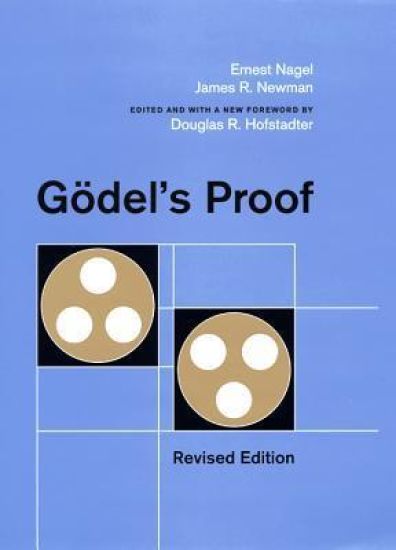
Gödel's Proof
Ernest Nagel; James R. Newman; Douglas R. Hofstadter
New York University Press
2008
pokkari
An accessible explanation of Kurt Gödel's groundbreaking work in mathematical logic In 1931 Kurt Gödel published his fundamental paper, "On Formally Undecidable Propositions of Principia Mathematica and Related Systems." This revolutionary paper challenged certain basic assumptions underlying much research in mathematics and logic. Gödel received public recognition of his work in 1951 when he was awarded the first Albert Einstein Award for achievement in the natural sciences—perhaps the highest award of its kind in the United States. The award committee described his work in mathematical logic as "one of the greatest contributions to the sciences in recent times." However, few mathematicians of the time were equipped to understand the young scholar's complex proof. Ernest Nagel and James Newman provide a readable and accessible explanation to both scholars and non-specialists of the main ideas and broad implications of Gödel's discovery. It offers every educated person with a taste for logic and philosophy the chance to understand a previously difficult and inaccessible subject. New York University Press is proud to publish this special edition of one of its bestselling books. With a new introduction by Douglas R. Hofstadter, this book will appeal students, scholars, and professionals in the fields of mathematics, computer science, logic and philosophy, and science.
This book presents a readable explanation of Godel's theorem to both scholars and non-specialists. A combination of science and accessibility, it offers those with a taste for logic and philosophy the chance to satisfy their intellectual curiosity.
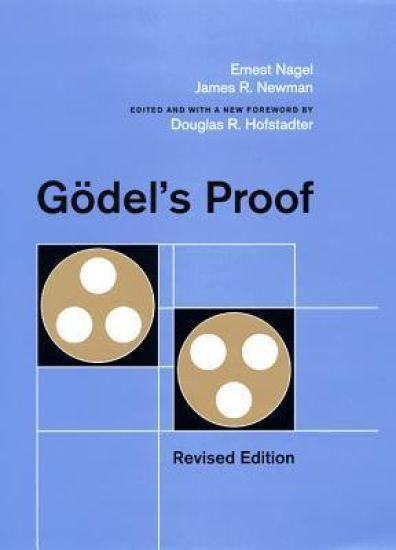
Gödel's Proof
Ernest Nagel; James R. Newman; Douglas R. Hofstadter
New York University Press
2001
sidottu
An accessible explanation of Kurt Gödel's groundbreaking work in mathematical logic In 1931 Kurt Gödel published his fundamental paper, "On Formally Undecidable Propositions of Principia Mathematica and Related Systems." This revolutionary paper challenged certain basic assumptions underlying much research in mathematics and logic. Gödel received public recognition of his work in 1951 when he was awarded the first Albert Einstein Award for achievement in the natural sciences—perhaps the highest award of its kind in the United States. The award committee described his work in mathematical logic as "one of the greatest contributions to the sciences in recent times." However, few mathematicians of the time were equipped to understand the young scholar's complex proof. Ernest Nagel and James Newman provide a readable and accessible explanation to both scholars and non-specialists of the main ideas and broad implications of Gödel's discovery. It offers every educated person with a taste for logic and philosophy the chance to understand a previously difficult and inaccessible subject. New York University Press is proud to publish this special edition of one of its bestselling books. With a new introduction by Douglas R. Hofstadter, this book will appeal students, scholars, and professionals in the fields of mathematics, computer science, logic and philosophy, and science.
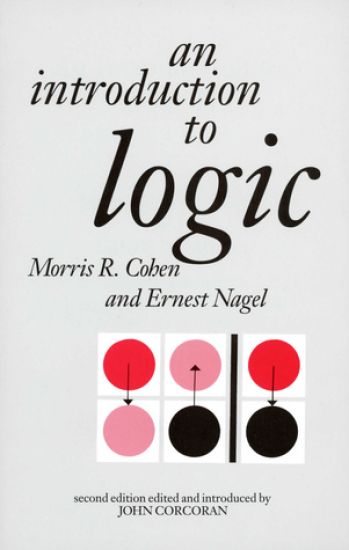
An Introduction to Logic
Morris R. Cohen; Ernest Nagel; John (EDT) Corcoran
Hackett Pub Co Inc
1993
pokkari
This is a revised reprint of the Harcourt, Brace and Company edition of 1962. Written for independent study and suitable for an introductory course in logic, this classic text combines a sound presentation of logic with effective pedagogy and illustrates the role of logic in many areas of humanistic and scientific thought. Cohen and Nagel's elegant integration of the history of philosophy, natural science, and mathematics helps earn this work its distinguished reputation.
"Structure of Science: Problems in the Logic of Scientific Explanation - 2nd Edition".
An Introduction to Logic and Scientific Method
Morris R. Cohen; Ernest Nagel
Simon Publications, LLC
1934
pokkari