Kirjojen hintavertailu. Mukana 12 390 323 kirjaa ja 12 kauppaa.

Kirjailija

Ernst Haeckel

Kirjat ja teokset yhdessä paikassa: 318 kirjaa, julkaisuja vuosilta 1866-2026, suosituimpien joukossa Designs in Nature: the coloring book. Vertaile teosten hintoja ja tarkista saatavuus suomalaisista kirjakaupoista.

318 kirjaa

Kirjojen julkaisuhaarukka 1866-2026.

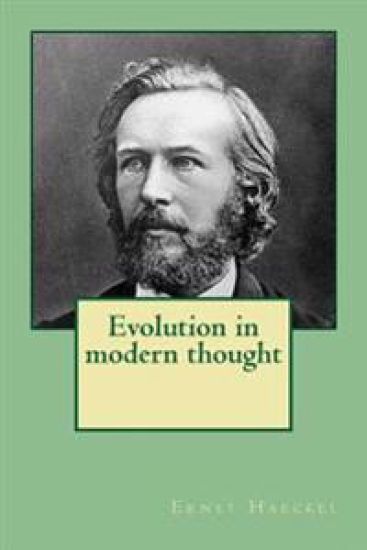
Evolution in modern thought

Evolution in modern thought

Ernst Haeckel

Createspace Independent Publishing Platform
2015
nidottu
Ernst Heinrich Philipp August Haeckel (Potsdam, February 16, 1834 - Jena, August 8, 1919), was a biologist, philosopher and German free thinker. He made known the theories of Charles Darwin in Germany and developed a theory of human origins. Haeckel was a physician and professor of comparative anatomy and was one of the first scientists who understood the psychology as a branch of physiology. He also participated in introducing some concepts of modern biology such as those of "branch" or "ecology". Haeckel also pointed to the policy as applied biology. He sketched on science ideology, Weltanschauung of monism and founded January 11, 1906 the Deutscher Monistenbund (monistic German law) in Jena. Ernst Haeckel contributed much through his writings to the dissemination of the theory of evolution. He is considered a pioneer of eugenics, although he has had himself no eugenic design because it escomptait, confident in the progress due to changes greater development and no "degeneration". Like other freethinkers organizations, union-tier German was banned in 1933 by the Nazis. Nazi ideologues used excerpts from his writings as justification for their racist theories of social Darwinism, but at the same time declared that the essential elements of the worldview of Haeckel were inconsistent with the views of National Socialism. R sum As an epoch-marking contribution to Natural History in the widest sense, we rank the picture which Darwin gave to the world of the web of life, that is to say, of the inter-relations and linkages in Nature. For the Biology of the individual--if that be not a contradiction in terms--no idea is more fundamental than that of the correlation of organs, but Darwin's most characteristic contribution was not less fundamental, --it was the idea of the correlation of organisms.
The Wonders Of Life: A Popular Study Of Biological Philosophy
The Wonders of Life: A Popular Study of Biological Philosophy is a book written by Ernst Haeckel, a German biologist, philosopher, and artist. The book is a comprehensive study of the wonders of life, exploring the mysteries of the natural world and the philosophical implications of biological phenomena. Haeckel delves into a wide range of topics, including the origins of life, the evolution of species, the structure and function of organisms, and the interplay between living beings and their environment. He explores the fundamental principles of biology, such as cell theory, genetics, and embryology, and discusses their significance for our understanding of life.The book is written in a clear and accessible style, making it suitable for both scientists and non-scientists alike. Haeckel's vivid illustrations and diagrams are also included throughout the text, helping to illustrate key concepts and enhance the reader's understanding of the subject matter.Overall, The Wonders of Life is a fascinating exploration of the mysteries of biology and the philosophical implications of the natural world. It is a must-read for anyone with an interest in science, philosophy, or the wonders of life itself.This is a new release of the original 1905 edition.This scarce antiquarian book is a facsimile reprint of the old original and may contain some imperfections such as library marks and notations. Because we believe this work is culturally important, we have made it available as part of our commitment for protecting, preserving, and promoting the world's literature in affordable, high quality, modern editions, that are true to their original work.