Kirjojen hintavertailu. Mukana 12 259 798 kirjaa ja 12 kauppaa.

Kirjailija

Ernst Hairer

Kirjat ja teokset yhdessä paikassa: 12 kirjaa, julkaisuja vuosilta 1989-2013, suosituimpien joukossa Solving Ordinary Differential Equations I. Vertaile teosten hintoja ja tarkista saatavuus suomalaisista kirjakaupoista.

12 kirjaa

Kirjojen julkaisuhaarukka 1989-2013.

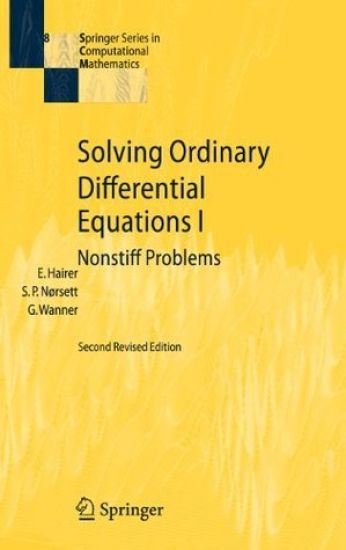
Solving Ordinary Differential Equations I

Solving Ordinary Differential Equations I

Ernst Hairer; Syvert P. Nørsett; Gerhard Wanner

Springer-Verlag Berlin and Heidelberg GmbH Co. K
1993
sidottu
This book deals with methods for solving nonstiff ordinary differential equations. The first chapter describes the historical development of the classical theory, and the second chapter includes a modern treatment of Runge-Kutta and extrapolation methods. Chapter three begins with the classical theory of multistep methods, and concludes with the theory of general linear methods. The reader will benefit from many illustrations, a historical and didactic approach, and computer programs which help him/her learn to solve all kinds of ordinary differential equations. This new edition has been rewritten and new material has been included.

Current Challenges in Stability Issues for Numerical Differential Equations

Current Challenges in Stability Issues for Numerical Differential Equations

Wolf-Jürgen Beyn; Luca Dieci; Nicola Guglielmi; Ernst Hairer; Jesús María Sanz-Serna; Marino Zennaro

Springer International Publishing AG
2013
nidottu
This volume addresses some of the research areas in the general field of stability studies for differential equations, with emphasis on issues of concern for numerical studies. Topics considered include: (i) the long time integration of Hamiltonian Ordinary DEs and highly oscillatory systems, (ii) connection between stochastic DEs and geometric integration using the Markov chain Monte Carlo method, (iii) computation of dynamic patterns in evolutionary partial DEs, (iv) decomposition of matrices depending on parameters and localization of singularities, and (v) uniform stability analysis for time dependent linear initial value problems of ODEs. The problems considered in this volume are of interest to people working on numerical as well as qualitative aspects of differential equations, and it will serve both as a reference and as an entry point into further research.
Solving Ordinary Differential Equations I

Solving Ordinary Differential Equations I

Ernst Hairer; Syvert P. Nørsett; Gerhard Wanner

Springer-Verlag Berlin and Heidelberg GmbH Co. K
2010
nidottu
This book deals with methods for solving nonstiff ordinary differential equations. The first chapter describes the historical development of the classical theory, and the second chapter includes a modern treatment of Runge-Kutta and extrapolation methods. Chapter three begins with the classical theory of multistep methods, and concludes with the theory of general linear methods. The reader will benefit from many illustrations, a historical and didactic approach, and computer programs which help him/her learn to solve all kinds of ordinary differential equations. This new edition has been rewritten and new material has been included.
Analysis in historischer Entwicklung

Analysis in historischer Entwicklung

Ernst Hairer; Gerhard Wanner

Springer-Verlag Berlin and Heidelberg GmbH Co. K
2010
nidottu
Diese Einführung in die Analysis orientiert sich in ihrem Aufbau an der zeitlichen Entwicklung der Themen. Die ersten zwei Kapitel schlagen den Bogen von historischen Berechnungsmethoden praktischer Problemen hin zu unendlichen Reihen, Differential- und Integralrechnung und zu Differentialgleichungen. Das Etablieren einer mathematisch stringenten Denkhaltung im 19. Jahrhundert für Analysis ein und mehrerer Variablen wird in den Kapiteln III und IV behandelt. Viele Beispiele, Berechnungen und Bilder ergänzen das Buch und machen es zu einem Lesevergnügen für Studierende, Lehrer und Forscher.
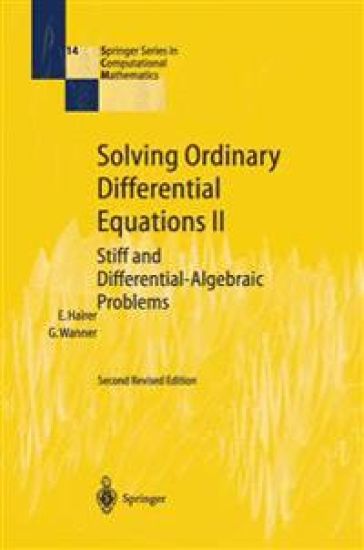
Solving Ordinary Differential Equations II

Solving Ordinary Differential Equations II

Ernst Hairer; Gerhard Wanner

Springer-Verlag Berlin and Heidelberg GmbH Co. K
2010
nidottu
"Whatever regrets may be, we have done our best." (Sir Ernest Shack­ 0 leton, turning back on 9 January 1909 at 88 23' South.) Brahms struggled for 20 years to write his first symphony. Compared to this, the 10 years we have been working on these two volumes may even appear short. This second volume treats stiff differential equations and differential algebraic equations. It contains three chapters: Chapter IV on one-step (Runge-Kutta) meth­ ods for stiff problems, Chapter V on multistep methods for stiff problems, and Chapter VI on singular perturbation and differential-algebraic equations. Each chapter is divided into sections. Usually the first sections of a chapter are of an introductory nature, explain numerical phenomena and exhibit numerical results. Investigations of a more theoretical nature are presented in the later sections of each chapter. As in Volume I, the formulas, theorems, tables and figures are numbered con­ secutively in each section and indicate, in addition, the section number. In cross references to other chapters the (latin) chapter number is put first. References to the bibliography are again by "author" plus "year" in parentheses. The bibliography again contains only those papers which are discussed in the text and is in no way meant to be complete.
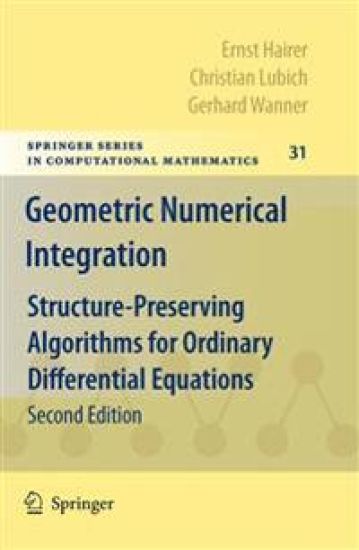
Geometric Numerical Integration

Geometric Numerical Integration

Ernst Hairer; Christian Lubich; Gerhard Wanner

Springer-Verlag Berlin and Heidelberg GmbH Co. K
2010
nidottu
Numerical methods that preserve properties of Hamiltonian systems, reversible systems, differential equations on manifolds and problems with highly oscillatory solutions are the subject of this book. A complete self-contained theory of symplectic and symmetric methods, which include Runge-Kutta, composition, splitting, multistep and various specially designed integrators, is presented and their construction and practical merits are discussed. The long-time behaviour of the numerical solutions is studied using a backward error analysis (modified equations) combined with KAM theory. The book is illustrated by many figures, it treats applications from physics and astronomy and contains many numerical experiments and comparisons of different approaches. The second edition is substantially revised and enlarged, with many improvements in the presentation and additions concerning in particular non-canonical Hamiltonian systems, highly oscillatory mechanical systems, and the dynamics of multistep methods.
Solving Ordinary Differential Equations I

Solving Ordinary Differential Equations I

Ernst Hairer; Syvert P. Nørsett; Gerhard Wanner

Springer-Verlag Berlin and Heidelberg GmbH Co. K
2009
nidottu
This book deals with methods for solving nonstiff ordinary differential equations. The first chapter describes the historical development of the classical theory, and the second chapter includes a modern treatment of Runge-Kutta and extrapolation methods. Chapter three begins with the classical theory of multistep methods, and concludes with the theory of general linear methods. The reader will benefit from many illustrations, a historical and didactic approach, and computer programs which help him/her learn to solve all kinds of ordinary differential equations. This new edition has been rewritten and new material has been included.
Analysis by Its History

Analysis by Its History

Ernst Hairer; Gerhard Wanner

Springer-Verlag New York Inc.
2008
nidottu
. . . that departed from the traditional dry-as-dust mathematics textbook. (M. Kline, from the Preface to the paperback edition of Kline 1972) Also for this reason, I have taken the trouble to make a great number of drawings. (Brieskom & Knorrer, Plane algebraic curves, p. ii) . . . I should like to bring up again for emphasis . . . points, in which my exposition differs especially from the customary presentation in the text­ books: 1. Illustration of abstract considerations by means of figures. 2. Emphasis upon its relation to neighboring fields, such as calculus of dif­ ferences and interpolation . . . 3. Emphasis upon historical growth. It seems to me extremely important that precisely the prospective teacher should take account of all of these. (F. Klein 1908, Eng\. ed. p. 236) Traditionally, a rigorous first course in Analysis progresses (more or less) in the following order: limits, sets, '* continuous '* derivatives '* integration. mappings functions On the other hand, the historical development of these subjects occurred in reverse order: Archimedes Cantor 1875 Cauchy 1821 Newton 1665 . ;::: Kepler 1615 Dedekind . ;::: Weierstrass . ;::: Leibniz 1675 Fermat 1638 In this book, with the four chapters Chapter I. Introduction to Analysis of the Infinite Chapter II. Differential and Integral Calculus Chapter III. Foundations of Classical Analysis Chapter IV. Calculus in Several Variables, we attempt to restore the historical order, and begin in Chapter I with Cardano, Descartes, Newton, and Euler's famous Introductio.
Geometric Numerical Integration

Geometric Numerical Integration

Ernst Hairer; Christian Lubich; Gerhard Wanner

Springer-Verlag Berlin and Heidelberg GmbH Co. K
2006
sidottu
Numerical methods that preserve properties of Hamiltonian systems, reversible systems, differential equations on manifolds and problems with highly oscillatory solutions are the subject of this book. A complete self-contained theory of symplectic and symmetric methods, which include Runge-Kutta, composition, splitting, multistep and various specially designed integrators, is presented and their construction and practical merits are discussed. The long-time behaviour of the numerical solutions is studied using a backward error analysis (modified equations) combined with KAM theory. The book is illustrated by many figures, it treats applications from physics and astronomy and contains many numerical experiments and comparisons of different approaches. The second edition is substantially revised and enlarged, with many improvements in the presentation and additions concerning in particular non-canonical Hamiltonian systems, highly oscillatory mechanical systems, and the dynamics of multistep methods.
Solving Ordinary Differential Equations II

Solving Ordinary Differential Equations II

Ernst Hairer; Gerhard Wanner

Springer-Verlag Berlin and Heidelberg GmbH Co. K
1996
sidottu
"Whatever regrets may be, we have done our best." (Sir Ernest Shack­ 0 leton, turning back on 9 January 1909 at 88 23' South.) Brahms struggled for 20 years to write his first symphony. Compared to this, the 10 years we have been working on these two volumes may even appear short. This second volume treats stiff differential equations and differential algebraic equations. It contains three chapters: Chapter IV on one-step (Runge-Kutta) meth­ ods for stiff problems, Chapter V on multistep methods for stiff problems, and Chapter VI on singular perturbation and differential-algebraic equations. Each chapter is divided into sections. Usually the first sections of a chapter are of an introductory nature, explain numerical phenomena and exhibit numerical results. Investigations of a more theoretical nature are presented in the later sections of each chapter. As in Volume I, the formulas, theorems, tables and figures are numbered con­ secutively in each section and indicate, in addition, the section number. In cross references to other chapters the (latin) chapter number is put first. References to the bibliography are again by "author" plus "year" in parentheses. The bibliography again contains only those papers which are discussed in the text and is in no way meant to be complete.
Analysis by Its History

Analysis by Its History

Ernst Hairer; Gerhard Wanner

Springer-Verlag New York Inc.
1995
sidottu
. . . that departed from the traditional dry-as-dust mathematics textbook. (M. Kline, from the Preface to the paperback edition of Kline 1972) Also for this reason, I have taken the trouble to make a great number of drawings. (Brieskom & Knorrer, Plane algebraic curves, p. ii) . . . I should like to bring up again for emphasis . . . points, in which my exposition differs especially from the customary presentation in the text­ books: 1. Illustration of abstract considerations by means of figures. 2. Emphasis upon its relation to neighboring fields, such as calculus of dif­ ferences and interpolation . . . 3. Emphasis upon historical growth. It seems to me extremely important that precisely the prospective teacher should take account of all of these. (F. Klein 1908, Eng\. ed. p. 236) Traditionally, a rigorous first course in Analysis progresses (more or less) in the following order: limits, sets, '* continuous '* derivatives '* integration. mappings functions On the other hand, the historical development of these subjects occurred in reverse order: Archimedes Cantor 1875 Cauchy 1821 Newton 1665 . ;::: Kepler 1615 Dedekind . ;::: Weierstrass . ;::: Leibniz 1675 Fermat 1638 In this book, with the four chapters Chapter I. Introduction to Analysis of the Infinite Chapter II. Differential and Integral Calculus Chapter III. Foundations of Classical Analysis Chapter IV. Calculus in Several Variables, we attempt to restore the historical order, and begin in Chapter I with Cardano, Descartes, Newton, and Euler's famous Introductio.
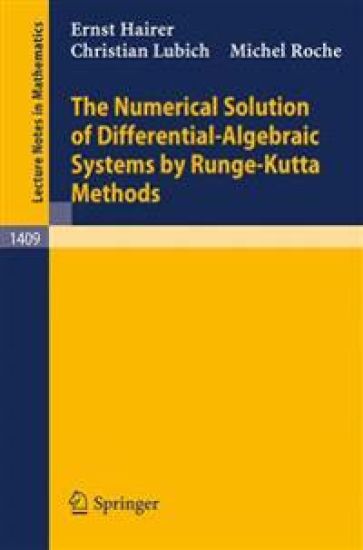
The Numerical Solution of Differential-Algebraic Systems by Runge-Kutta Methods

The Numerical Solution of Differential-Algebraic Systems by Runge-Kutta Methods

Ernst Hairer; Christian Lubich; Michel Roche

Springer-Verlag Berlin and Heidelberg GmbH Co. K
1989
nidottu
The term differential-algebraic equation was coined to comprise differential equations with constraints (differential equations on manifolds) and singular implicit differential equations. Such problems arise in a variety of applications, e.g. constrained mechanical systems, fluid dynamics, chemical reaction kinetics, simulation of electrical networks, and control engineering. From a more theoretical viewpoint, the study of differential-algebraic problems gives insight into the behaviour of numerical methods for stiff ordinary differential equations. These lecture notes provide a self-contained and comprehensive treatment of the numerical solution of differential-algebraic systems using Runge-Kutta methods, and also extrapolation methods. Readers are expected to have a background in the numerical treatment of ordinary differential equations. The subject is treated in its various aspects ranging from the theory through the analysis to implementation and applications.