Kirjojen hintavertailu. Mukana 12 595 353 kirjaa ja 12 kauppaa.

Kirjailija

Ernst Heinrich Hirschel

Kirjat ja teokset yhdessä paikassa: 12 kirjaa, julkaisuja vuosilta 1992-2025, suosituimpien joukossa Aeronautical Research in Germany. Vertaile teosten hintoja ja tarkista saatavuus suomalaisista kirjakaupoista.

12 kirjaa

Kirjojen julkaisuhaarukka 1992-2025.

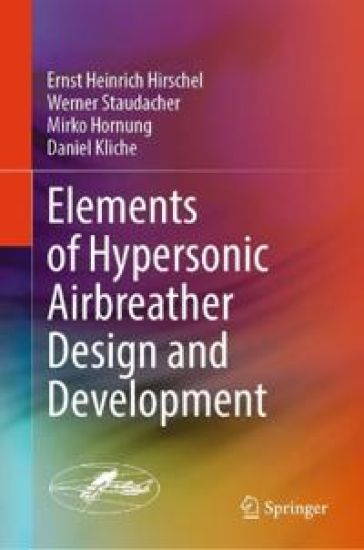
Elements of Hypersonic Airbreather Design and Development

Elements of Hypersonic Airbreather Design and Development

Ernst Heinrich Hirschel; Werner Staudacher; Mirko Hornung; Daniel Kliche

Springer International Publishing AG
2025
sidottu
This book sketches key design, development, and engineering issues. To think up an airbreathing hypersonic aircraft is one thing; to design, develop, and produce it is another one. Airframe-propulsion integration plays a central role, with six integration types identified. Most demanding is that of a large aircraft with both lift and propulsion located at its lower side—an approach exemplified early by the US National Aerospace Plane. Topics treated are the flight environment, design sensitivities, fuel considerations, aerothermodynamics, scramjet propulsion, airframe-propulsion integration, structural and materials issues, and aerothermoelasticity. Persistent challenges include laminar-turbulent transition and joint modelling. Capabilities and shortcomings of experimental, computational, and in-flight simulation are considered. The second wave of mathematization—culminating in the concept of the virtual product—has fundamentally transformed flight vehicle design, enabling integrated, high-fidelity simulation across disciplines. In this book, students, design engineers, and technical managers will find ample insight and practical knowledge regarding hypersonic airbreather design.
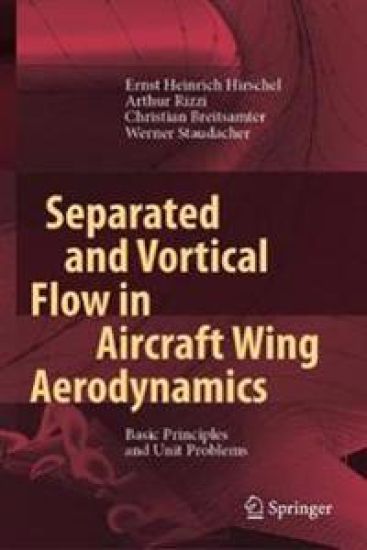
Separated and Vortical Flow in Aircraft Wing Aerodynamics

Separated and Vortical Flow in Aircraft Wing Aerodynamics

Ernst Heinrich Hirschel; Arthur Rizzi; Christian Breitsamter; Werner Staudacher

Springer-Verlag Berlin and Heidelberg GmbH Co. K
2020
sidottu
Fluid mechanical aspects of separated and vortical flow in aircraft wing aerodynamics are treated. The focus is on two wing classes: (1) large aspect-ratio wings and (2) small aspect-ratio delta-type wings. Aerodynamic design issues in general are not dealt with. Discrete numerical simulation methods play a progressively larger role in aircraft design and development. Accordingly, in the introduction to the book the different mathematical models are considered, which underlie the aerodynamic computation methods (panel methods, RANS and scale-resolving methods). Special methods are the Euler methods, which as rather inexpensive methods embrace compressibility effects and also permit to describe lifting-wing flow. The concept of the kinematically active and inactive vorticity content of shear layers gives insight into many flow phenomena, but also, with the second break of symmetry---the first one is due to the Kutta condition---an explanation of lifting-wing flow fields. The prerequisite is an extended definition of separation: “flow-off separation” at sharp trailing edges of class (1) wings and at sharp leading edges of class (2) wings. The vorticity-content concept, with a compatibility condition for flow-off separation at sharp edges, permits to understand the properties of the evolving trailing vortex layer and the resulting pair of trailing vortices of class (1) wings. The concept also shows that Euler methods at sharp delta or strake leading edges of class (2) wings can give reliable results. Three main topics are treated: 1) Basic Principles are considered first: boundary-layer flow, vortex theory, the vorticity content of shear layers, Euler solutions for lifting wings, the Kutta condition in reality and the topology of skin-friction and velocity fields. 2) Unit Problems treat isolated flow phenomena of the two wing classes. Capabilities of panel and Euler methods are investigated. One Unit Problem is the flow past the wing of the NASA Common Research Model. Other Unit Problems concern the lee-side vortex system appearing at the Vortex-Flow Experiment 1 and 2 sharp- and blunt-edged delta configurations, at a delta wing with partly round leading edges, and also at the Blunt Delta Wing at hypersonic speed. 3) Selected Flow Problems of the two wing classes. In short sections practical design problems are discussed. The treatment of flow past fuselages, although desirable, was not possible in the frame of this book.
Basics of Aerothermodynamics

Basics of Aerothermodynamics

Ernst Heinrich Hirschel

Springer International Publishing AG
2016
nidottu
This successful book gives an introduction to the basics of aerothermodynamics, as applied in particular to winged re-entry vehicles and airbreathing hypersonic cruise and acceleration vehicles. The book gives a review of the issues of transport of momentum, energy and mass, real-gas effects as well as inviscid and viscous flow phenomena. In this second, revised edition the chapters with the classical topics of aerothermodynamics more or less were left untouched. The access to some single topics of practical interest was improved. Auxiliary chapters were put into an appendix. The recent successful flights of the X-43A and the X-51A indicate that the dawn of sustained airbreathing hypersonic flight now has arrived. This proves that the original approach of the book to put emphasis on viscous effects and the aerothermodynamics of radiation-cooled vehicle surfaces was timely. This second, revised edition even more accentuates these topics. A new, additional chapter treats examples of viscous thermal surface effects. Partly only very recently obtained experimental and numerical results show the complexity of such phenomena (dependence of boundary-layer stability, skin friction, boundary-layer thicknesses, and separation on the thermal state of the surface) and their importance for airbreathing hypersonic flight vehicles, but also for any other kind of hypersonic vehicle.
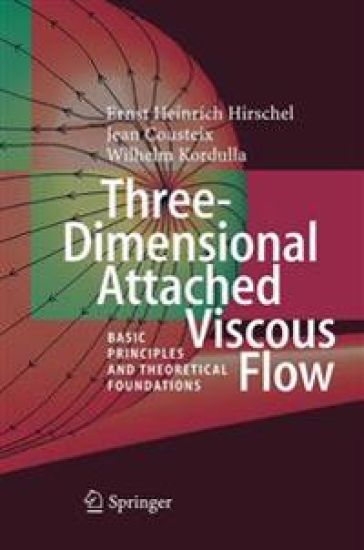
Three-Dimensional Attached Viscous Flow

Three-Dimensional Attached Viscous Flow

Ernst Heinrich Hirschel; Jean Cousteix; Wilhelm Kordulla

Springer-Verlag Berlin and Heidelberg GmbH Co. K
2016
nidottu
Viscous flow is treated usually in the frame of boundary-layer theory and as two-dimensional flow. Books on boundary layers give at most the describing equations for three-dimensional boundary layers, and solutions often only for some special cases.This book provides basic principles and theoretical foundations regarding three-dimensional attached viscous flow. Emphasis is put on general three-dimensional attached viscous flows and not on three-dimensional boundary layers. This wider scope is necessary in view of the theoretical and practical problems to be mastered in practice. The topics are weak, strong, and global interaction, the locality principle, properties of three-dimensional viscous flow, thermal surface effects, characteristic properties, wall compatibility conditions, connections between inviscid and viscous flow, flow topology, quasi-one- and two-dimensional flows, laminar-turbulent transition and turbulence. Though the primary flight speed range is that of civil air transport vehicles, flows past other flying vehicles up to hypersonic speeds are also considered. Emphasis is put on general three-dimensional attached viscous flows and not on three-dimensional boundary layers, as this wider scope is necessary in view of the theoretical and practical problems that have to be overcome in practice.The specific topics covered include weak, strong, and global interaction; the locality principle; properties of three-dimensional viscous flows; thermal surface effects; characteristic properties; wall compatibility conditions; connections between inviscid and viscous flows; flow topology; quasi-one- and two-dimensional flows; laminar-turbulent transition; and turbulence. Detailed discussions of examples illustrate these topics and the relevant phenomena encountered in three-dimensional viscous flows. The full governing equations, reference-temperature relations for qualitative considerations and estimations of flow properties, and coordinates for fuselages and wings are also provided. Sample problems with solutions allow readers to test their understanding.
Basics of Aerothermodynamics

Basics of Aerothermodynamics

Ernst Heinrich Hirschel

Springer International Publishing AG
2015
sidottu
This successful book gives an introduction to the basics of aerothermodynamics, as applied in particular to winged re-entry vehicles and airbreathing hypersonic cruise and acceleration vehicles. The book gives a review of the issues of transport of momentum, energy and mass, real-gas effects as well as inviscid and viscous flow phenomena. In this second, revised edition the chapters with the classical topics of aerothermodynamics more or less were left untouched. The access to some single topics of practical interest was improved. Auxiliary chapters were put into an appendix. The recent successful flights of the X-43A and the X-51A indicate that the dawn of sustained airbreathing hypersonic flight now has arrived. This proves that the original approach of the book to put emphasis on viscous effects and the aerothermodynamics of radiation-cooled vehicle surfaces was timely. This second, revised edition even more accentuates these topics. A new, additional chapter treats examples of viscous thermal surface effects. Partly only very recently obtained experimental and numerical results show the complexity of such phenomena (dependence of boundary-layer stability, skin friction, boundary-layer thicknesses, and separation on the thermal state of the surface) and their importance for airbreathing hypersonic flight vehicles, but also for any other kind of hypersonic vehicle.
Selected Aerothermodynamic Design Problems of Hypersonic Flight Vehicles

Selected Aerothermodynamic Design Problems of Hypersonic Flight Vehicles

Ernst Heinrich Hirschel; Claus Weiland

Springer-Verlag Berlin and Heidelberg GmbH Co. K
2014
nidottu
Hypersonic ?ight and aerothermodynamics are fascinating topics. Design problems and aerothermodynamic phenomena are partly very di?erent for the various kinds of hypersonic ?ight vehicles. These are-and will be in the future-winged and non-winged re-entry vehicles as well as airbreathing cruise and acceleration and also ascent and re-entry vehicles. Both authors of the book worked for almost four decades in hypersonics: at the German aerospace research establishment (DVL/DFVLR, now DLR) to the end of the 1970s, then in industry (MBB/Dasa, now EADS). They were involved in many major technology programs and projects. First, in the early 1970s, the German ART program (Association for Re-Entry Te- nologies), and, in the 1980s, the European (ESA) HERMES project and the .. German Hypersonics Technology (SANGER) program. Then followed, in the 1990s, the Future European Space Transportation Investigations program (FESTIP), the Manned Space Transportationprogram(MSTP) with the - mosphericRe-EntryDemonstrator(ARD), theX-CRVProjectwiththe X-38 vehicle and, later, the German technology programs TETRA (Technologies for Future Space Transportation Systems), ASTRA (Selected Systems and Technologies for Future Space Transportation Systems Applications), and IMENS (Integrated Multidisciplinary Design of Hot Structures for Space - hicles). Research in the 1960s and 1970s placed great emphasis on low-density ?ows, high temperature real gas e?ects in ground-simulation facilities and, already, on discrete numerical computation methods. After the ?rst ?ights of the Space Shuttle Orbiter with its generally very good aerodynamic p- formance, interest in low-density problems diminished.
Shear Flow in Surface-Oriented Coordinate

Shear Flow in Surface-Oriented Coordinate

Ernst Heinrich Hirschel

Vieweg+teubner Verlag
2014
nidottu
Having worked on problems of three-dimensional boundary-layer flow for more than a decade, the authors decided to publish some of their results and ideas as a book. They believe this is worthwhile to do in spite of the availability of other books on boundary-layer theory. These books have their emphasis mainly on two-dimensional flow, on the modeling of turbulent flow, or on prediction techniques. The present book, on the other hand, is dedicated to the descrip tion of three-dimensional shear flow past realistic configurations and to the provision of formulations for prediction methods. To this end several sets of governing equations for the treatment of high-Reynolds number viscous flows are being discussed, together with approximations of the geometry of general configurations. Thus the book, which gives a uniform representation of the for mulation of the many problems, and not so much a review of the work done so far at different places, is aimed at the perspective in vestigator of three-dimensional viscous-flow problems. The reader should not allow himself to e scared off'by the use of tensorial concepts and of the index notation, both not too familiar in classic fluid mechanics. The authors made the experience that the use of these concepts alleviates much the work on realistic flow problems. In the book they have emphasized the use of these concepts and not their mathematical proofs."
Three-Dimensional Attached Viscous Flow

Three-Dimensional Attached Viscous Flow

Ernst Heinrich Hirschel; Jean Cousteix; Wilhelm Kordulla

Springer-Verlag Berlin and Heidelberg GmbH Co. K
2013
sidottu
Viscous flow is treated usually in the frame of boundary-layer theory and as two-dimensional flow. Books on boundary layers give at most the describing equations for three-dimensional boundary layers, and solutions often only for some special cases.This book provides basic principles and theoretical foundations regarding three-dimensional attached viscous flow. Emphasis is put on general three-dimensional attached viscous flows and not on three-dimensional boundary layers. This wider scope is necessary in view of the theoretical and practical problems to be mastered in practice. The topics are weak, strong, and global interaction, the locality principle, properties of three-dimensional viscous flow, thermal surface effects, characteristic properties, wall compatibility conditions, connections between inviscid and viscous flow, flow topology, quasi-one- and two-dimensional flows, laminar-turbulent transition and turbulence. Though the primary flight speed range is that of civil air transport vehicles, flows past other flying vehicles up to hypersonic speeds are also considered. Emphasis is put on general three-dimensional attached viscous flows and not on three-dimensional boundary layers, as this wider scope is necessary in view of the theoretical and practical problems that have to be overcome in practice.The specific topics covered include weak, strong, and global interaction; the locality principle; properties of three-dimensional viscous flows; thermal surface effects; characteristic properties; wall compatibility conditions; connections between inviscid and viscous flows; flow topology; quasi-one- and two-dimensional flows; laminar-turbulent transition; and turbulence. Detailed discussions of examples illustrate these topics and the relevant phenomena encountered in three-dimensional viscous flows. The full governing equations, reference-temperature relations for qualitative considerations and estimations of flow properties, and coordinates for fuselages and wings are also provided. Sample problems with solutions allow readers to test their understanding.
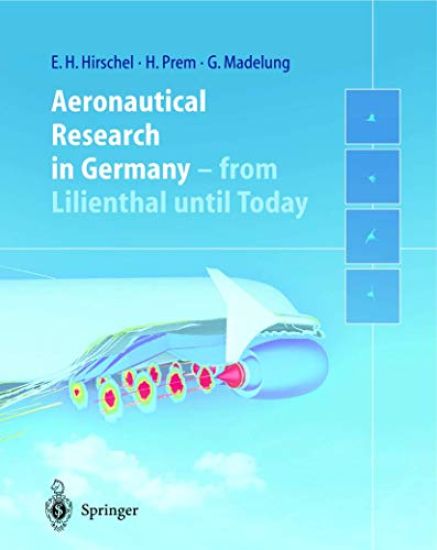
Aeronautical Research in Germany

Aeronautical Research in Germany

Ernst Heinrich Hirschel; Horst Prem; Gero Madelung

Springer-Verlag Berlin and Heidelberg GmbH Co. K
2012
nidottu
From the pioneering glider flights of Otto Lilienthal (1891) to the advanced avionics of today’s Airbus passenger jets, aeronautical research in Germany has been at the forefront of the birth and advancement of aeronautics. On the occasion of the centennial commemoration of the Wright Brother’s first powered flight (December 1903), this English-language edition of Aeronautical Research in Germany recounts and celebrates the considerable contributions made in Germany to the invention and ongoing development of aircraft. Featuring hundreds of historic photos and non-technical language, this comprehensive and scholarly account will interest historians, engineers, and, also, all serious airplane devotees. Through individual contributions by 35 aeronautical experts, it covers in fascinating detail the milestones of the first 100 years of aeronautical research in Germany, within the broader context of the scientific, political, and industrial milieus. This richly illustrated and authoritative volume constitutes a most timely and substantial overview of the crucial contributions to the foundation and advancement of aeronautics made by German scientists and engineers.
Basics of Aerothermodynamics

Basics of Aerothermodynamics

Ernst Heinrich Hirschel

Springer-Verlag Berlin and Heidelberg GmbH Co. K
2010
nidottu
The last two decades have brought two important developments for aeroth- modynamics. One is that airbreathing hypersonic flight became the topic of technology programmes and extended system studies. The other is the emergence and maturing of the discrete numerical methods of aerodyn- ics/aerothermodynamics complementary to the ground-simulation facilities, with the parallel enormous growth of computer power. Airbreathing hypersonic flight vehicles are, in contrast to aeroassisted re-entry vehicles, drag sensitive. They have, further, highly integrated lift and propulsion systems. This means that viscous eflFects, like boundary-layer development, laminar-turbulent transition, to a certain degree also strong interaction phenomena, are much more important for such vehicles than for re-entry vehicles. This holds also for the thermal state of the surface and thermal surface effects, concerning viscous and thermo-chemical phenomena (more important for re-entry vehicles) at and near the wall. The discrete numerical methods of aerodynamics/aerothermodynamics permit now - what was twenty years ago not imaginable - the simulation of high speed flows past real flight vehicle configurations with thermo-chemical and viscous effects, the description of the latter being still handicapped by in­ sufficient flow-physics models. The benefits of numerical simulation for flight vehicle design are enormous: much improved aerodynamic shape definition and optimization, provision of accurate and reliable aerodynamic data, and highly accurate determination of thermal and mechanical loads. Truly mul- disciplinary design and optimization methods regarding the layout of thermal protection systems, all kinds of aero-servoelasticity problems of the airframe, et cetera, begin now to emerge.
Aeronautical Research in Germany

Aeronautical Research in Germany

Ernst Heinrich Hirschel; Horst Prem; Gero Madelung

Springer-Verlag Berlin and Heidelberg GmbH Co. KG
2003
sidottu
From the pioneering glider flights of Otto Lilienthal (1891) to the advanced avionics of today’s Airbus passenger jets, aeronautical research in Germany has been at the forefront of the birth and advancement of aeronautics. On the occasion of the centennial commemoration of the Wright Brother’s first powered flight (December 1903), this English-language edition of Aeronautical Research in Germany recounts and celebrates the considerable contributions made in Germany to the invention and ongoing development of aircraft. Featuring hundreds of historic photos and non-technical language, this comprehensive and scholarly account will interest historians, engineers, and, also, all serious airplane devotees. Through individual contributions by 35 aeronautical experts, it covers in fascinating detail the milestones of the first 100 years of aeronautical research in Germany, within the broader context of the scientific, political, and industrial milieus. This richly illustrated and authoritative volume constitutes a most timely and substantial overview of the crucial contributions to the foundation and advancement of aeronautics made by German scientists and engineers.
Numerical Solutions of the Euler Equations for Steady Flow Problems

Numerical Solutions of the Euler Equations for Steady Flow Problems

Albrecht Eberle; Arthur Rizzi; Ernst Heinrich Hirschel

Friedrich Vieweg Sohn Verlagsgesellschaft mbH
1992
nidottu
The last decade has seen a dramatic increase of our abilities to solve numerically the governing equations of fluid mechanics. In design aerodynamics the classical potential-flow methods have been complemented by higher modelling-level methods. Euler solvers, and for special purposes, already Navier-Stokes solvers are in use. The authors of this book have been working on the solution of the Euler equations for quite some time. While the first two of us have worked mainly on algorithmic problems, the third has been concerned off and on with modelling and application problems of Euler methods. When we started to write this book we decided to put our own work at the center of it. This was done because we thought, and we leave this to the reader to decide, that our work has attained over the years enough substance in order to justify a book. The problem which we soon faced, was that the field still is moving at a fast pace, for instance because hyper­ sonic computation problems became more and more important.