Kirjojen hintavertailu. Mukana 12 335 830 kirjaa ja 12 kauppaa.

Kirjailija

Erwin Chemerinsky

Kirjat ja teokset yhdessä paikassa: 26 kirjaa, julkaisuja vuosilta 1987-2025, suosituimpien joukossa Justice at Trial. Vertaile teosten hintoja ja tarkista saatavuus suomalaisista kirjakaupoista.

26 kirjaa

Kirjojen julkaisuhaarukka 1987-2025.

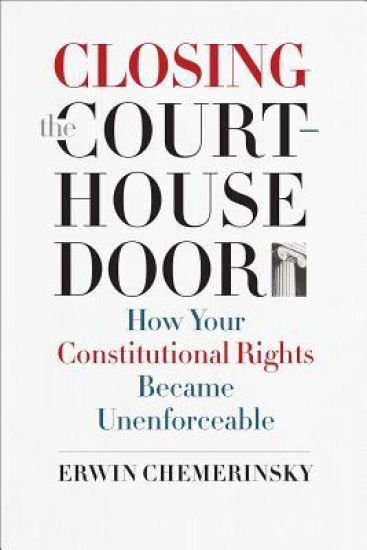
Closing the Courthouse Door

Closing the Courthouse Door

Erwin Chemerinsky

Yale University Press
2017
sidottu
A leading legal scholar explores how the constitutional right to seek justice has been restricted by the Supreme Court The Supreme Court’s decisions on constitutional rights are well known and much talked about. But individuals who want to defend those rights need something else as well: access to courts that can rule on their complaints. And on matters of access, the Court’s record over the past generation has been almost uniformly hostile to the enforcement of individual citizens’ constitutional rights. The Court has restricted who has standing to sue, expanded the immunity of governments and government workers, limited the kinds of cases the federal courts can hear, and restricted the right of habeas corpus. Closing the Courthouse Door, by the distinguished legal scholar Erwin Chemerinsky, is the first book to show the effect of these decisions: taken together, they add up to a growing limitation on citizens’ ability to defend their rights under the Constitution. Using many stories of people whose rights have been trampled yet who had no legal recourse, Chemerinsky argues that enforcing the Constitution should be the federal courts’ primary purpose, and they should not be barred from considering any constitutional question.
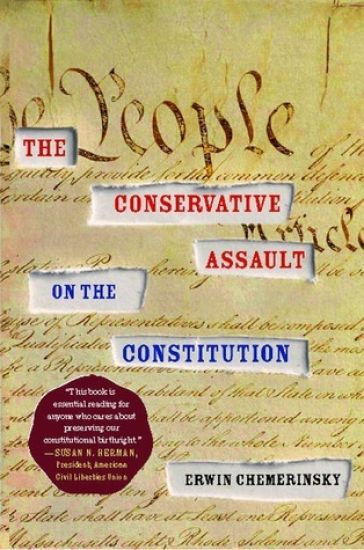
The Conservative Assault on the Constitution

The Conservative Assault on the Constitution

Erwin Chemerinsky

SIMON SCHUSTER
2011
nidottu
Over the last few decades, the Supreme Court and the federal appellate courts have undergone a dramatic shift to the right, the result of a determined effort by right-wing lawmakers and presidents to reinterpret the Constitution by reshaping the judiciary. Conservative activist justices have narrowed the scope of the Constitution, denying its protections to millions of Americans, exactly as the lawmakers who appointed and confirmed these jurists intended. Basic long-standing principles of constitutional law have been overturned by the Rehnquist and Roberts courts. As distinguished law professor and constitutional expert Erwin Chemerinsky demonstrates in this invaluable book, these changes affect the lives of every American. As a result of political pressure from conservatives and a series of Supreme Court decisions, our public schools are increasingly separate and unequal, to the great disadvantage of poor and minority students. Right-wing politicians and justices are dismantling the wall separating church and state, allowing ever greater government support for religion. With the blessing of the Supreme Court, absurdly harsh sentences are being handed down to criminal defendants, such as life sentences for shoplifting and other petty offenses. Even in death penalty cases, defendants are being denied the right to competent counsel at trial, and as a result innocent people have been convicted and sentenced to death. Right-wing politicians complain that government is too big and intrusive while at the same time they are only too happy to insert the government into the most intimate aspects of the private lives of citizens when doing so conforms to conservative morality. Conservative activist judges say that the Constitution gives people an inherent right to own firearms but not to make their own medical decisions. In some states it is easier to buy an assault rifle than to obtain an abortion. Nowhere has the conservative assault on the Constitution been more visible or more successful than in redefining the role of the president. From Richard Nixon to George W. Bush, conservatives have sought to significantly increase presidential power. The result in recent years has been unprecedented abuses, including indefinite detentions, illegal surveillance, and torture of innocent people. Finally, access to the courts is being restricted by new rulings that deny legal protections to ordinary Americans. Fewer lawsuits alleging discrimination in employment are heard; fewer people are able to sue corporations or governments for injuries they have suffered; and even when these cases do go to trial, new restrictions limit damages that plaintiffs can collect. The first step in reclaiming the protections of the Constitution, says Chemerinsky, is to recognize that right-wing justices are imposing their personal prejudices, not making neutral decisions about the scope of the Constitution, as they claim, or following the "original meaning" of the Constitution. Only then do we stand a chance of reclaiming our constitutional liberties from a rigid ideological campaign that has transformed our courts and our laws. Only then can we return to a constitutional law that advances freedom and equality.
Our Nation Unhinged

Our Nation Unhinged

Peter Jan Honigsberg; Erwin Chemerinsky

University of California Press
2009
sidottu
Jose Padilla short-shackled and wearing blackened goggles and earmuffs to block out all light and sound on his way to the dentist. Fifteen-year-old Omar Khadr crying out to an American soldier, 'Kill me!' Hunger strikers at Guantanamo being restrained and force-fed through tubes up their nostrils. John Walker Lindh lying naked and blindfolded in a metal container, bound by his hands and feet, in the freezing Afghan winter night. This is the story of the Bush administration's response to the attacks of September 11, 2001 - and of how we have been led down a path of executive abuses, human tragedies, abandonment of the Constitution, and the erosion of due process and liberty. In this vitally important book, Peter Jan Honigsberg chronicles the black hole of the American judicial system from 2001 to the present, providing an incisive analysis of exactly what we have lost over the past seven years and where we are now headed.
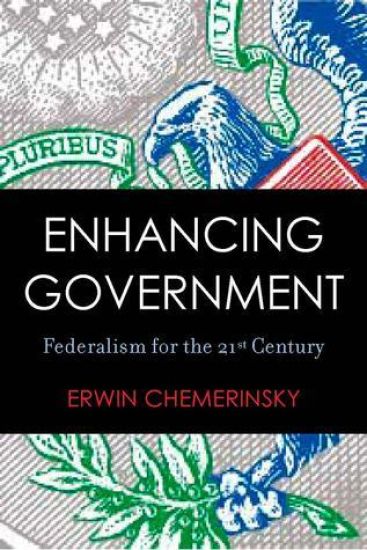
Enhancing Government

Enhancing Government

Erwin Chemerinsky

Stanford University Press
2008
pokkari
Federalism—the division of power between national and state governments—has been a divisive issue throughout American history. Conservatives argued in support of federalism and states' rights to oppose the end of slavery, the New Deal, and desegregation. In the 1990s, the Rehnquist Court used federalism to strike down numerous laws of public good, including federal statutes requiring the clean up of nuclear waste and background checks for gun ownership. Now the Roberts Court appears poised to use federalism and states' rights to limit federal power even further. In this book, Erwin Chemerinsky passionately argues for a different vision: federalism as empowerment. He analyzes and criticizes the Supreme Court's recent conservative trend, and lays out his own challenge to the Court to approach their decisions with the aim of advancing liberty and enhancing effective governance. While the traditional approach has been about limiting federal power, an alternative conception would empower every level of government to deal with social problems. In Chemerinsky's view, federal power should address national problems like environmental protection and violations of civil rights, while state power can be strengthened in areas such as consumer privacy and employee protection. The challenge for the 21st century is to reinvent American government so that it can effectively deal with enduring social ills and growing threats to personal freedom and civil liberties. Increasing the chains on government—as the Court and Congress are now doing in the name of federalism—is exactly the wrong way to enter the new century. But, an empowered federalism, as Chemerinsky shows, will profoundly alter the capabilities and promise of U.S. government and society.
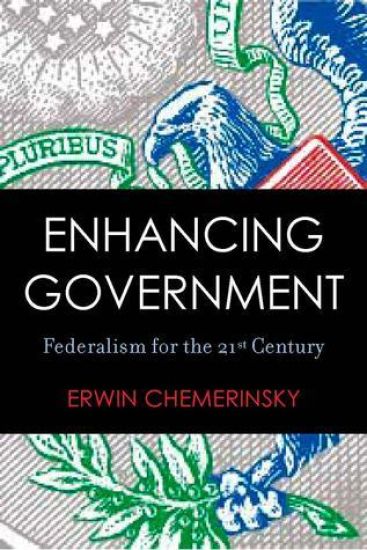
Enhancing Government

Enhancing Government

Erwin Chemerinsky

Stanford Law and Politics
2008
sidottu
Federalism—the division of power between national and state governments—has been a divisive issue throughout American history. Conservatives argued in support of federalism and states' rights to oppose the end of slavery, the New Deal, and desegregation. In the 1990s, the Rehnquist Court used federalism to strike down numerous laws of public good, including federal statutes requiring the clean up of nuclear waste and background checks for gun ownership. Now the Roberts Court appears poised to use federalism and states' rights to limit federal power even further. In this book, Erwin Chemerinsky passionately argues for a different vision: federalism as empowerment. He analyzes and criticizes the Supreme Court's recent conservative trend, and lays out his own challenge to the Court to approach their decisions with the aim of advancing liberty and enhancing effective governance. While the traditional approach has been about limiting federal power, an alternative conception would empower every level of government to deal with social problems. In Chemerinsky's view, federal power should address national problems like environmental protection and violations of civil rights, while state power can be strengthened in areas such as consumer privacy and employee protection. The challenge for the 21st century is to reinvent American government so that it can effectively deal with enduring social ills and growing threats to personal freedom and civil liberties. Increasing the chains on government—as the Court and Congress are now doing in the name of federalism—is exactly the wrong way to enter the new century. But, an empowered federalism, as Chemerinsky shows, will profoundly alter the capabilities and promise of U.S. government and society.
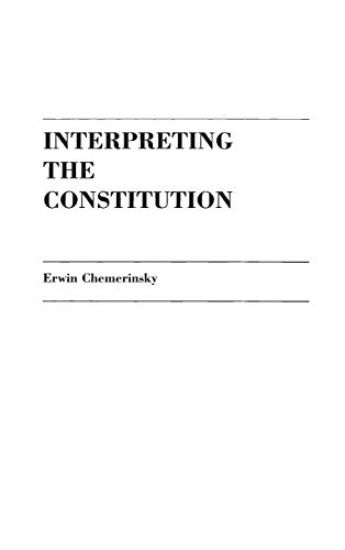
Interpreting the Constitution

Interpreting the Constitution

Erwin Chemerinsky

Praeger Publishers Inc
1987
sidottu
Interpreting The Constitution doesn't fit neatly into the extensive literature on judicial review and constitutional interpretation that reconciles judicial review with democracy defined as majority rule. Indeed, Chemerinsky criticizes this method of interpretation and contends that the Constitution exists to protect political minorities and fundamental rights from majority rule. Chapter by chapter, he keenly defends this unique method of interpretation, challenges the general approach, and offers thorough, expert coverage.