Kirjojen hintavertailu. Mukana 12 390 323 kirjaa ja 12 kauppaa.

Kirjailija

Esther Chung-Kim

Kirjat ja teokset yhdessä paikassa: 5 kirjaa, julkaisuja vuosilta 2014-2024, suosituimpien joukossa Awakening to Justice. Vertaile teosten hintoja ja tarkista saatavuus suomalaisista kirjakaupoista.

Mukana myös kirjoitusasut: Esther Chung–kim

5 kirjaa

Kirjojen julkaisuhaarukka 2014-2024.

Awakening to Justice

Awakening to Justice

Jemar Tisby; Christopher P. Momany; Sègbégnon Mathieu Gnonhossou; David D. Daniels; R. Matthew Sigler; Douglas M. Strong; Diane Leclerc; Esther Chung-Kim; Albert G. Miller; Estrelda Y. Alexander

IVP Academic
2024
nidottu
"O where are the sympathies of Christians for the slave and where are their exertions for their liberation? . . . It seems as if the church were asleep."David Ingraham, 1839In 2015, the historian Chris Momany helped discover a manuscript that had been forgotten in a storage closet at Adrian College in Michigan. He identified it as the journal of a nineteenth-century Christian abolitionist and missionary, David Ingraham. As Momany and a fellow historian Doug Strong pored over the diary, they realized that studying this document could open new conversations for twenty-first-century Christians to address the reality of racism today. They invited a multiracial team of fourteen scholars to join in, thus launching the Dialogue on Race and Faith Project.Awakening to Justice presents the groundbreaking work of these scholars. In addition to reflecting on Ingraham's journal, chapters also explore the life and writings of two of Ingraham's Black colleagues, James Bradley and Nancy Prince. Appendixes feature writings by all three abolitionists so readers can engage the primary sources directly.Through considering connections between the revivalist, holiness, and abolitionist movements; the experiences of enslaved and freed people; abolitionists' spiritual practices; various tactics used by abolitionists; and other themes, the authors offer insight and hope for Christians concerned about racial justice. They highlight how Christians associated with Charles Finney's style of revivalism formed intentional, countercultural communities such as Oberlin College to be exemplars of interracial cooperation and equality.Christians have all too often compromised with racism throughout history, but that's not the whole story. Hearing the prophetic witness of revivalist social justice efforts in the nineteenth century can provide a fresh approach to today's conversations about race and faith in the church.
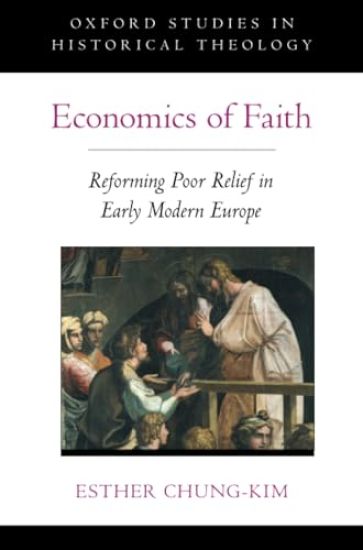
Economics of Faith

Economics of Faith

Esther Chung-Kim

OXFORD UNIVERSITY PRESS INC
2023
nidottu
Economics of Faith examines the role of religious leaders in the development of poor relief institutions in early modern Europe. As preachers, policy makers, advocates, and community leaders, these reformers offered a new interpretation of salvation and good works that provided the religious foundation for poor relief reform. Although poverty was once associated with the religious image of piety, reformers no longer saw it as a spiritual virtue. Rather they considered social welfare reform to be an integral part of religious reform and worked to modify existing poor relief institutions or to set up new ones. Population growth, economic crises, and migration in early modern Europe caused poverty and begging to be an ever-increasing concern, and religious leaders encouraged the development and expansion of poor relief institutions. This new cadre of reformers served as catalysts, organizers, stabilizers, and consolidators of strategies to alleviate poverty, the most glaring social problem of early modern society. Although different roles emerged from varying relationships and negotiations with local political authorities and city councils, reform-minded ministers and lay leaders shaped a variety of institutions to address the problem of poverty and to promote social and communal responsibility. As religious options multiplied within Christianity, one's understanding of community determined the boundaries, albeit contested and sometimes fluid, of responsible poor relief. This goal of communal care would be especially relevant for religious refugees who as foreigners and strangers became responsible for caring for their own group.
Inventing Authority

Inventing Authority

Esther Chung-Kim

Baylor University Press
2022
pokkari
Adding great historical insight to the events of the sixteenth century, Inventing Authority uncovers how and why the Protestant reformers came, in their dissent from the Catholic church, to turn to the Church Fathers and align their movements with the early church. Discovering that the reformers most frequently appealed to patristic sources in polemical contexts, Esther Chung-Kim adeptly traces the variety and creativity of their appeals to their forebears in order to support their arguments--citing them to be authoritative for being "exemplary scriptural exegetes" to "instruments of choice."Examining three generations of sixteenth-century reformers--from such heavy-weights as Calvin and Luther to lesser-known figures like Oecolampadius and Hesshusen—Chung-Kim offers an analysis of striking breadth, one that finds its center by focusing in on the perennially contentious topic of the Eucharist. Filling a significant lacuna in the early history of the Lutheran and Reformed traditions, Inventing Authority is an important and eye-opening contribution to Reformation studies.
Economics of Faith

Economics of Faith

Esther Chung-Kim

Oxford University Press Inc
2021
sidottu
Economics of Faith examines the role of religious leaders in the development of poor relief institutions in early modern Europe. As preachers, policy makers, advocates, and community leaders, these reformers offered a new interpretation of salvation and good works that provided the religious foundation for poor relief reform. Although poverty was once associated with the religious image of piety, reformers no longer saw it as a spiritual virtue. Rather they considered social welfare reform to be an integral part of religious reform and worked to modify existing poor relief institutions or to set up new ones. Population growth, economic crises, and migration in early modern Europe caused poverty and begging to be an ever-increasing concern, and religious leaders encouraged the development and expansion of poor relief institutions. This new cadre of reformers served as catalysts, organizers, stabilizers, and consolidators of strategies to alleviate poverty, the most glaring social problem of early modern society. Although different roles emerged from varying relationships and negotiations with local political authorities and city councils, reform-minded ministers and lay leaders shaped a variety of institutions to address the problem of poverty and to promote social and communal responsibility. As religious options multiplied within Christianity, one's understanding of community determined the boundaries, albeit contested and sometimes fluid, of responsible poor relief. This goal of communal care would be especially relevant for religious refugees who as foreigners and strangers became responsible for caring for their own group.
Acts

Acts

Esther Chung–kim; Todd R. Hains

Inter-Varsity Press,US
2014
sidottu
Preaching's Preacher's Guide to the Best Bible Reference The Reformation was a call to return with renewed vigor to the biblical roots of Christian faith and practice. Still, for the Reformers, the truth of the Bible could never be separated from the true community of God's people gathered by his Word. In the book of Acts, they found God's blueprint for how the church should participate with the Holy Spirit in accomplishing his purposes in the world. In the latest Reformation Commentary on Scripture, we watch as the diverse streams of the Protestant movement converge on the book of Acts. As we return with the Reformers to this vision of Spirit-filled community, we are given a lesson in the nature of biblical reform from those who bore it out for the first time. Authors Esther Chung-Kim and Todd R. Hains present a vivid portrait of the Reformers? views on the contemporary church?s faithfulness to its God-given identity and calling. The Reformers approached the narrative account of the early church in the book of Acts from diverse viewpoints. Commentators like John Calvin and the Swiss Reformed Heinrich Bullinger elaborated on the theological implications of the text with a great deal of historical detail. Others like reform-minded Catholic Johann Eck evoked episodes in Acts in response to pressing concerns of the day. Sermons upheld notable characters in Acts such as Peter, Stephen, Paul, Lydia and Apollos as examples of robust faith and of life in Christian community. Anabaptists in their apologetic works focused heavily on the necessity of believer's baptism. The commentators' interactions range from irate disagreement to irenic concord, but all exhort their readers not to dissolve "the holy knot" of the plain history of Christ's works and their lasting fruits. For them, Acts is certainly history, but it cannot be mere history.