Kirjojen hintavertailu. Mukana 12 595 353 kirjaa ja 12 kauppaa.
Kirjailija
Esther D Rothblum
Kirjat ja teokset yhdessä paikassa: 53 kirjaa, julkaisuja vuosilta 1988-2019, suosituimpien joukossa Wilderness Therapy for Women. Vertaile teosten hintoja ja tarkista saatavuus suomalaisista kirjakaupoista.
Here is a unique collection of personal memoirs from feminist therapists which provides a revealing look at their professional training experiences. This superb volume offers a rare glimpse at the struggles of these women, both as therapists and feminists, as they continue to develop professionally while maintaining their own identities. These candid accounts clearly recount the realities of professional training for the feminist therapist as a combination of painful memories, active struggle, impromptu friendship, and humor. The stories comprising this extraordinary volume cover several decades, ranging from the experiences of therapists trained in the 1930s to those of women currently undergoing therapy training.Share the trials and triumphs of these seventeen women who faced professional, personal, and ethical challenges during their professional therapy training. Read about the variety of experiences in the heterogeneous group of feminist therapists who describe the circumstances of their training including the account of mother and daughter therapists who compare their training of the 1930s and the 1970s; that of one woman who entered graduate school in the 1950s and was prohibited from specializing solely in research; one woman whose teaching was sabotaged by the “old boy” network; one woman’s experience of coming out as a lesbian in medical school during a psychiatric residency program; one therapist’s double minority status as female and Japanese-American; a Black student’s confrontation with the alienation and invisibility of her presence in an all-white classroom; and a first-year graduate student who describes her transition from a women’s studies undergraduate focus to a traditional male-dominated research institution.Students and instructors in clinical psychology, counseling, and social work will find the accounts in Professional Training for Feminist Therapists: Personal Memoirs a valuable resource for exploring the experiences of women in professional training for feminist therapy. Established therapists will value this work for the clarity and insight that comes from reflection, as will women who undergo professional training in future generations.
I had just witnessed women who shingled their own roofs, drove eighteen-wheeler trucks, and built their own housesas well as kept them clean and cooked a damn good meal. On women’s land I am a first-class citizen, I’m treated as an equal. I now see the world with righteous anger and hope. Living in womyn’s community has provided that lens for me.Elizabeth Sturrus, third wave feministOne of the driving forces in the lives of many lesbians is the search for community in a society that favors heterosexuality and often turns a cold shoulder toward women who love women. Lesbian Communities: Festivals, RVs, and the Internet takes you inside flourishing lesbian communitiesphysical, spiritual, and virtual (online)that provide practical help, emotional support, and much-needed outlets for creative expression. Exploring communities functioning in harmony with general American society as well as separatist groups, festival communities which form for short times annually, and informal online groups offering meaningful communication to physically isolated lesbians, this book offers a ray of light to those whose search is still ongoing. It also provides much-needed analysis of the current state of lesbian communitiessome decades old nowfor educators, researchers, and social scientists. In Lesbian Communities: Festivals, RVs, and the Internet, Susan Krieger revisits the vibrant community she first explored in The Mirror Dance. An African American member of Old Lesbians Organizing for Change shares the details of her search for a cooperative, caring space for aging lesbiansand what led to her eventual decision to create this space herself. And one of the founders of Hallomas, a back-to-the-land community that has survived in northern California since the late 1970s, reflects on that unique community’s birth and lifewith 13 photographs and illustrations. The book also bears witness to a life-changing encounter and dialogue between second-wave feminists from the woman's land collective of Arcadia and third wave feminists. You’ll also learn about: the birth, joys, and tribulations of an online community that becomes physical each year at the Michigan Womyn’s Music Festival the accidental birth of a lesbian community in isolated and fundamentalist-dominated West Texas the international online lesbian parenting community called MOMS (affectionately known as Dykes and Tykes)how it began, what belonging to this community provides for its members, and a look toward the future the debate on inclusiveness versus exclusiveness (of bisexual women, transgender people, and the male children of lesbians) in lesbian communities the current decline of availability and dilution of the purity of lesbian-only spaceand the rise of segregation (by social class and financial status) and oppression within the lesbian community the current plight of lesbian bookstores, which since the 1970s have served not only as gateways to a multitude of lesbian communities, but as the centers of lesbian communities themselves the online experience of lesbians searching for community in Japan the issues facing Jewish lesbians and the formation of Nice Jewish Girls, a Montreal group for anyone who identifies as a lesbian, bisexual, or queer woman and their non-Jewish partners and friends the power of myth and mythmaking to help women regain lost strength and reclaim lost history From the efforts of back-to-the-land groups creating wimmin’s space to life in modern residential/retirement settings, this book explores the places created by and for lesbians. Photos and illustrations bring these women and their communities to life. Lesbian Communities: Festivals, RVs, and the Internet w
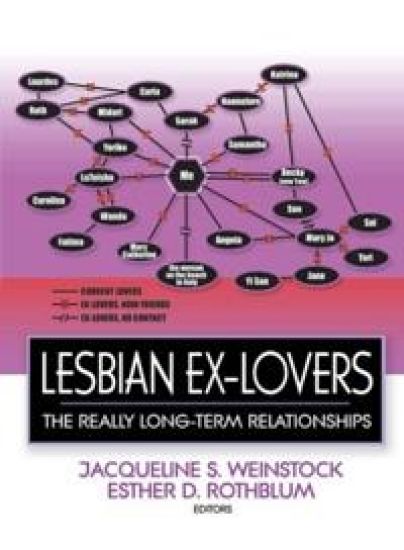
We have earned a certain place in each other’s lives, and in the best of times we can rest on what we have made together. Lesbian Ex-Lovers: The Really Long-Term Relationships examines the need for the development of better understanding and more critical analysis of lesbian ex-lover relationships. This eye-opening look into the minds and hearts of women offers personal insight into the possibilities for and potential pitfalls of lesbian ex-lover relations. This book contains personal stories, fictional accounts, poetry, and theoretical analyses of the frequency and significance of ex-lovers at different stages in a relationship. Topics of interest in Lesbian Ex-Lovers include: the roles ex-lovers play in our lives ex-lovers as contexts for change and development how we continue to be influenced by ex-lovers letting go and moving on ex-lovers as current friends and family themes of betrayal and loss of faith reconstructing friendships and community the mystique of the ex-lover friend/family connections among lesbian ex-lovers Rather than totally scrap a relationship, we recycle itfrom lover to ex-lover to friend in a relatively short half-life. Lesbian Ex-Lovers is the only book in print that explores how a lesbian’s ex-lovers impact her subsequent romances and lifestyle. This special collection adds a new dynamic to the current literature for and about the lesbian community. Lesbian Ex-Lovers offers advice, anecdotes, and interpretations from such authors, poetesses, and artists as: Michelle Gibson, PhDeducator and editor of Femme/Butch: New Considerations of the Way We Want to Go who says goodbye to her lover in a sad, passionate elegy Marny HallPsychotherapist, editor of the anthology Sexualities, and author of several books, including The Lavender Couch: A Consumer’s Guide to Psychotherapy for Lesbians and Gay Menwho muses on the unique bonding between lesbians and their ex-lovers, lending a mystique that surrounds the lesbian lifestyle Alison Bechdelcreator of the comic strip Dykes to Watch Out Forwho presents a humorous comic strip thanking her former lovers for teaching her about herself Jane Futchernewspaper reporter and author of three novelswho uses a chapter in her novel to illustrate the tensions that can occur when ex-lovers choose to remain friends, especially when those bonds provoke jealousy in both current and ex-lovers Renny Christophereducator and award-winning poetesswho expresses her love, loss, and regret in three poems about her ex-lover and much more!
Who are the women who struggled to form lesbian communities--and how did they fund their activism?In Everyday Mutinies: Funding Lesbian Activism, two dozen lesbians--including well-known activists such as Martina Navratilova, Alison Bechdel, Dee Mosbacher, and Jewelle Gomez--tell the stories of their activism, with an emphasis on how they support themselves and fund their political activities. Their examples can help you deal with raising and allocating money. Less than 0.3 of all philanthropic dollars are awarded to lesbian and gay projects each year. Yet Everyday Mutinies shares amazing success stories of women surviving, thriving, and making an impact by using the resources they have with intelligence and skill. You will be moved and inspired by the stories behind Naiad Press, The Ladder, Straight from the Heart, and the National Center for Lesbian Rights.Everyday Mutinies presents the voices of scientists, political strategists, artists, writers, fundraisers, and community organizers. These courageous women discuss their strategies for getting and using money to pursue their visions, including: funding scientific studies in creative ways liberating corporate resources encouraging responsible stewardship of inherited wealth getting paid for working on lesbian causes choosing a job to support activism financing lesbian media from magazines to documentaries giving time versus giving moneyEveryday Mutinies is an essential resource on the history and practice of lesbian activism. It also contains valuable ideas for any political lesbian who has wondered how she can possibly pay her bills and make the rent while remaining a full-time activist.
Love Matters: A Book of Lesbian Romance and Relationships is a collection of advice columns and personal reflections that will help lesbian couples validate and appreciate their unique relationships. With excerpts taken from the author’s “Love Matters” column in the lesbian newspaper New Phazes, this book explores real-life questions and issues that lesbians have about dating, sex, love, and relationship longevity. From Love Matters, you’ll receive honest, informative advice that can help you and your partner share a more open and fulfilling relationship.Offering support, care, and understanding for lesbian couples, Love Matters seeks to recognize the “new female role” for lesbian women. Using her 15-year long relationship as a basis for many of the responses, the author provides you with suggestions and insight into topics relating to lesbian relationships, such as:keeping sex alive in a long-term relationship handling finances fairly and successfully supporting your partner through the physical, emotional, and spiritual changes caused by menopause identifying the difficulties of dating and what lesbians look for on a date questioning the purpose of and emotions caused by a long-distance relationship realizing how homophobia affects love and relationshipsWhile focusing on the joys and experiences of couples, this book also addresses depression and loneliness felt by single lesbians, break-ups, and the death of a partner. You’ll find that Love Matters offers comfort, hope, and humor that will help you understand the difficulties and rewards of your lesbian relationship.
If you’re a long-time veteran of feminist therapy or someone just starting out, you’ll find a helpful, reliable list of "dos" and "don'ts" in Learning from Our Mistakes: Difficulties and Failures in Feminist Therapy. Frank and honest in tone, makeup, and style, this one-of-a-kind publication looks at the failures and roadblocks that have hampered feminist therapists in the past so you can learn from their misfortunes and avoid them in your own professional endeavors.In Learning from Our Mistakes, you’ll come face-to-face with classic difficult cases, and you’ll see from a feminist perspective how therapists used various treatments to deal with these seemingly insurmountable challenges. You’ll find that these and other topics will help you in navigating the difficult situations that arise in your personal practice: the pros and cons of terminating with a client who has an eroticized transference differences between therapists and clients in terms of race, ethnicity, and age problems encountered by rural therapists in small communities using a translator in therapy when the therapist and client don’t speak the same language feelings of anger in therapy many other “log jams” in the therapeutic processIt's no mistake that Learning from Our Mistakes is full of what works and what doesn't. In it, three veteran discussants give you the tools necessary to overcome the uncertainties and inadequacies that plague therapists. You’ll come away understanding the many ways failure is embedded in both the theory and practice of psychotherapy. Ultimately, you’ll find that mistakes are really only failure narratives waiting to be used, shaped, and turned toward the positive experiences of both client and therapist.
While most women’s studies texts function “topically” as “readings” for courses and general use, Women’s Work: A Survey of Scholarship By and About Women takes a broad spectrum of women’s disciplines--psychological, artistic, religious, and philosophical--and gives you a diverse, interdisciplinary view of this important and ever-expanding field of study in one accessible volume. You’ll see that women are leading the world into the twenty-first century in such areas as education, business, health, and science. You’ll also find your appreciation for the current developments in women’s studies increase as you see how far-reaching and multifaceted this crucial discipline really is.Women’s Work avoids the compilations of topical readings that tend to bog down typical women’s studies courses and explores the different disciplines that continue to make this field central to the development of the academic world community. You’ll find your perspective on women’s studies expand and take on new meaning as you delve into these and other areas:feminist approaches to research the lack of women in science and feminist critiques of science women and health psychology and discussions on sex differences, sex similarities, and gender roles communication differences between men and women women in literature, art history, and metaphysics Judeo-Christian religions and goddess religionsThis comprehensive compendium has something for everyone interested in the massive contribution that women have made--and will continue to make--in all areas of human development. All readers, especially women’s studies scholars, professors, students, and informed members of the general public looking for an excellent, up-to-date resource concerning the general direction of feminist disciplines today, will definitely want a copy of Women’s Work.
Lesbian Step Families: An Ethnography of Love explores five lesbian step families’definitions of the step parent role and how they accomplish parenting tasks, cope with homophobia, and define and interpret their experiences. An intensive feminist qualitative study, the book offers guidelines for counselors and lesbian step families for creating healthy, functioning family structures and environments. It is the first book to concentrate exclusively on lesbian step families rather than on lesbian mothering in general.In Lesbian Step Families: An Ethnography of Love, you’ll explore in detail the different kinds of step relationships that are developed and what factors may lead to the different types of step mothering in lesbian step families. The book helps you understand these relationships and parent roles through in-depth discussions of:how a step mother and legal mother who live together negotiate and organize parenting and homemaking tasks how members of lesbian step families define and create the step mother role strategies family members use to define and cope with oppression how sexism is transmitted within the family and how mothering may limit and/or contribute to female liberation the opinions and viewpoints of the children of these families The findings in Lesbian Step Families: An Ethnography of Love challenge traditional views of mothering and fathering as gender and biologically based activities; they indicate that lesbian step families model gender flexibility and that the mothers and step mothers share parenting--both traditional mothering and fathering--tasks. This allows the biological mother some freedom from motherhood as well as support in it. With insight such as this, you will be prepared to help a client, a loved one, or yourself develop and maintain healthy family relationships.
If you’re a long-time veteran of feminist therapy or someone just starting out, you’ll find a helpful, reliable list of "dos" and "don'ts" in Learning from Our Mistakes: Difficulties and Failures in Feminist Therapy. Frank and honest in tone, makeup, and style, this one-of-a-kind publication looks at the failures and roadblocks that have hampered feminist therapists in the past so you can learn from their misfortunes and avoid them in your own professional endeavors.In Learning from Our Mistakes, you’ll come face-to-face with classic difficult cases, and you’ll see from a feminist perspective how therapists used various treatments to deal with these seemingly insurmountable challenges. You’ll find that these and other topics will help you in navigating the difficult situations that arise in your personal practice: the pros and cons of terminating with a client who has an eroticized transference differences between therapists and clients in terms of race, ethnicity, and age problems encountered by rural therapists in small communities using a translator in therapy when the therapist and client don’t speak the same language feelings of anger in therapy many other “log jams” in the therapeutic processIt's no mistake that Learning from Our Mistakes is full of what works and what doesn't. In it, three veteran discussants give you the tools necessary to overcome the uncertainties and inadequacies that plague therapists. You’ll come away understanding the many ways failure is embedded in both the theory and practice of psychotherapy. Ultimately, you’ll find that mistakes are really only failure narratives waiting to be used, shaped, and turned toward the positive experiences of both client and therapist.
While most women’s studies texts function “topically” as “readings” for courses and general use, Women’s Work: A Survey of Scholarship By and About Women takes a broad spectrum of women’s disciplines--psychological, artistic, religious, and philosophical--and gives you a diverse, interdisciplinary view of this important and ever-expanding field of study in one accessible volume. You’ll see that women are leading the world into the twenty-first century in such areas as education, business, health, and science. You’ll also find your appreciation for the current developments in women’s studies increase as you see how far-reaching and multifaceted this crucial discipline really is.Women’s Work avoids the compilations of topical readings that tend to bog down typical women’s studies courses and explores the different disciplines that continue to make this field central to the development of the academic world community. You’ll find your perspective on women’s studies expand and take on new meaning as you delve into these and other areas:feminist approaches to research the lack of women in science and feminist critiques of science women and health psychology and discussions on sex differences, sex similarities, and gender roles communication differences between men and women women in literature, art history, and metaphysics Judeo-Christian religions and goddess religionsThis comprehensive compendium has something for everyone interested in the massive contribution that women have made--and will continue to make--in all areas of human development. All readers, especially women’s studies scholars, professors, students, and informed members of the general public looking for an excellent, up-to-date resource concerning the general direction of feminist disciplines today, will definitely want a copy of Women’s Work.
Lesbian Step Families: An Ethnography of Love explores five lesbian step families’definitions of the step parent role and how they accomplish parenting tasks, cope with homophobia, and define and interpret their experiences. An intensive feminist qualitative study, the book offers guidelines for counselors and lesbian step families for creating healthy, functioning family structures and environments. It is the first book to concentrate exclusively on lesbian step families rather than on lesbian mothering in general.In Lesbian Step Families: An Ethnography of Love, you’ll explore in detail the different kinds of step relationships that are developed and what factors may lead to the different types of step mothering in lesbian step families. The book helps you understand these relationships and parent roles through in-depth discussions of:how a step mother and legal mother who live together negotiate and organize parenting and homemaking tasks how members of lesbian step families define and create the step mother role strategies family members use to define and cope with oppression how sexism is transmitted within the family and how mothering may limit and/or contribute to female liberation the opinions and viewpoints of the children of these families The findings in Lesbian Step Families: An Ethnography of Love challenge traditional views of mothering and fathering as gender and biologically based activities; they indicate that lesbian step families model gender flexibility and that the mothers and step mothers share parenting--both traditional mothering and fathering--tasks. This allows the biological mother some freedom from motherhood as well as support in it. With insight such as this, you will be prepared to help a client, a loved one, or yourself develop and maintain healthy family relationships.
Breasts: The Women’s Perspective on an American Obsession describes and explores our national breast fetish, which is defined as a culturally constructed obsession that is deeply interwoven with beauty standards, breastfeeding practices, and sexuality. By tracing the complex history of this erotic fascination and discovering how it affects men’s and women’s sexuality and their relationships, this book will help women accept their breasts as they are and provide male readers with insight into how women think and feel about their bodies. This awareness will enable them to better understand and empathize with women’s experiences as objects of a cultural fetish.Focusing on adult joys and anxieties about breasts, sex, and breastfeeding, this text uses research and expert opinions from several different fields, including psychology, anthropology, sociology, mythology, and sexology. You will find several other issues in Breasts: The Women’s Perspective on an American Obsession that involve men’s and women’s struggles with this obsession, such as:breast implants human psychology and breasts beauty standards and breast sexuality how breasts are portrayed in mythology and art how ancient religions saw the breast as a sign of motherhood and giver of life ”breast men” debates on how and why the breast evolved adolescent girls and breasts breast activists, such as La Leche League, who are proponents of breastfeeding in publicThrough personal interviews with men and women, Breasts: The Women’s Perspective on an American Obsession also addresses women’s pride and shame about their breasts and their confusion about the attention their breasts receive. Ultimately, this exploration of breast obsession sheds light on our society’s general fear of and ambivalence toward women’s bodies. Breasts: The Women’s Perspective on an American Obsession shows you that breasts have a venerable history and urges you to see beyond the contemporary standards of visual perfection to give you an overall sense of the female body’s power and worth.
For many women, the advice “Use a condom!” is not enough to help protect them from HIV infection. As Women and AIDS reveals, “negotiating” safer sex practices is a very complex issue for women who are involved in relationships where they do not enjoy physical, social, or economic equality. The book’s authors maintain that the key to curbing the spread of HIV and to caring for those already infected--is communication. Women and AIDS is the first volume to address HIV/AIDS and women from a communication perspective.This helpful guidebook addresses how women might achieve safer sexual and drug injection practices with partners, but it also explores women’s negotiation of the health care system as patients, medical research subjects, and caregivers. It challenges traditional assumptions about the relationship between care providers and patients and the meaning of patient compliance and raises important questions about gender, race, and class that are exacerbated by the epidemic. Designed to ground interventions in the realities of women’s lives, Women and AIDS discusses what women can do to get around communication and health care obstacles. To this end, you will learn about:using the media for HIV-related social action and to promote women’s views of HIV and sexuality prison health care for HIV-positive women cultural constructions of sex and drug sharing in a variety of communities long-term changes that will empower women delivering an HIV-positive diagnosis to patients gender roles and caregiving the language we use to talk about “Third World” women and “Asian AIDS” women AIDS filmmakers/videographersFor the benefit of AIDS activists, health care providers, and counselors, Women and AIDS discusses women and their communication and awareness from virtually every angle. This book analyzes situations where communication breaks down--from the woman who can’t openly discuss safe sex with her partner, to the drunk college student who “hooks up,” to the doctor who gives an HIV-positive diagnosis without compassion--and offers communication solutions. This will help women avoid such risks, establish communication and safety in their lives, and construct meaningful roles in relationship to HIV/AIDS.
Jewish women of all ages and backgrounds come together in Celebrating the Lives of Jewish Women to explore and rejoice in what they have in common--their heritage. They reveal in striking personal stories how their Jewishness has shaped their identities and informed their experiences in innumerable, meaningful ways. Survivors, witnesses, defenders, innovators, and healers, these women question, celebrate, and transmit Jewish and feminist values in hopes that they might bridge the differences among Jewish women. They invite both Jewish and non-Jewish readers to share in their discussions and stories that convey and celebrate the multiplicity of Jewish backgrounds, attitudes, and issues.In Celebrating the Lives of Jewish Women, you will read about cultural, religious, and gender choices, conversion to Judaism, family patterns, Jewish immigrant experiences, the complexities of Jewish secular identities, antisemitism, sexism, and domestic violence in the Jewish community. As the pages unfold in this wonderful book of personal odysseys, the colorful patterns of Jewish women’s lives are laid before you. You will find much cause for rejoicing, as the authors weave together their compelling and unique stories about:midlife Bat mitzvah preparations the transmission of Jewish values by Sephardi and Ashkenazi grandmothers traditional Sephardi customs the sorrow and healing involved in coping with the Holocaust a lesbian’s fascination with Kafka the external and internal obstacles Jewish women encounter in their efforts to study Jewish topics and participate in Jewish ritual becoming a Reconstructionist rabbi the difficulties and benefits of being the teenaged daughter of a rabbiA harmonious chorus of individual voices, Celebrating the Lives of Jewish Women will delight and inspire Jewish and non-Jewish readers alike. It reminds each of us how diverse and distinctive Jewish women’s lives are, as well as how united they can be under the wonderful fold of Judaism. This book will be of great interest to all women, as well as to rabbis, Jewish community leaders and professionals, mental health workers, and those in Jewish studies, women’s studies, and multicultural studies.