Kirjojen hintavertailu. Mukana 12 595 353 kirjaa ja 12 kauppaa.

Kirjailija

Ethan Stoneman

Kirjat ja teokset yhdessä paikassa: 5 kirjaa, julkaisuja vuosilta 2018-2026, suosituimpien joukossa Cypher Culture. Vertaile teosten hintoja ja tarkista saatavuus suomalaisista kirjakaupoista.

5 kirjaa

Kirjojen julkaisuhaarukka 2018-2026.

Cypher Culture

Cypher Culture

Joseph Packer; Ethan Stoneman

LOUISIANA STATE UNIVERSITY PRESS
2026
pokkari
By highlighting the interplay between esotericism, conspiracy theory, and fandom, Cypher Culture examines how marginalized and embattled groups learn to read cultural texts for hidden meanings in hostile environments. Drawing on Leo Strauss's theory of esotericism, Joseph Packer and Ethan Stoneman argue that "reading between the lines" has moved from classical philosophy into popular culture, where queer fandoms, political extremists, and others uncover whispered messages in mass media. The result is a shared interpretive practice with radically different ethical and political consequences. Cypher Culture presents a series of case studies capturing a wide spectrum of esoteric fandom, from interpretations of Shakespeare and Disney to analyses of Taylor Swift, The Dark Knight trilogy of Batman films, and the QAnon phenomenon. Exploring the ways groups interact with these texts helps uncover the dynamics of fan culture and its political dimensions. The book's focus on the interplay of scene, surface, and receiver provides a nuanced framework for understanding how esoteric interpretations take hold and circulate within fan communities, particularly online. Pairing close readings of popular media with cultural analyses of their dedicated communities of esoteric readers, Cypher Culture diagnoses the stylistic, contextual, and authorial elements of a text that invite esoteric interpretations. This approach goes beyond traditional views of esotericism, as formulated by Strauss, demonstrating its evolution in the digital age as not just an authorial strategy but a hermeneutic lens through which fans interpret popular culture.

Byung-Chul Han

Byung-Chul Han

Steven Knepper; Ethan Stoneman; Robert Wyllie

JOHN WILEY AND SONS LTD
2024
sidottu
Byung-Chul Han is one of the most important living philosophers, renowned for his critiques of the digital age. In response to the idea that new technological devices expand our freedom, he argues that they lead to burnout and self-absorption and that we must redevelop contemplative practices which slow us down and open us up. He has brought to his thought forms of deep cosmopolitanism developed from both Zen Buddhism and a renewed Romanticism. This book is the first critical introduction to Han’s body of work. Knepper, Stoneman, and Wyllie explore Han’s rich oeuvre to date and his incisive contributions to a range of disciplines, including critical theory, media studies, political philosophy, and aesthetics. They unpack his key terms and illustrate his concepts with a range of examples, revealing how the critiques of the “achievement society” and burnout, which have earned Han a global audience, build on his earlier accounts of power, violence, and mood. This broader view addresses the most frequent criticisms of Han and makes a compelling case that he is not only an insightful diagnostician of the present moment but one whose interpretation of both Western and Eastern traditions offers wisdom for navigating the now acute problems of modernity. This lively book is essential reading for anyone getting to grips with Han’s extraordinary work.
Byung-Chul Han

Byung-Chul Han

Steven Knepper; Ethan Stoneman; Robert Wyllie

JOHN WILEY AND SONS LTD
2024
nidottu
Byung-Chul Han is one of the most important living philosophers, renowned for his critiques of the digital age. In response to the idea that new technological devices expand our freedom, he argues that they lead to burnout and self-absorption and that we must redevelop contemplative practices which slow us down and open us up. He has brought to his thought forms of deep cosmopolitanism developed from both Zen Buddhism and a renewed Romanticism. This book is the first critical introduction to Han’s body of work. Knepper, Stoneman, and Wyllie explore Han’s rich oeuvre to date and his incisive contributions to a range of disciplines, including critical theory, media studies, political philosophy, and aesthetics. They unpack his key terms and illustrate his concepts with a range of examples, revealing how the critiques of the “achievement society” and burnout, which have earned Han a global audience, build on his earlier accounts of power, violence, and mood. This broader view addresses the most frequent criticisms of Han and makes a compelling case that he is not only an insightful diagnostician of the present moment but one whose interpretation of both Western and Eastern traditions offers wisdom for navigating the now acute problems of modernity. This lively book is essential reading for anyone getting to grips with Han’s extraordinary work.
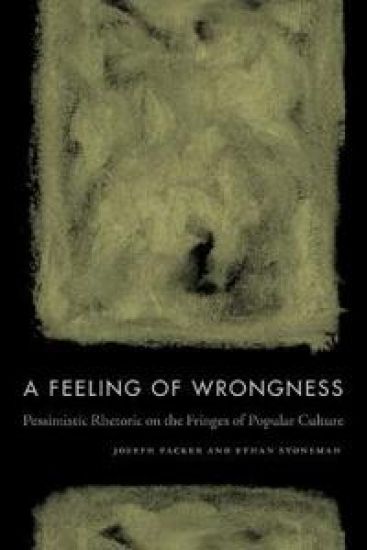
A Feeling of Wrongness

A Feeling of Wrongness

Joseph Packer; Ethan Stoneman

Pennsylvania State University Press
2019
pokkari
In A Feeling of Wrongness, Joseph Packer and Ethan Stoneman confront the rhetorical challenge inherent in the concept of pessimism by analyzing how it is represented in an eclectic range of texts on the fringes of popular culture, from adult animated cartoons to speculative fiction.Packer and Stoneman explore how narratives such as True Detective, Rick and Morty, Final Fantasy VII, Lovecraftian weird fiction, and the pop ideology of transhumanism are better suited to communicate pessimistic affect to their fans than most carefully argued philosophical treatises and polemics. They show how these popular nondiscursive texts successfully circumvent the typical defenses against pessimism identified by Peter Wessel Zapffe as distraction, isolation, anchoring, and sublimation. They twist genres, upend common tropes, and disturb conventional narrative structures in a way that catches their audience off guard, resulting in belief without cognition, a more rhetorically effective form of pessimism than philosophical pessimism.While philosophers and polemicists argue for pessimism in accord with the inherently optimistic structures of expressive thought or rhetoric, Packer and Stoneman show how popular texts are able to communicate their pessimism in ways that are paradoxically freed from the restrictive tools of optimism. A Feeling of Wrongness thus presents uncharted rhetorical possibilities for narrative, making visible the rhetorical efficacy of alternate ways and means of persuasion.
A Feeling of Wrongness

A Feeling of Wrongness

Joseph Packer; Ethan Stoneman

Pennsylvania State University Press
2018
sidottu
In A Feeling of Wrongness, Joseph Packer and Ethan Stoneman confront the rhetorical challenge inherent in the concept of pessimism by analyzing how it is represented in an eclectic range of texts on the fringes of popular culture, from adult animated cartoons to speculative fiction.Packer and Stoneman explore how narratives such as True Detective, Rick and Morty, Final Fantasy VII, Lovecraftian weird fiction, and the pop ideology of transhumanism are better suited to communicate pessimistic affect to their fans than most carefully argued philosophical treatises and polemics. They show how these popular nondiscursive texts successfully circumvent the typical defenses against pessimism identified by Peter Wessel Zapffe as distraction, isolation, anchoring, and sublimation. They twist genres, upend common tropes, and disturb conventional narrative structures in a way that catches their audience off guard, resulting in belief without cognition, a more rhetorically effective form of pessimism than philosophical pessimism.While philosophers and polemicists argue for pessimism in accord with the inherently optimistic structures of expressive thought or rhetoric, Packer and Stoneman show how popular texts are able to communicate their pessimism in ways that are paradoxically freed from the restrictive tools of optimism. A Feeling of Wrongness thus presents uncharted rhetorical possibilities for narrative, making visible the rhetorical efficacy of alternate ways and means of persuasion.