Kirjailija
Étienne Balibar
Kirjat ja teokset yhdessä paikassa: 36 kirjaa, julkaisuja vuosilta 1977-2025, suosituimpien joukossa Spinoza und die Politik. Vertaile teosten hintoja ja tarkista saatavuus suomalaisista kirjakaupoista.
Mukana myös kirjoitusasut: Etienne Balibar, Ètienne Balibar
36 kirjaa
Kirjojen julkaisuhaarukka 1977-2025.
If fundamental political categories were represented as geometric shapes, citizenship would be one of those rotating polyhedrons with reflective surfaces that together create effects of light and shade. With extraordinarily acute discernment, the leading philosopher Étienne Balibar examines one by one the various faces of this object, more numerous - and far more fissured - than one would imagine. The question of what it means to be a citizen has, from the dawn of Western politics, been anything but clear and straightforward; and modernity has shown it to be even more enigmatic and contested. Inseparable from democracy, and the demands for equality and liberty from which democracy draws its origins, citizenship is constantly being redefined within the unresolved contradiction between universal principles and the discriminatory mechanisms that regulate membership of a political community. Not everyone is a citizen, even within one nation-state. It has been said that ?certain persons are in society without being of society?. The dynamics of inclusion and exclusion continue to generate dramatic asymmetries and create openings and closures, especially today in a time of particular fragility and when national sovereignty is in flux. So are there too many antinomies within citizenship? Balibar does not shy away from these antimonies, but he knows that to renounce citizenship would be to abandon the chance to create new modes of collective autonomy, in short, to democratize democracy.
In Violence and Civility, Etienne Balibar boldly confronts the insidious causes of violence, racism, nationalism, and ethnic cleansing worldwide, as well as mass poverty and dispossession. Through a novel synthesis of theory and empirical studies of contemporary violence, the acclaimed thinker pushes past the limits of political philosophy to reconceive war, revolution, sovereignty, and class. Through the pathbreaking thought of Derrida, Balibar builds a topography of cruelty converted into extremism by ideology, juxtaposing its subjective forms (identity delusions, the desire for extermination, and the pursuit of vengeance) and its objective manifestations (capitalist exploitation and an institutional disregard for life). Engaging with Marx, Hegel, Hobbes, Clausewitz, Schmitt, and Luxemburg, Balibar introduces a new, productive understanding of politics as antiviolence and a fresh approach to achieving and sustaining civility. Rooted in the principles of transformation and empowerment, this theory brings hope to a world increasingly divided even as it draws closer together.
First published in French in 2010, Equaliberty brings together essays by Étienne Balibar, one of the preeminent political theorists of our time. The book is organized around equaliberty, a term coined by Balibar to connote the tension between the two ideals of modern democracy: equality (social rights and political representation) and liberty (the freedom citizens have to contest the social contract). He finds the tension between these different kinds of rights to be ingrained in the constitution of the modern nation-state and the contemporary welfare state. At the same time, he seeks to keep rights discourse open, eschewing natural entitlements in favor of a deterritorialized citizenship that could be expanded and invented anew in the age of globalization. Deeply engaged with other thinkers, including Arendt, Rancière, and Laclau, he posits a theory of the polity based on social relations. In Equaliberty Balibar brings both the continental and analytic philosophical traditions to bear on the conflicted relations between humanity and citizenship.
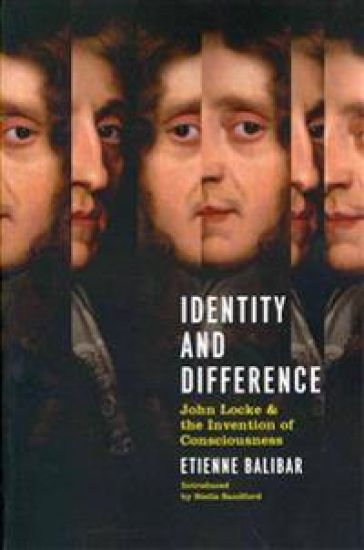
John Locke's foundational place in the history of British empiricism and liberal political thought is well established. So, in what sense can Locke be considered a modern European philosopher? Identity and Difference argues for reassessing this canonical figure. Closely examining the "treatise on identity" added to the second edition of An Essay Concerning Human Understanding, Etienne Balibar demonstrates Locke's role in the formation of two concepts central to the metaphysics of the subject-consciousness and the self-and the complex philosophical, legal, moral and political nature of his terms. With an accompanying essay by Stella Sandford, situating Balibar's reading of Locke in the history of the reception of the Essay and within Balibar's other writings on "the subject," Identity and Difference rethinks a crucial moment in the history of Western philosophy.
As one of Louis Althusser's most brilliant students in the 1960s, Etienne Balibar contributed to the theoretical collective masterpiece of Reading Capital. Since then he has established himself among the most subtle philosophical and political thinkers in France. In Politics and the Other Scene Balibar deepens and extends the work he first developed with Immanuel Wallerstein in Race, Nation, Class. Exploring the theme of universalism and difference, he addresses such topical questions as European racism, the notion of the border, whether a European citizenship is possible or desirable, violence and politics, and identity and emancipation.
Forty years after the defeat of Nazism, and twenty years after the great wave of decolonization, how is it that racism remains a growing phenomenon? What are the special characteristics of contemporary racism? How can it be related to class divisions and to the contradictions of the nation-state? And how far, in turn, does racism today compel us to rethink the relationship between class struggles and nationalism?This book attempts to answer these fundamental questions through a remarkable dialogue between the French philosopher Etienne Balibar and the American historian and sociologist Immanuel Wallerstein. Each brings to the debate the fruits of over two decades of analytical work, greatly inspired, respectively, by Louis Althusser and Fernand Braudel. Both authors challenge the commonly held notion of racism as a continuation of, or throwback to, the xenophobias of past societies and communities. They analyze it instead as a social relation indissolubly tied to present social structures-the nation-state, the division of labor, and the division between core and periphery-which are themselves constantly being reconstructed. Despite their productive disagreements, Balibar and Wallerstein both emphasize the modernity of racism and the need to understand its relation to contemporary capitalism and class struggle. Above all, their dialogue reveals the forms of present and future social conflict, in a world where the crisis of the nation-state is accompanied by an alarming rise of nationalism and chauvinism.
Vi, det europeiska folket? : reflektioner kring ett transnationellt medborgarskap
Ètienne Balibar
Tankekraft Förlag
2009
nidottu
Europabygget tycks befinna sig i en permanent kris. Istället för en allt tätare sammanslutning mellan de europeiska folken, ser vi hur Europa fragmenteras genom uppkomsten av nya skiljelinjer och hierarkier. De dilemman och paradoxer som dagens Europa står inför är utgångspunkten för Étienne Balibars reflektioner i Vi, det europeiska folket? Det europeiska projektets verkliga sanningstest, menar Balibar, står att finna i hur det förmår hantera de former av uteslutning och diskriminering som främst drabbar immigranter. I samband med att kontinenten påstår sig gå in i en postnationell era, finns det en reell risk för att en slags europeisk apartheid uppstår och befästs som en integrerad del av den europeiska konstruktionen. För att motverka denna ödesdigra tendens krävs en aktiv kamp för en demokratisering av gränser och ett transnationellt medborgarskap som förmår omfatta alla människor som lever och verkar i Europa. Detta är utan tvekan en av de mest enastående politiska bedrifterna i våra dagar. I en öppen och engagerande prosa erbjuder Balibar en saklig och djupgående analys av vad medborgarskap skulle kunna innebära mot bakgrund av de förändrade förhållandena och den ökande immigrationen i Europa. Hans kritik åtföljs av en politisk vision om demokrati som är på samma gång behärskad och hoppfull. Judith Butler, litteraturprofessor och författare till böckerna Genustrubbel och Könet brinner! Étienne Balibar (1942-) är professor emeritus i filosofi vid universitetet Paris X. Som lärjunge till Louis Althusser har han varit en av de mest inflytelserika förvaltarna av det marxistiska idéarvet i Frankrike. Bland hans mångtaliga publikationer återfinns Att läsa kapitalet (tillsammans med Louis Althusser), Ras, nation, klass (tillsammans med Immanuel Wallerstein) samt Spinoza et la politique.
Establishing a rigorous program of "symptomatic reading" that cuts through the silences and lacunae of Capital to reveal its philosophical core, Louis Althusser interprets Marx's structural analysis of production as a revolutionary break-the basis of a completely new science. Building on a series of Althussers's conceptual innovations that includes "overdetermination" and "social formation," Étienne Balibar explores the historical and structural facets of production as Marx understood them, scrutinizing many of the most fundamental points in Capital, as though for the first time.
With Hobbes and Locke, Spinoza is arguably one of the most important political philosophers of the modern era, a premier theoretician of democracy and mass politics. In this revised and augmented English translation of his 1985 classic, Spinoza et la Politique, Etienne Balibar presents a synoptic account of Spinoza's major works, admirably demonstrating relevance to his contemporary political life.Balibar carefully situates Spinoza's major treatises in the period in which they were written. In successive chapters, he examines the political situation in the United Provinces during Spinoza's lifetime, Spinoza's own religious and ideological associations, the concept of democracy developed in the Theologico-Political Treatise, the theory of the state advanced in the Political Treatise and the anthropological basis for politics established in the Ethics.
etienne Balibar has been one of Europe's most important philosophical and political thinkers since the 1960s. His work has been vastly influential on both sides of the Atlantic throughout the humanities and the social sciences. In We, the People of Europe?, he expands on themes raised in his previous works to offer a trenchant and eloquently written analysis of "transnational citizenship" from the perspective of contemporary Europe. Balibar moves deftly from state theory, national sovereignty, and debates on multiculturalism and European racism, toward imagining a more democratic and less state-centered European citizenship. Although European unification has progressively divorced the concepts of citizenship and nationhood, this process has met with formidable obstacles. While Balibar seeks a deep understanding of this critical conjuncture, he goes beyond theoretical issues. For example, he examines the emergence, alongside the formal aspects of European citizenship, of a "European apartheid," or the reduplication of external borders in the form of "internal borders" nurtured by dubious notions of national and racial identity. He argues for the democratization of how immigrants and minorities in general are treated by the modern democratic state, and the need to reinvent what it means to be a citizen in an increasingly multicultural, diversified world. A major new work by a renowned theorist, We, the People of Europe? offers a far-reaching alternative to the usual framing of multicultural debates in the United States while also engaging with these debates.
As one of Louis Althusser's most brilliant students in the 1960s, Etienne Balibar contributed to the theoretical collective masterpiece of Reading Capital. Since then he has established himself amongst the most subtle philosophical and political thinkers in France. In Politics and the Other Scene Balibar deepens and extends the work he first developed with Immanuel Wallerstein in Race, Nation, Class. Exploring the theme of universalism and difference, he addresses questions such as "European racism," the notion of the border, whether a European citizenship is possible or desirable, violence and politics, identity and emancipation.
In Masses, Classes, Ideas, well-known French philosopher Etienne Balibar explores the relationship between abstract philosophy and concrete politics. The book gathers together for the first time in English nine of Balibar's most influential essays written over the last decade, which have been carefully revised and reordered in logical succession with an original preface.Balibar discusses the influence of political philosophy on collective movements, touching on issues of religious and class struggle, nationalism and racism, the rights of man and the citizen, and property as a social relation. He seeks to explain the novelty of Marxist philosophy and political theory with respect to the classical doctrines of "state" and "revolution." Masses, Classes, Ideas also examines the limitations and aporias which have become manifest in Marxist philosophy and critically assesses its legacy, offering a provocative contribution to the project of renewing democratic theory.
No-one and nothing, not even the Congress of a Communist Party, can abolish the dictatorship of the proletariat. That is the most important conclusion of this book by Étienne Balibar.Balibar spells out his reasoning against the background of the 22nd Congress of the French Communist Party, which decided to 'drop' the aim of the dictatorship of the proletariat and to substitute the objective of a 'democratic' road to socialism. His concrete references are therefore usually to arguments put forward within the French Party. But it is quite obvious that the significance of this book is much wider, not least because, in spite of the important political and economic differences separating the nations of western Europe, many of their Communist Parties are evolving in an apparently similar ideological direction, and indeed appear to be borrowing arguments from one another in support of their new positions.