Kirjojen hintavertailu. Mukana 12 595 353 kirjaa ja 12 kauppaa.

Kirjailija

Etienne Pardoux

Kirjat ja teokset yhdessä paikassa: 9 kirjaa, julkaisuja vuosilta 1991-2021, suosituimpien joukossa Ecole d'Ete de Probabilites de Saint-Flour XIX - 1989. Vertaile teosten hintoja ja tarkista saatavuus suomalaisista kirjakaupoista.

Mukana myös kirjoitusasut: Étienne Pardoux

9 kirjaa

Kirjojen julkaisuhaarukka 1991-2021.

Stochastic Partial Differential Equations

Stochastic Partial Differential Equations

Étienne Pardoux

Springer Nature Switzerland AG
2021
nidottu
This book gives a concise introduction to the classical theory of stochastic partial differential equations (SPDEs). It begins by describing the classes of equations which are studied later in the book, together with a list of motivating examples of SPDEs which are used in physics, population dynamics, neurophysiology, finance and signal processing. The central part of the book studies SPDEs as infinite-dimensional SDEs, based on the variational approach to PDEs. This extends both the classical Itô formulation and the martingale problem approach due to Stroock and Varadhan. The final chapter considers the solution of a space-time white noise-driven SPDE as a real-valued function of time and (one-dimensional) space. The results of J. Walsh's St Flour notes on the existence, uniqueness and Hölder regularity of the solution are presented. In addition, conditions are given under which the solution remains nonnegative, and the Malliavin calculus is applied. Lastly, reflected SPDEs and their connection with super Brownian motion are considered. At a time when new sophisticated branches of the subject are being developed, this book will be a welcome reference on classical SPDEs for newcomers to the theory.
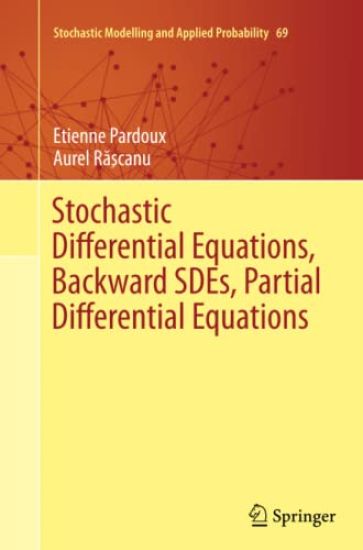
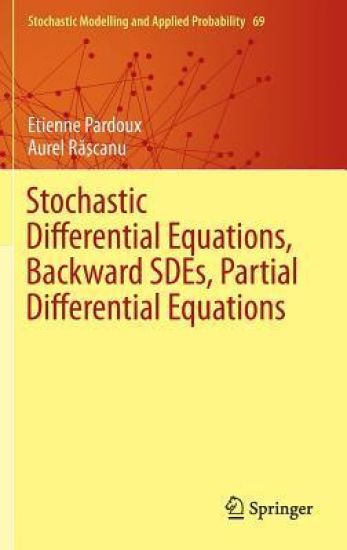
Stochastic Differential Equations, Backward SDEs, Partial Differential Equations

Stochastic Differential Equations, Backward SDEs, Partial Differential Equations

Etienne Pardoux; Aurel R?scanu

Springer International Publishing AG
2016
nidottu
This research monograph presents results to researchers in stochastic calculus, forward and backward stochastic differential equations, connections between diffusion processes and second order partial differential equations (PDEs), and financial mathematics. It pays special attention to the relations between SDEs/BSDEs and second order PDEs under minimal regularity assumptions, and also extends those results to equations with multivalued coefficients. The authors present in particular the theory of reflected SDEs in the above mentioned framework and include exercises at the end of each chapter.Stochastic calculus and stochastic differential equations (SDEs) were first introduced by K. Itô in the 1940s, in order to construct the path of diffusion processes (which are continuous time Markov processes with continuous trajectories taking their values in a finite dimensional vector space or manifold), which had been studied from a more analytic point of view by Kolmogorov in the 1930s. Since then, this topic has become an important subject of Mathematics and Applied Mathematics, because of its mathematical richness and its importance for applications in many areas of Physics, Biology, Economics and Finance, where random processes play an increasingly important role. One important aspect is the connection between diffusion processes and linear partial differential equations of second order, which is in particular the basis for Monte Carlo numerical methods for linear PDEs. Since the pioneering work of Peng and Pardoux in the early 1990s, a new type of SDEs called backward stochastic differential equations (BSDEs) has emerged. The two main reasons why this new class of equations is important are the connection between BSDEs and semilinear PDEs, and the fact that BSDEs constitute a natural generalization of the famous Black and Scholes model from Mathematical Finance, and thus offer a natural mathematical framework for the formulation of many new models in Finance.
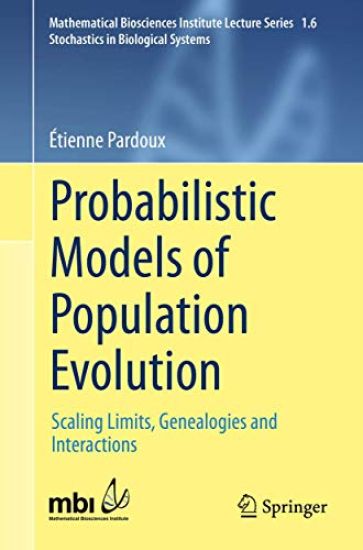
Probabilistic Models of Population Evolution

Probabilistic Models of Population Evolution

Étienne Pardoux

Springer International Publishing AG
2016
nidottu
This expository book presents the mathematical description of evolutionary models of populations subject to interactions (e.g. competition) within the population. The author includes both models of finite populations, and limiting models as the size of the population tends to infinity. The size of the population is described as a random function of time and of the initial population (the ancestors at time 0). The genealogical tree of such a population is given. Most models imply that the population is bound to go extinct in finite time. It is explained when the interaction is strong enough so that the extinction time remains finite, when the ancestral population at time 0 goes to infinity. The material could be used for teaching stochastic processes, together with their applications.Étienne Pardoux is Professor at Aix-Marseille University, working in the field of Stochastic Analysis, stochastic partial differential equations, and probabilistic models in evolutionary biology and population genetics. He obtained his PhD in 1975 at University of Paris-Sud.
Stochastic Differential Equations, Backward SDEs, Partial Differential Equations

Stochastic Differential Equations, Backward SDEs, Partial Differential Equations

Etienne Pardoux; Aurel R?scanu

Springer International Publishing AG
2014
sidottu
This research monograph presents results to researchers in stochastic calculus, forward and backward stochastic differential equations, connections between diffusion processes and second order partial differential equations (PDEs), and financial mathematics. It pays special attention to the relations between SDEs/BSDEs and second order PDEs under minimal regularity assumptions, and also extends those results to equations with multivalued coefficients. The authors present in particular the theory of reflected SDEs in the above mentioned framework and include exercises at the end of each chapter.Stochastic calculus and stochastic differential equations (SDEs) were first introduced by K. Itô in the 1940s, in order to construct the path of diffusion processes (which are continuous time Markov processes with continuous trajectories taking their values in a finite dimensional vector space or manifold), which had been studied from a more analytic point of view by Kolmogorov in the 1930s. Since then, this topic has become an important subject of Mathematics and Applied Mathematics, because of its mathematical richness and its importance for applications in many areas of Physics, Biology, Economics and Finance, where random processes play an increasingly important role. One important aspect is the connection between diffusion processes and linear partial differential equations of second order, which is in particular the basis for Monte Carlo numerical methods for linear PDEs. Since the pioneering work of Peng and Pardoux in the early 1990s, a new type of SDEs called backward stochastic differential equations (BSDEs) has emerged. The two main reasons why this new class of equations is important are the connection between BSDEs and semilinear PDEs, and the fact that BSDEs constitute a natural generalization of the famous Black and Scholes model from Mathematical Finance, and thus offer a natural mathematical framework for the formulation of many new models in Finance.
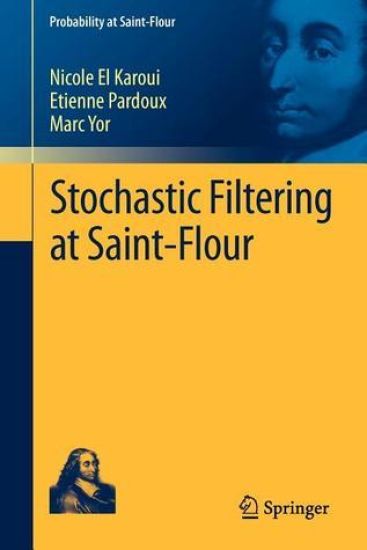
Stochastic Filtering at Saint-Flour

Stochastic Filtering at Saint-Flour

Nicole El Karoui; Etienne Pardoux; Marc Yor

Springer-Verlag Berlin and Heidelberg GmbH Co. K
2012
nidottu
El Karoui: Les aspects probabilistes du contrôle stochastique.- Pardoux, Etienne: Filtrage non linéaire et équations aux dérivées partielles stochastiques associées.- Yor, M.: Sur la théorie du filtrage.
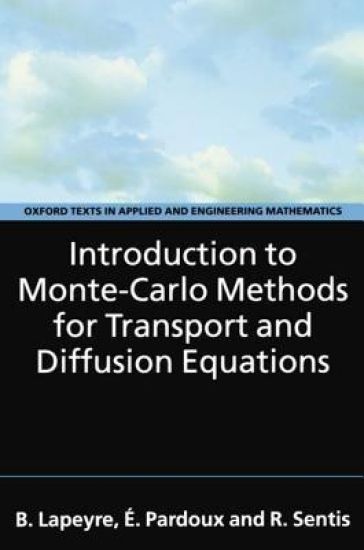
Introduction to Monte-Carlo Methods for Transport and Diffusion Equations

Introduction to Monte-Carlo Methods for Transport and Diffusion Equations

Bernard Lapeyre; Etienne Pardoux; Remi Sentis

Oxford University Press
2003
nidottu
Monte-Carlo methods is the generic term given to numerical methods that use sampling of random numbers. This text is aimed at graduate students in mathematics, physics, engineering, economics, finance, and the biosciences that are interested in using Monte-Carlo methods for the resolution of partial differential equations, transport equations, the Boltzmann equation and the parabolic equations of diffusion. It includes applied examples, particularly in mathematical finance, along with discussion of the limits of the methods and description of specific techniques used in practice for each example. This is the sixth volume in the Oxford Texts in Applied and Engineering Mathematics series, which includes texts based on taught courses that explain the mathematical or computational techniques required for the resolution of fundamental applied problems, from the undergraduate through to the graduate level. Other books in the series include: Jordan & Smith: Nonlinear Ordinary Differential Equations: An introduction to Dynamical Systems; Sobey: Introduction to Interactive Boundary Layer Theory; Scott: Nonlinear Science: Emergence and Dynamics of Coherent Structures; Tayler: Mathematical Models in Applied Mechanics; Ram-Mohan: Finite Element and Boundary Element Applications in Quantum Mechanics; Elishakoff and Ren: Finite Element Methods for Structures with Large Stochastic Variations.
Introduction to Monte-Carlo Methods for Transport and Diffusion Equations

Introduction to Monte-Carlo Methods for Transport and Diffusion Equations

Bernard Lapeyre; Etienne Pardoux; Remi Sentis

Oxford University Press
2003
sidottu
Monte-Carlo methods is the generic term given to numerical methods that use sampling of random numbers. This text is aimed at graduate students in mathematics, physics, engineering, economics, finance, and the biosciences that are interested in using Monte-Carlo methods for the resolution of partial differential equations, transport equations, the Boltzmann equation and the parabolic equations of diffusion. It includes applied examples, particularly in mathematical finance, along with discussion of the limits of the methods and description of specific techniques used in practice for each example. This is the sixth volume in the Oxford Texts in Applied and Engineering Mathematics series, which includes texts based on taught courses that explain the mathematical or computational techniques required for the resolution of fundamental applied problems, from the undergraduate through to the graduate level. Other books in the series include: Jordan & Smith: Nonlinear Ordinary Differential Equations: An introduction to Dynamical Systems; Sobey: Introduction to Interactive Boundary Layer Theory; Scott: Nonlinear Science: Emergence and Dynamics of Coherent Structures; Tayler: Mathematical Models in Applied Mechanics; Ram-Mohan: Finite Element and Boundary Element Applications in Quantum Mechanics; Elishakoff and Ren: Finite Element Methods for Structures with Large Stochastic Variations.
Méthodes de Monte-Carlo pour les équations de transport et de diffusion

Méthodes de Monte-Carlo pour les équations de transport et de diffusion

Bernard Lapeyre; Etienne Pardoux; Rémi Sentis

Springer-Verlag Berlin and Heidelberg GmbH Co. K
1997
nidottu
Le but de ce livre est de donner une introduction aux méthodes de Monte-Carlo orientée vers la résolution des équations aux dérivées partielles. Après des rappels sur les techniques de simulation, de réduction de variance et de suites à discrépance faible, les auteurs traitent en détail le cas des équations de transport, de l'équation de Boltzmann et des équations paraboliques de diffusion. Dans chaque cas ils introduisent les processus aléatoires associés et discutent les techniques d'implémentation. Des exemples issus notamment de la neutronique et d'applications financières sont donnés. Ce livre est destiné à des étudiants de maîtrise et de D.E.A. ou à des élèves d'Ecole d'ingénieurs ayant de bonnes connaissances en probabilités.