Kirjojen hintavertailu. Mukana 12 390 323 kirjaa ja 12 kauppaa.

Kirjailija

Eugene Barsky

Kirjat ja teokset yhdessä paikassa: 6 kirjaa, julkaisuja vuosilta 2010-2025, suosituimpien joukossa Critical Regimes of Two-Phase Flows with a Polydisperse Solid Phase. Vertaile teosten hintoja ja tarkista saatavuus suomalaisista kirjakaupoista.

6 kirjaa

Kirjojen julkaisuhaarukka 2010-2025.

Theoretical Foundations of Separation Processes

Theoretical Foundations of Separation Processes

Eugene Barsky

JOHN WILEY SONS INC
2025
sidottu
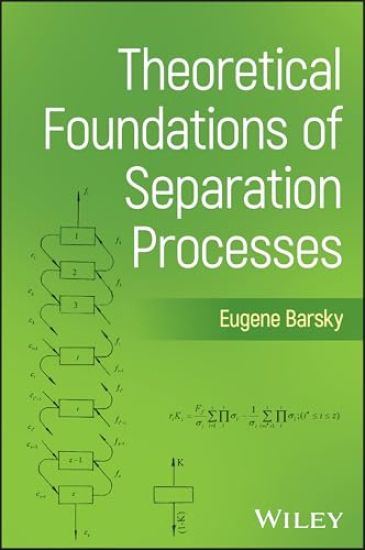
Enables readers to understand separation processes from a physical, combinatorial, and statistical perspective, focusing on the entropy of two-phase flows Theoretical Foundations of Separation Processes delves into the underlying theory behind how substances separate from one another. Mathematical modeling and the concept of entropy play pivotal roles throughout the text. This book includes information on: Theoretical underpinnings such as two-phase flows, solid particles, and gas-solid interactionsProcesses of polyfractional solid materials separationsCalculation methodology for various separation systems and devices, with information on finding the results of separation processes depending on the design of the classifierApplications across industries such as agriculture, chemistry, mining, food, cement, mechanical, refractory production, electronics, and nanotechnology This title is an essential reference to help engineers improve their separation processes. It is also useful for a variety of companies involved in the design and manufacture of relevant equipment and operating separations equipment.
Entropy of Complex Processes and Systems

Entropy of Complex Processes and Systems

Eugene Barsky

Elsevier Science Publishing Co Inc
2020
nidottu
Entropy of Complex Processes and Systems formalizes our understanding of many complex processes, including the development of the methodology of analytical computation of complex processes as applied in many industries, such as ore processing, or more generally, in areas of natural sciences. The adequacy of the results of these calculations is confirmed by numerous experimental data obtained both on pilots and industrial facilities. The book also provides a thorough analysis of the underlying physical foundations of entropy performed from new standpoints that are of interest to theoreticians studying contemporary expositions.
Gibbs' Entropic Paradox and Problems of Separation Processes
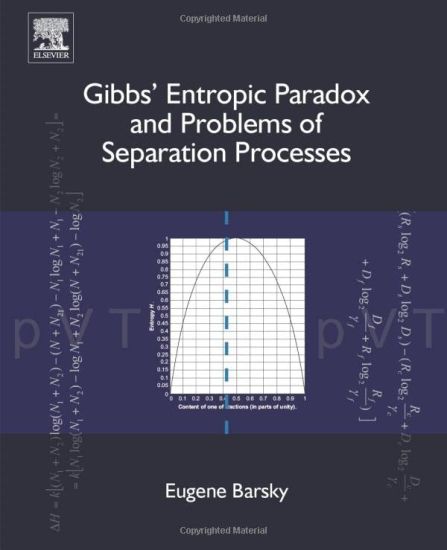
Gibbs' Entropic Paradox and Problems of Separation Processes reviews the so-called Gibb’s Paradox observed during the mixing of two systems. During the last 150 years, many physicists and specialists in thermodynamics, statistical and quantum mechanics been engaged in the solution of the Gibbs paradox. Many books and journal articles have written on this topic, but a widely accepted answer is still lacking. In this book, the author reviews and analyzes all this data. Based on findings, the book formulates a different approach to this paradox and substantiates it on the basis of physical and statistical principles. The book clearly shows that entropy consists of two parts, static and dynamic. Up to now, entropy has been connected only with the process dynamics. However, the Gibbs paradox is caused by the change in the static component of entropy. Finally, the book includes examples of separation processes and how to optimize them in various fields, including biology, cosmology, crystallography and the social sciences.
Critical Regimes of Two-Phase Flows with a Polydisperse Solid Phase
Critical regimes of two-phase flows with a polydisperse solid phase form the basis of such widespread industrial processes as separation of various powdery materials and minerals dressing. It is impossible to describe such complicated flows analytically. Therefore, this study concentrates on invariants experimentally revealed and theoretically grounded for such flows. This approach can be compared with the situation in gases, where in order to determine principal parameters of their state, one does not need to measure the kinetic energy and velocity of each molecule and find its contribution to the temperature and pressure. These parameters are determined in a simple way for the system on the whole. A novel conception of two-phase flows allowing the formulation of their statistical parameters is physically substantiated. On the basis of the invariants and these parameters, a comprehensive method of estimating and predicting mass transfer in such flows is developed. It is noteworthy that the presented results are mostly phenomenological. Such an approach can be successfully extended to the separation of liquids, gases and isotopes. The book is intended for students and specialists engaged in chemical technology, mineral dressing, ceramics, microelectronics, pharmacology, power generation, thermal engineering and other fields in which flows carrying solid particles are used in the technological process.
Critical Regimes of Two-Phase Flows with a Polydisperse Solid Phase
Critical regimes of two-phase flows with a polydisperse solid phase form the basis of such widespread industrial processes as separation of various powdery materials and minerals dressing. It is impossible to describe such complicated flows analytically. Therefore, this study concentrates on invariants experimentally revealed and theoretically grounded for such flows. This approach can be compared with the situation in gases, where in order to determine principal parameters of their state, one does not need to measure the kinetic energy and velocity of each molecule and find its contribution to the temperature and pressure. These parameters are determined in a simple way for the system on the whole. A novel conception of two-phase flows allowing the formulation of their statistical parameters is physically substantiated. On the basis of the invariants and these parameters, a comprehensive method of estimating and predicting mass transfer in such flows is developed. It is noteworthy that the presented results are mostly phenomenological. Such an approach can be successfully extended to the separation of liquids, gases and isotopes. The book is intended for students and specialists engaged in chemical technology, mineral dressing, ceramics, microelectronics, pharmacology, power generation, thermal engineering and other fields in which flows carrying solid particles are used in the technological process.