Kirjojen hintavertailu. Mukana 12 390 323 kirjaa ja 12 kauppaa.

Kirjailija

Eugene D. Genovese

Kirjat ja teokset yhdessä paikassa: 16 kirjaa, julkaisuja vuosilta 1966-2021, suosituimpien joukossa Roll, Jordan, Roll. Vertaile teosten hintoja ja tarkista saatavuus suomalaisista kirjakaupoista.

16 kirjaa

Kirjojen julkaisuhaarukka 1966-2021.

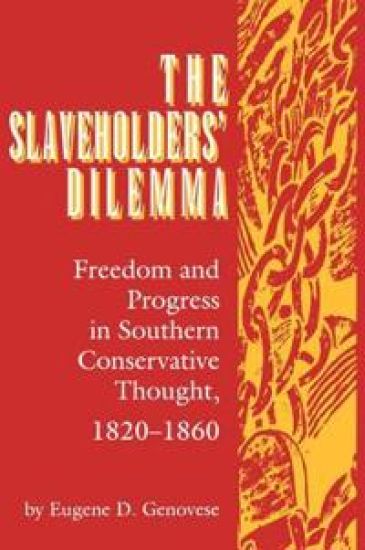
The Slaveholders' Dilemma

The Slaveholders' Dilemma

Eugene D. Genovese; Douglas Ambrose

University of South Carolina Press
2021
nidottu
In The Slaveholders' Dilemma, Eugene D. Genovese explores the efforts of American slaveholders to reconcile the intellectual dilemma in which they found themselves as supporters of freedom but defenders of slavery. In the American South slaveholders perceived themselves as thoroughly modern, moral men who protected human progress against the perversions of the Enlightenment and the French Revolution. Surprisingly, they also accepted the widespread idea that freedom generated the economic, social, and moral progress they embraced as their own cause. Nonetheless, they continued to defend slavery. In this compact but densely argued volume, Genovese rehearses the central arguments that would define the latter portion of his career, thus offering a window not only into the mind of the master class but also the mind of one of the most important scholars of the American South.A new foreword is provided by Douglas Ambrose, professor of history at Hamilton College and author of Henry Hughes and Proslavery Thought in the Old South.

The Sweetness of Life

The Sweetness of Life

Eugene D. Genovese

Cambridge University Press
2017
sidottu
This book examines the home and leisure life of planters in the antebellum American South. Based on a lifetime of research by the late Eugene Genovese (1930–2012), with an introduction and epilogue by Douglas Ambrose, The Sweetness of Life presents a penetrating study of slaveholders and their families in both intimate and domestic settings: at home; attending the theatre; going on vacations to spas and springs; throwing parties; hunting; gambling; drinking and entertaining guests, completing a comprehensive portrait of the slaveholders and the world that they built with slaves. Genovese subtly but powerfully demonstrates how much politics, economics, and religion shaped, informed, and made possible these leisure activities. A fascinating investigation of a little-studied aspect of planter life, The Sweetness of Life broadens our understanding of the world that the slaveholders and their slaves made; a tragic world of both 'sweetness' and slavery.
The Sweetness of Life

The Sweetness of Life

Eugene D. Genovese

Cambridge University Press
2017
pokkari
This book examines the home and leisure life of planters in the antebellum American South. Based on a lifetime of research by the late Eugene Genovese (1930–2012), with an introduction and epilogue by Douglas Ambrose, The Sweetness of Life presents a penetrating study of slaveholders and their families in both intimate and domestic settings: at home; attending the theatre; going on vacations to spas and springs; throwing parties; hunting; gambling; drinking and entertaining guests, completing a comprehensive portrait of the slaveholders and the world that they built with slaves. Genovese subtly but powerfully demonstrates how much politics, economics, and religion shaped, informed, and made possible these leisure activities. A fascinating investigation of a little-studied aspect of planter life, The Sweetness of Life broadens our understanding of the world that the slaveholders and their slaves made; a tragic world of both 'sweetness' and slavery.
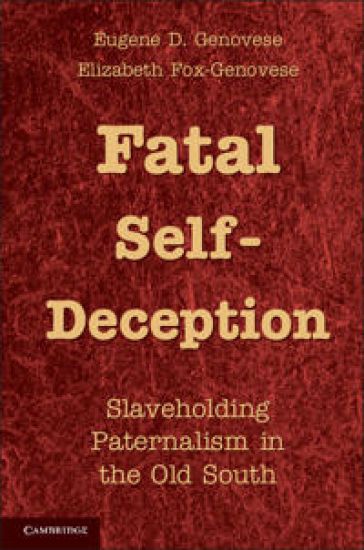
Fatal Self-Deception

Fatal Self-Deception

Eugene D. Genovese; Elizabeth Fox-Genovese

Cambridge University Press
2011
sidottu
Slaveholders were preoccupied with presenting slavery as a benign, paternalistic institution in which the planter took care of his family and slaves were content with their fate. In this book, Eugene D. Genovese and Elizabeth Fox-Genovese discuss how slaveholders perpetuated and rationalized this romanticized version of life on the plantation. Slaveholders' paternalism had little to do with ostensible benevolence, kindness and good cheer. It grew out of the necessity to discipline and morally justify a system of exploitation. At the same time, this book also advocates the examination of masters' relations with white plantation laborers and servants - a largely unstudied subject. Southerners drew on the work of British and European socialists to conclude that all labor, white and black, suffered de facto slavery, and they championed the South's 'Christian slavery' as the most humane and compassionate of social systems, ancient and modern.
Fatal Self-Deception

Fatal Self-Deception

Eugene D. Genovese; Elizabeth Fox-Genovese

Cambridge University Press
2011
pokkari
Slaveholders were preoccupied with presenting slavery as a benign, paternalistic institution in which the planter took care of his family and slaves were content with their fate. In this book, Eugene D. Genovese and Elizabeth Fox-Genovese discuss how slaveholders perpetuated and rationalized this romanticized version of life on the plantation. Slaveholders' paternalism had little to do with ostensible benevolence, kindness and good cheer. It grew out of the necessity to discipline and morally justify a system of exploitation. At the same time, this book also advocates the examination of masters' relations with white plantation laborers and servants - a largely unstudied subject. Southerners drew on the work of British and European socialists to conclude that all labor, white and black, suffered de facto slavery, and they championed the South's 'Christian slavery' as the most humane and compassionate of social systems, ancient and modern.
A Consuming Fire

A Consuming Fire

Eugene D. Genovese

University of Georgia Press
2009
pokkari
The fall of the Confederacy proved traumatic for a people who fought with the belief that God was on their side. Yet, as Eugene D. Genovese writes in A Consuming Fire, Southern Christians continued to trust in the Lord's will. The churches had long defended "southern rights" and insisted upon the divine sanction for slavery, but they also warned that God was testing His people, who must bring slavery up to biblical standards or face the wrath of an angry God.In the eyes of proslavery theorists, clerical and lay, social relations and material conditions affected the extent and pace of the spread of the Gospel and men's preparation to receive it. For proslavery spokesmen, "Christian slavery" offered the South, indeed the world, the best hope for the vital work of preparation for the Kingdom, but they acknowledged that, from a Christian point of view, the slavery practiced in the South left much to be desired. For them, the struggle to reform, or rather transform, social relations was nothing less than a struggle to justify the trust God placed in them when He sanctioned slavery.The reform campaign of prominent ministers and church laymen featured demands to secure slave marriages and family life, repeal the laws against slave literacy, and punish cruel masters. A Consuming Fire analyzes the strength, weakness, and failure of the struggle for reform and the nature and significance of southern Christian orthodoxy and its vision of a proper social order, class structure, and race relations.
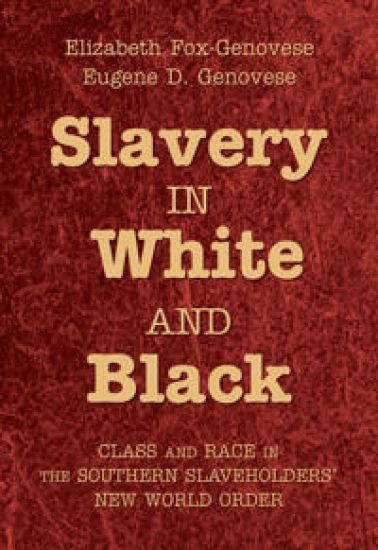
Slavery in White and Black

Slavery in White and Black

Elizabeth Fox-Genovese; Eugene D. Genovese

Cambridge University Press
2008
sidottu
Southern slaveholders proudly pronounced themselves orthodox Christians, who accepted responsibility for the welfare of the people who worked for them. They proclaimed that their slaves enjoyed a better and more secure life than any laboring class in the world. Now, did it not follow that the lives of laborers of all races across the world would be immeasurably improved by their enslavement? In the Old South but in no other slave society a doctrine emerged among leading clergymen, politicians, and intellectuals - 'Slavery in the Abstract', which declared enslavement the best possible condition for all labor regardless of race. They joined the Socialists, whom they studied, in believing that the free-labor system, wracked by worsening class warfare, was collapsing. A vital question: to what extent did the people of the several social classes of the South accept so extreme a doctrine? That question lies at the heart of this book.
Slavery in White and Black

Slavery in White and Black

Elizabeth Fox-Genovese; Eugene D. Genovese

Cambridge University Press
2008
pokkari
Southern slaveholders proudly pronounced themselves orthodox Christians, who accepted responsibility for the welfare of the people who worked for them. They proclaimed that their slaves enjoyed a better and more secure life than any laboring class in the world. Now, did it not follow that the lives of laborers of all races across the world would be immeasurably improved by their enslavement? In the Old South but in no other slave society a doctrine emerged among leading clergymen, politicians, and intellectuals - 'Slavery in the Abstract', which declared enslavement the best possible condition for all labor regardless of race. They joined the Socialists, whom they studied, in believing that the free-labor system, wracked by worsening class warfare, was collapsing. A vital question: to what extent did the people of the several social classes of the South accept so extreme a doctrine? That question lies at the heart of this book.
The Mind of the Master Class

The Mind of the Master Class

Elizabeth Fox-Genovese; Eugene D. Genovese

Cambridge University Press
2005
sidottu
The Mind of the Master Class tells of America's greatest historical tragedy. It presents the slaveholders as men and women, a great many of whom were intelligent, honorable, and pious. It asks how people who were admirable in so many ways could have presided over a social system that proved itself an enormity and inflicted horrors on their slaves. The South had formidable proslavery intellectuals who participated fully in transatlantic debates and boldly challenged an ascendant capitalist ('free-labor') society. Blending classical and Christian traditions, they forged a moral and political philosophy designed to sustain conservative principles in history, political economy, social theory, and theology, while translating them into political action. Even those who judge their way of life most harshly have much to learn from their probing moral and political reflections on their times - and ours - beginning with the virtues and failings of their own society and culture.
The Mind of the Master Class

The Mind of the Master Class

Elizabeth Fox-Genovese; Eugene D. Genovese

Cambridge University Press
2005
pokkari
The Mind of the Master Class tells of America's greatest historical tragedy. It presents the slaveholders as men and women, a great many of whom were intelligent, honorable, and pious. It asks how people who were admirable in so many ways could have presided over a social system that proved itself an enormity and inflicted horrors on their slaves. The South had formidable proslavery intellectuals who participated fully in transatlantic debates and boldly challenged an ascendant capitalist ('free-labor') society. Blending classical and Christian traditions, they forged a moral and political philosophy designed to sustain conservative principles in history, political economy, social theory, and theology, while translating them into political action. Even those who judge their way of life most harshly have much to learn from their probing moral and political reflections on their times - and ours - beginning with the virtues and failings of their own society and culture.
The Southern Tradition

The Southern Tradition

Eugene D. Genovese

Harvard University Press
1996
nidottu
In recent years American conservatism has found a new voice, a new way of picking up the political pieces left in the wake of liberal policies. But what seems innovative, Eugene Genovese shows us, may in fact have very old roots. Tracing a certain strain of conservatism to its sources in a rich southern tradition, his book introduces a revealing perspective on the politics of our day. As much a work of political and moral philosophy as one of history, The Southern Tradition is based on the intellectual journey of one of the most influential historians of the late twentieth century. To appreciate the tradition of southern conservatism, Genovese tells us, we must first understand the relation of southern thought to politics. Toward this end, he presents a historical overview that identifies the tenets, sensibilities, and attitudes of the southern-conservative world view. With these conditions in mind, he considers such political and constitutional issues as state rights, concurrent majority, and the nature and locus of political power in a constitutional republic. Of special interest are the southern-conservative critiques of equality and democracy, and of the Leviathan state in its liberal, socialist, and fascist forms. Genovese examines these critiques in light of the specific concept of property that has been central to southern social and political thought. Not only does this book illuminate a political tradition grounded in the writings of John Randolph and John C. Calhoun, but it shows how this lineage has been augmented by powerful literary figures such as Allen Tate, Lewis Simpson, and Robert Penn Warren. Genovese here reconstitutes the historical canon, re-envisions the strengths and weaknesses of the conservative tradition, and broadens the spectrum of political debate for our time.
Slaveholder's Dilemma

Slaveholder's Dilemma

Eugene D. Genovese

University of South Carolina Press
1994
nidottu
In antebellum times slaveholders perceived themselves as thoroughly modern and moral men who were protecting human progress against the perversions spawned by the more radical aspects of the Enlightenment and the French Revolution. The slaveholders insisted that, in resisting the religious heresies, infidelity, ultra-democratic politics, and egalitarian dogmas then sweeping the North and Western Europe, they were proving themselves the firmest carriers of genuine progress itself. Surprisingly, they accepted the widespread idea that freedom generated the economic, social, and moral progress they embraced as their own cause. But they nonetheless increasingly took higher ground in defense of their slave system. In consequence, they plunged into an intellectual and political cul de sac. Genovese, in exploring their efforts to fight their way out of this dilemma, argues that proslavery Southerners--theologians, political theorists, economists, sociologists, and moral philosophers--simultaneously formed part of a broad trans-Atlantic conservative movement and yet advanced a distinct position that set them apart from their Northern and European counterparts. He also holds that the spokesmen for Southern slavery demonstrated a much higher level of intellectual talent than has been generally recognized and that they will no longer be subject to the obscurity into which they have fallen.
From Rebellion to Revolution

From Rebellion to Revolution

Eugene D. Genovese

Louisiana State University Press
1992
nidottu
In one of his most important books, the renowned historian Eugene D. Genovese examines slave revolts in the United States, the Caribbean, and Brazil, placing them in the context of modern world history. By studying the conditions that favoured these revolts and the history of slave guerrilla warfare throughout the Western Hemisphere, he connects the ideology of the revolts to the ideology of the great revolutionary movements of the late eighteenth century.Genovese finds that the slave rebellion in Saint-Domingue, led by Toussaint L'Ouverture, constituted a turning point in the history of the slave revolts and, indeed, in the history of the human spirit. By claiming for his enslaved brothers and sisters the same right to human dignity that the French bourgeoisie claimed for itself during the French Revolution, Toussaint began the process by which slave uprisings changed from secessionist rebellions to revolutionary demands for liberty, equality, and justice.
Roll, Jordan, Roll

Roll, Jordan, Roll

Eugene D. Genovese

Random House USA Inc
1976
pokkari
This landmark history of slavery in the South--a winner of the Bancroft Prize--challenged conventional views of slaves by illuminating the many forms of resistance to dehumanization that developed in slave society. Rather than emphasizing the cruelty and degradation of slavery, historian Eugene Genovese investigates the ways that slaves forced their owners to acknowledge their humanity through culture, music, and religion. Not merely passive victims, the slaves in this account actively engaged with the paternalism of slaveholding culture in ways that supported their self-respect and aspirations for freedom. "Roll, Jordan, Roll "covers a vast range of subjects, from slave weddings and funerals, to the language, food, clothing, and labor of slaves, and places particular emphasis on religion as both a major battleground for psychological control and a paradoxical source of spiritual strength. Displaying keen insight into the minds of both slaves and slaveholders, "Roll, Jordan, Roll" is a testament to the power of the human spirit under conditions of extreme oppression.
American Negro Slavery

American Negro Slavery

Ulrich Bonnell Phillips; Eugene D. Genovese

Louisiana State University Press
1966
nidottu
Phillips came close to greatness as a historian, perhaps as close and any historian this country has produced. We may leave to those who live in the world of absolute good and evil the task of explaining how a man with such primitive views of fundamental social questions could write such splendid history. . . . He asked more and better questions than many of us still are willing to admit, and he carried on his investigations with consistent freshness and critical intelligence. . . . American Negro Slavery is not the last word on its subject; merely the indispensable first. - Eugene D. Genovese