Kirjojen hintavertailu. Mukana 12 390 323 kirjaa ja 12 kauppaa.

Kirjailija

Eugene Garver

Kirjat ja teokset yhdessä paikassa: 9 kirjaa, julkaisuja vuosilta 1995-2024, suosituimpien joukossa Classical Rhetoric and Contemporary Law. Vertaile teosten hintoja ja tarkista saatavuus suomalaisista kirjakaupoista.

9 kirjaa

Kirjojen julkaisuhaarukka 1995-2024.

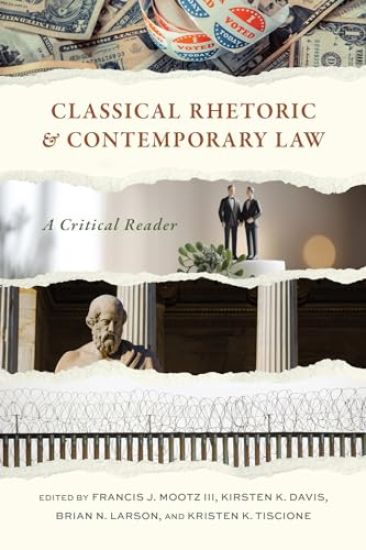
Classical Rhetoric and Contemporary Law

Classical Rhetoric and Contemporary Law

Vasileios Adamidis; Elizabeth C. Britt; David A. Frank; Michael Gagarin; Eugene Garver; Mark A. Hannah; Catherine L. Langford; Craig A. Meyer; Susan E. Provenzano; Nick J. Sciullo; Laura A. Webb

THE UNIVERSITY OF ALABAMA PRESS
2024
sidottu
Pairs passages from works of classical rhetoric with contemporary legal rulings to highlight and analyze their deep and abiding connections in matters of persuasionClassical Rhetoric and Contemporary Law: A Critical Reader is a rich work that analyzes the interplay between ancient rhetorical traditions and modern legal practice, reestablishing the lost connections between law and classical rhetoric. From Isocrates’s Panegyricus in 380 BCE to the landmark US Supreme Court case Trump v. Hawaii in 2018, and from Antiphon’s fifth century BCE First Tetralogy to 1995’s O. J. Simpson trial, the volume draws on an array of sources to illuminate how ancient rhetorical insights may even today challenge and enrich our grasp of contemporary legal principles. The collection opens with a brisk review of the historical development of rhetoric. The second part examines a pair of rhetorical theorists whose works frame the period across which classical rhetoric declined as a mode of thought. A contemporary appellate case contrasts with the work of Giambattista Vico, an eighteenth-century professor of rhetoric who warned of the separation of law from rhetoric. The analysis of the work of twentieth-century scholars ChaÏm Perelman and Lucie Olbrects-Tyteca shows that where Cartesian rationality fails, the humanistic tradition of rhetoric allows the law to respond to the needs of justice. In the third part, ten case studies bring together a classical rhetorical theorist with a contemporary court case, demonstrating the abiding relevance of the classical tradition to contemporary jurisprudence. With its cross-disciplinary appeal, Classical Rhetoric and Contemporary Law encompasses the work of legal, rhetorical, English, and communication scholars alike, catalyzing interactive exploration into the profound ways ancient rhetorical insights continue to shape our comprehension of today’s legal landscape.CONTRIBUTORS Vasileios Adamidis / Elizabeth C. Britt / Kirsten K. Davis / David A. Frank / Michael Gagarin / Eugene Garver / Mark A. Hannah / Catherine L. Langford / Brian N. Larson / Craig A. Meyer / Francis J. Mootz III / Susan E. Provenzano / Nick J. Sciullo / Kristen K. Tiscione / Laura A. Webb
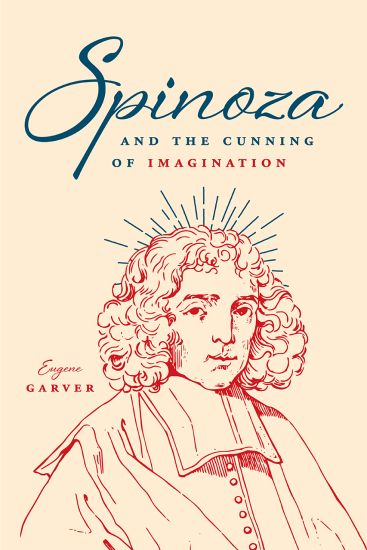
Spinoza and the Cunning of Imagination

Spinoza and the Cunning of Imagination

Eugene Garver

University of Chicago Press
2018
sidottu
Spinoza’s Ethics, and its project of proving ethical truths through the geometric method, have attracted and challenged readers for more than three hundred years. In Spinoza and the Cunning of Imagination, Eugene Garver uses the imagination as a guiding thread to this work. Other readers have looked at the imagination to account for Spinoza’s understanding of politics and religion, but this is the first inquiry to see it as central to the Ethics as a whole—imagination as a quality to be cultivated, and not simply overcome. Spinoza initially presents imagination as an inadequate and confused way of thinking, always inferior to ideas that adequately represent things as they are. It would seem to follow that one ought to purge the mind of imaginative ideas and replace them with rational ideas as soon as possible, but as Garver shows, the Ethics don’t allow for this ultimate ethical act until one has cultivated a powerful imagination. This is, for Garver, “the cunning of imagination.” The simple plot of progress becomes, because of the imagination, a complex journey full of reversals and discoveries. For Garver, the “cunning” of the imagination resides in our ability to use imagination to rise above it.
Confronting Aristotle's Ethics

Confronting Aristotle's Ethics

Eugene Garver

University of Chicago Press
2015
nidottu
What is the good life? Posing this question today would likely elicit very different answers. Some might say that the good life means doing good - improving one's community and the lives of others. Others might respond that it means doing well - cultivating one's own abilities in a meaningful way. But for Aristotle these two distinct ideas - doing good and doing well - were one and the same and could be realized in a single life. In Confronting Aristotle's Ethics, Eugene Garver examines how we can draw this conclusion from Aristotle's works, while also studying how this conception of the good life relates to contemporary ideas of morality. The key to Aristotle's views on ethics, argues Garver, lies in the Metaphysics or, more specifically, in his thoughts on activities, actions, and capacities. For Aristotle, Garver shows, it is only possible to be truly active when acting for the common good, and it is only possible to be truly happy when active to the extent of one's own powers. But does this mean we should aspire to Aristotle's impossibly demanding vision of the good life? In a word, no. Garver stresses the enormous gap between life in Aristotle's time and ours. As a result, this book is a welcome rumination not only on Aristotle but on the relationship between the individual and society in everyday life.
Aristotle's Politics

Aristotle's Politics

Eugene Garver

University of Chicago Press
2014
nidottu
"Man is a political animal," Aristotle asserts near the beginning of the Politics. In this unique reading of one of the foundational texts of political philosophy, Eugene Garver traces the surprising implications of Aristotle's claim and explores the treatise's relevance to ongoing political concerns. Often dismissed as overly grounded in Aristotle's specific moment in time, in fact the Politics challenges contemporary understandings of human action and allows us to better see ourselves today. Close examination of Aristotle's treatise, Garver finds, reveals a significant, practical role for philosophy to play in politics. Philosophers present arguments about issues - such as the right and the good, justice and modes of governance, the relation between the good person and the good citizen, and the character of a good life - that politicians must then make appealing to their fellow citizens. Completing Garver's trilogy on Aristotle's unique vision, Aristotle's Politics yields new ways of thinking about ethics and politics, ancient and modern.
Aristotle's Politics

Aristotle's Politics

Eugene Garver

University of Chicago Press
2012
sidottu
"Man is a political animal", Aristotle asserts near the beginning of the "Politics". In this novel reading of one of the foundational texts of political philosophy, Eugene Garver traces the surprising implications of Aristotle's claim and explores the treatise's relevance to ongoing political concerns. Often dismissed as overly grounded in Aristotle's specific moment in time, in fact the "Politics" challenges contemporary understandings of human action and allows us to better see ourselves today. Close examination of Aristotle's treatise, Garver finds, reveals a significant, practical role for philosophy to play in politics. Philosophers present arguments about issues - such as the right and the good, justice and modes of governance, the relation between the good person and the good citizen, and the character of a good life - that politicians must then make appealing to their fellow citizens. Completing Garver's trilogy on Aristotle's unique vision, "Aristotle's Politics" yields new ways of thinking about ethics and politics, ancient and modern.
Confronting Aristotle's Ethics

Confronting Aristotle's Ethics

Eugene Garver

University of Chicago Press
2006
sidottu
What is the good life? Posing this question today would likely elicitvery different answers. Some might say that the good life means doing good-improving one's community and the lives of others. Others might respond that it means doing well-cultivating one's own abilities in a meaningful way. But for Aristotle these two distinct ideas-doing good and doing well-were one and the same and could be realized in a single life. In Confronting Aristotle's Ethics, Eugene Garver examines how we can draw this conclusion from Aristotle's works, while also studying how this conception of the good life relates to contemporary ideas of morality. The key to Aristotle's views on ethics, argues Garver, liesin the Metaphysics or, more specifically, in his thoughts on activities, actions, and capacities. For Aristotle, Garver shows, it is only possible to be truly active when acting for the common good, and it is only possible to be truly happy when active to the extent of one's own powers. But does this mean we should aspire to Aristotle's impossibly demandingvision of the good life? In a word, no. Garver stressesthe enormous gap between life in Aristotle's time and ours. As a result, this bookwill be a welcome rumination on not only Aristotle, but the relationship between the individual and society in everyday life.
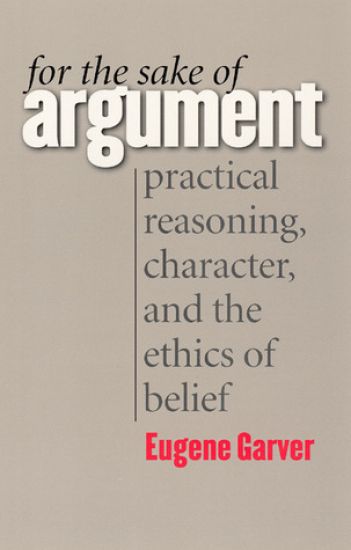
For the Sake of Argument

For the Sake of Argument

Eugene Garver

University of Chicago Press
2004
nidottu
What role does reason play in our lives? What role should it play? And are claims to rationality liberating or oppressive? For the Sake of Argument addresses questions such as these to consider the relationship between thought and character. Eugene Garver brings Aristotle's Rhetoric to bear on practical reasoning to show how the value of such thinking emerges when members of communities deliberate together, persuade each other, and are persuaded by each other - that is to say, when they argue. Garver roots deliberation and persuasion in political friendship instead of a neutral, impersonal framework of justice. Through incisive readings of examples in modern legal and political history, from Brown v. Board of Education to the South African Truth and Reconciliation Commission, he demonstrates how acts of deliberation and persuasion foster friendship among individuals, leading to common action amid diversity. In an Aristotelian sense, there is a place for pathos and ethos in rational thought. Passion and character have as pivotal a role in practical reasoning as logic and language.
For the Sake of Argument

For the Sake of Argument

Eugene Garver

University of Chicago Press
2004
sidottu
What role does reason play in our lives? What role should it play? And are claims to rationality liberating or oppressive? For the Sake of Argument addresses questions such as these to consider the relationship between thought and character. Eugene Garver brings Aristotle's Rhetoric to bear on practical reasoning to show how the value of such thinking emerges when members of communities deliberate together, persuade each other, and are persuaded by each other - that is to say, when they argue. Garver roots deliberation and persuasion in political friendship instead of a neutral, impersonal framework of justice. Through incisive readings of examples in modern legal and political history, from Brown v. Board of Education to the South African Truth and Reconciliation Commission, he demonstrates how acts of deliberation and persuasion foster friendship among individuals, leading to common action amid diversity. In an Aristotelian sense, there is a place for pathos and ethos in rational thought. Passion and character have as pivotal a role in practical reasoning as logic and language.
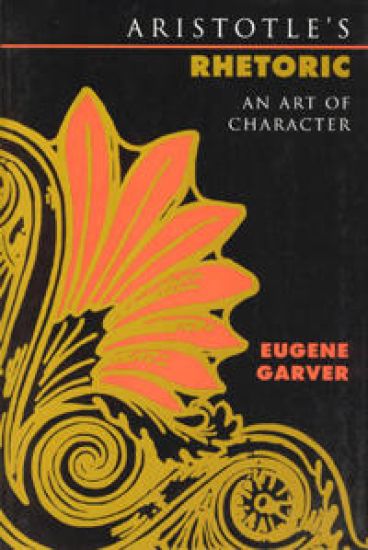
Aristotle's Rhetoric

Aristotle's Rhetoric

Eugene Garver

University of Chicago Press
1995
nidottu
In this contribution to philosophy and rhetoric, Eugene Garver shows how Aristotle integrates logic and virtue in his treatise, the "Rhetoric". Garver argues that Aristotle raises and answers a central question: can there be a civic art of rhetoric, an art that forms the character of citizens? By demonstrating the importance of the "Rhetoric" for understanding current philosophical problems of practical reason, virtue and character, Garver treats the "Rhetoric" as philosophy and connects its themes with parallel problems in Aristotle's "Ethics" and "Politics". Garver explores how Aristotle, instead of looking at the motives of rhetoricians or the effects of rhetorical practices, addresses the very activity of rhetoric and subjects it to rigorous rational analysis. On Aristotle's view, such rhetorical activities as giving advice, making policy decisions and persuading others in legal matters can be understood as artful, but not deceptive, activities in which the rhetorician brings to bear character, emotion and reason.