Kirjojen hintavertailu. Mukana 12 311 126 kirjaa ja 12 kauppaa.

Kirjailija

Eugene M. Izhikevich

Kirjat ja teokset yhdessä paikassa: 3 kirjaa, julkaisuja vuosilta 1997-2012, suosituimpien joukossa Weakly Connected Neural Networks. Vertaile teosten hintoja ja tarkista saatavuus suomalaisista kirjakaupoista.

3 kirjaa

Kirjojen julkaisuhaarukka 1997-2012.

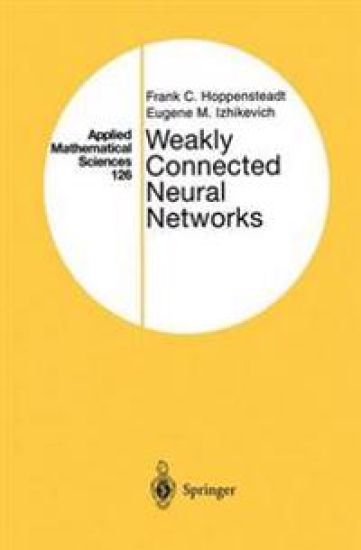
Weakly Connected Neural Networks

Weakly Connected Neural Networks

Frank C. Hoppensteadt; Eugene M. Izhikevich

Springer-Verlag New York Inc.
2012
nidottu
This book is devoted to an analysis of general weakly connected neural networks (WCNNs) that can be written in the form (0.1) m Here, each Xi E IR is a vector that summarizes all physiological attributes of the ith neuron, n is the number of neurons, Ii describes the dynam­ ics of the ith neuron, and gi describes the interactions between neurons. The small parameter € indicates the strength of connections between the neurons. Weakly connected systems have attracted much attention since the sec­ ond half of seventeenth century, when Christian Huygens noticed that a pair of pendulum clocks synchronize when they are attached to a light­ weight beam instead of a wall. The pair of clocks is among the first weakly connected systems to have been studied. Systems of the form (0.1) arise in formal perturbation theories developed by Poincare, Liapunov and Malkin, and in averaging theories developed by Bogoliubov and Mitropolsky.
Dynamical Systems in Neuroscience

Dynamical Systems in Neuroscience

Eugene M. Izhikevich

MIT Press
2010
pokkari
Explains the relationship of electrophysiology, nonlinear dynamics, and the computational properties of neurons, with each concept presented in terms of both neuroscience and mathematics and illustrated using geometrical intuition.In order to model neuronal behavior or to interpret the results of modeling studies, neuroscientists must call upon methods of nonlinear dynamics. This book offers an introduction to nonlinear dynamical systems theory for researchers and graduate students in neuroscience. It also provides an overview of neuroscience for mathematicians who want to learn the basic facts of electrophysiology.Dynamical Systems in Neuroscience presents a systematic study of the relationship of electrophysiology, nonlinear dynamics, and computational properties of neurons. It emphasizes that information processing in the brain depends not only on the electrophysiological properties of neurons but also on their dynamical properties. The book introduces dynamical systems, starting with one- and two-dimensional Hodgkin-Huxley-type models and continuing to a description of bursting systems. Each chapter proceeds from the simple to the complex, and provides sample problems at the end. The book explains all necessary mathematical concepts using geometrical intuition; it includes many figures and few equations, making it especially suitable for non-mathematicians. Each concept is presented in terms of both neuroscience and mathematics, providing a link between the two disciplines.Nonlinear dynamical systems theory is at the core of computational neuroscience research, but it is not a standard part of the graduate neuroscience curriculum-or taught by math or physics department in a way that is suitable for students of biology. This book offers neuroscience students and researchers a comprehensive account of concepts and methods increasingly used in computational neuroscience.An additional chapter on synchronization, with more advanced material, can be found at the author's website, www.izhikevich.com.
Weakly Connected Neural Networks

Weakly Connected Neural Networks

Frank C. Hoppensteadt; Eugene M. Izhikevich

Springer-Verlag New York Inc.
1997
sidottu
This book is devoted to an analysis of general weakly connected neural networks (WCNNs) that can be written in the form (0.1) m Here, each Xi E IR is a vector that summarizes all physiological attributes of the ith neuron, n is the number of neurons, Ii describes the dynam­ ics of the ith neuron, and gi describes the interactions between neurons. The small parameter € indicates the strength of connections between the neurons. Weakly connected systems have attracted much attention since the sec­ ond half of seventeenth century, when Christian Huygens noticed that a pair of pendulum clocks synchronize when they are attached to a light­ weight beam instead of a wall. The pair of clocks is among the first weakly connected systems to have been studied. Systems of the form (0.1) arise in formal perturbation theories developed by Poincare, Liapunov and Malkin, and in averaging theories developed by Bogoliubov and Mitropolsky.