Kirjojen hintavertailu. Mukana 12 595 353 kirjaa ja 12 kauppaa.

Kirjailija

Eugene O'Riordan

Kirjat ja teokset yhdessä paikassa: 3 kirjaa, julkaisuja vuosilta 2000-2019, suosituimpien joukossa Robust Computational Techniques for Boundary Layers. Vertaile teosten hintoja ja tarkista saatavuus suomalaisista kirjakaupoista.

3 kirjaa

Kirjojen julkaisuhaarukka 2000-2019.

Robust Computational Techniques for Boundary Layers

Robust Computational Techniques for Boundary Layers

Paul Farrell; Alan Hegarty; John M. Miller; Eugene O'Riordan; Grigory I. Shishkin

CRC Press
2019
nidottu
Current standard numerical methods are of little use in solving mathematical problems involving boundary layers. In Robust Computational Techniques for Boundary Layers, the authors construct numerical methods for solving problems involving differential equations that have non-smooth solutions with singularities related to boundary layers. They present a new numerical technique that provides precise results in the boundary layer regions for the problems discussed in the book. They show that this technique can be adapted in a natural way to a real flow problem, and that it can be used to construct benchmark solutions for comparison with solutions found using other numerical techniques. Focusing on robustness, simplicity, and wide applicability rather than on optimality, Robust Computational Techniques for Boundary Layers provides readers with an understanding of the underlying principles and the essential components needed for the construction of numerical methods for boundary layer problems. It explains the fundamental ideas through physical insight, model problems, and computational experiments and gives details of the linear solvers used in the computations so that readers can implement the methods and reproduce the numerical results.
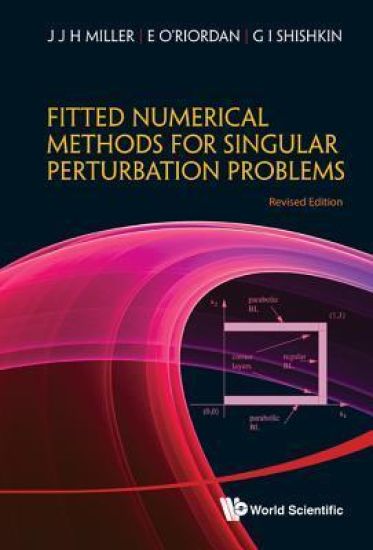
Fitted Numerical Methods For Singular Perturbation Problems: Error Estimates In The Maximum Norm For Linear Problems In One And Two Dimensions (Revised Edition)
Since the first edition of this book, the literature on fitted mesh methods for singularly perturbed problems has expanded significantly. Over the intervening years, fitted meshes have been shown to be effective for an extensive set of singularly perturbed partial differential equations. In the revised version of this book, the reader will find an introduction to the basic theory associated with fitted numerical methods for singularly perturbed differential equations. Fitted mesh methods focus on the appropriate distribution of the mesh points for singularly perturbed problems. The global errors in the numerical approximations are measured in the pointwise maximum norm. The fitted mesh algorithm is particularly simple to implement in practice, but the theory of why these numerical methods work is far from simple. This book can be used as an introductory text to the theory underpinning fitted mesh methods.
Robust Computational Techniques for Boundary Layers

Robust Computational Techniques for Boundary Layers

Paul Farrell; Alan Hegarty; John M. Miller; Eugene O'Riordan; Grigory I. Shishkin

Chapman Hall/CRC
2000
sidottu
Current standard numerical methods are of little use in solving mathematical problems involving boundary layers. In Robust Computational Techniques for Boundary Layers, the authors construct numerical methods for solving problems involving differential equations that have non-smooth solutions with singularities related to boundary layers. They present a new numerical technique that provides precise results in the boundary layer regions for the problems discussed in the book. They show that this technique can be adapted in a natural way to a real flow problem, and that it can be used to construct benchmark solutions for comparison with solutions found using other numerical techniques. Focusing on robustness, simplicity, and wide applicability rather than on optimality, Robust Computational Techniques for Boundary Layers provides readers with an understanding of the underlying principles and the essential components needed for the construction of numerical methods for boundary layer problems. It explains the fundamental ideas through physical insight, model problems, and computational experiments and gives details of the linear solvers used in the computations so that readers can implement the methods and reproduce the numerical results.