Kirjojen hintavertailu. Mukana 12 657 676 kirjaa ja 12 kauppaa.
Kirjailija
Eugene Thacker
Kirjat ja teokset yhdessä paikassa: 23 kirjaa, julkaisuja vuosilta 2004-2025, suosituimpien joukossa I denne planets støv. Vertaile teosten hintoja ja tarkista saatavuus suomalaisista kirjakaupoista.
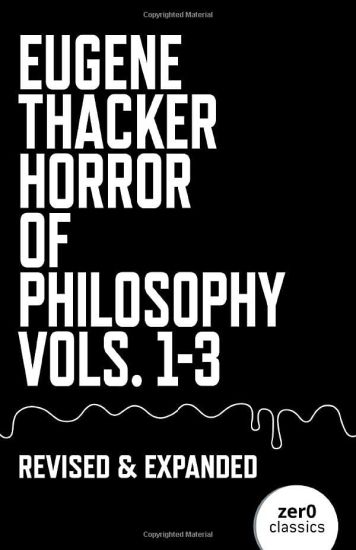
Zer0 Books presents a new, omnibus edition of a cult classic: all three volumes of Eugene Thacker?s Horror of Philosophy?trilogy, revised and expanded by the author. Across the three volumes of the series Thacker adopts a unique approach, reading works of horror as if they were philosophy, and works of philosophy as if they were horror, leading to far-reaching questions: Could it be that the more we know about the world, the less we understand it? Could it be that, while everything has been explained, nothing has meaning? At the center of Thacker?s project is the idea of the 'world without us,'?an increasingly unthinkable world of planetary disasters, emerging pandemics, and the looming threat of extinction. To confront this idea is to confront the limit of our ability to understand the world in which we live -?not a philosophy of horror, but a horror of philosophy.
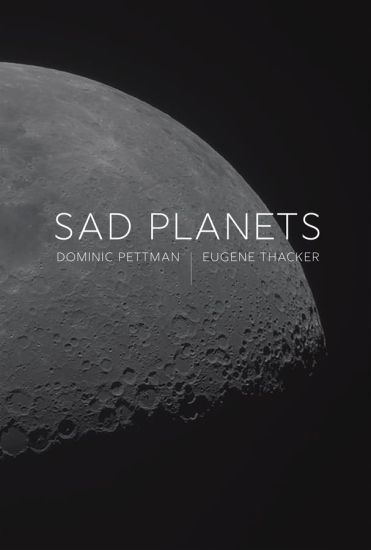
“Everything is sad,” wrote the Ancient poets. But is this sadness merely a human experience, projected onto the world, or is there a gloom attributable to the world itself? Could the universe be forever weeping the “tears of things”? In this series of meditations, Dominic Pettman and Eugene Thacker explore some of the key “negative affects” – both eternal and emergent – associated with climate change, environmental destruction, and cosmic solitude. In so doing they unearth something so obvious that it has gone largely unnoticed: the question of how we should feel about climate change. Between the information gathered by planetary sensors and the simple act of breathing the air, new unsettling moods are produced for which we currently lack an adequate language. Should we feel grief over the loss of our planet? Or is the strange feeling of witnessing mass extinction an indicator that the planet was never “ours” to begin with? Sad Planets explores this relationship between our all-too-human melancholia and a more impersonal sorrow, nestled in the heart of the cosmic elements.Spanning a wide range of topics – from the history of cosmology to the “existential threat” of climate change – this book is a reckoning with the limits of human existence and comprehension. As Pettman and Thacker observe, never before have we known so much about the planet and the cosmos, and yet never before have we felt so estranged from that same planet, to say nothing of the stars beyond.
“Everything is sad,” wrote the Ancient poets. But is this sadness merely a human experience, projected onto the world, or is there a gloom attributable to the world itself? Could the universe be forever weeping the “tears of things”? In this series of meditations, Dominic Pettman and Eugene Thacker explore some of the key “negative affects” – both eternal and emergent – associated with climate change, environmental destruction, and cosmic solitude. In so doing they unearth something so obvious that it has gone largely unnoticed: the question of how we should feel about climate change. Between the information gathered by planetary sensors and the simple act of breathing the air, new unsettling moods are produced for which we currently lack an adequate language. Should we feel grief over the loss of our planet? Or is the strange feeling of witnessing mass extinction an indicator that the planet was never “ours” to begin with? Sad Planets explores this relationship between our all-too-human melancholia and a more impersonal sorrow, nestled in the heart of the cosmic elements.Spanning a wide range of topics – from the history of cosmology to the “existential threat” of climate change – this book is a reckoning with the limits of human existence and comprehension. As Pettman and Thacker observe, never before have we known so much about the planet and the cosmos, and yet never before have we felt so estranged from that same planet, to say nothing of the stars beyond.
Verden er i stigende grad utænkelig – en verden med globale katastrofer, nye pandemier, tektoniske skift, mærkeligt vejr, oliedækkede havflader og den dunkle og konstant lurende trussel om udryddelse. Trods vores dagligdags bekymringer, behov og ønsker bliver det stadig sværere at forstå den verden, vi lever i og er del af. At stå over for denne tanke er at stå over for en absolut grænse for vores evne til i det hele taget at få en fyldestgørende forståelse af verden. Sådan indleder Eugene Thacker I denne planets støv – der netop undersøger den menneskelige tankes grænse; hvordan tænker vi det utænkelige? Gennem dæmonologi, okkultisme, mystik og genren overnaturlig horror samt filosofisk nihilisme og pessimisme undersøger Thacker filosofiens rædsel: At vi mennesker lever på et støvkorn i et uendeligt kosmos, på en planet uden mening og i en verden, der dybest set er indifferent i forhold til menneskets behov, håb og kampe. Eugene Thacker er filosof, digter og professor i mediestudier ved The New School i New York. Han kaldes kosmisk pessimist og hans arbejde kan associeres med den spekulative realisme.
The author of the contemporary classic, In the Dust of This Planet, is back with another raw and unsettling look at the human condition. Comprised of aphorisms, fragments, and observations both philosophical and personal, Thacker’s new book traces the contours of pessimism, caught as it often is between a philosophical position and a bad attitude. Reflecting on the universe’s “looming abyss of indifference,” Thacker explores the pessimism of a range of philosophers, from the well-known (Nietzsche, Schopenhauer, Camus), to the lesser-known (E.M. Cioran, Lev Shestov, Miguel de Unamuno). Readers will find food for thought in Thacker’s handling of a range of themes in Christianity and Buddhism, as well as his engagement with literary figures (from Dostoevsky to Thomas Bernhard, Osamu Dazai, and Fernando Pessoa), whose pessimism about the world both inspires and depresses Thacker. By turns melancholic, misanthropic, and darkly funny, (“Birth is a metaphysical injury — healing takes time — the span of one's life”), many will find Infinite Resignation a welcome antidote to the exuberant imbecility of our times.
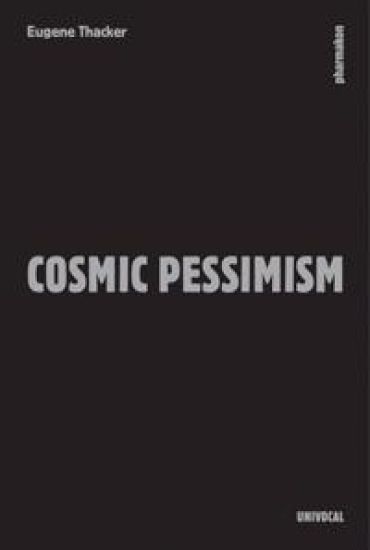
“We’re doomed.” So begins the work of the philosopher whose unabashed and aphoristic indictments of the human condition have been cropping up recently in popular culture. Today we find ourselves in an increasingly inhospitable world that is, at the same time, starkly indifferent to our species-specific hopes, desires, and disappointments. In the Anthropocene, pessimism is felt everywhere but rarely given its proper place. Though pessimism may be, as Eugene Thacker says, the lowest form of philosophy, it may also contain an enigma central to understanding the horizon of the human. Written in a series of fragments, aphorisms, and prose poems, Thacker’s Cosmic Pessimism explores the varieties of pessimism and its often-conflicted relation to philosophy. “Crying, laughing, sleeping-what other responses are adequate to a life that is so indifferent?”
Our contemporary horror stories are written in a world where there seems little faith, lost hope, and no salvation. All that remains is the fragmentary and occasionally lyrical testimony of the human being struggling to confront its lack of reason for being in the vast cosmos. This is the terrain of the horror genre. Eugene Thacker explores this situation in Tentacles Longer Than Night. Extending the ideas presented in his book In The Dust of This Planet, Thacker considers the relationship between philosophy and the horror genre. But instead of taking fiction as the mere illustration of ideas, Thacker reads horror stories as if they themselves were works of philosophy, driven by a speculative urge to question human knowledge and the human-centric view of the world, ultimately leading to the limit of the human-thought undermining itself, in thought. Tentacles Longer Than Night is the third volume of the "Horror of Philosophy" trilogy, together with the first volume, In The Dust of This Planet, and the second volume, Starry Speculative Corpse.
Could it be that the more we know about the world, the less we understand it? Could it be that, while everything has been explained, nothing has meaning? Extending the ideas presented in his book In The Dust of This Planet, Eugene Thacker explores these and other issues in Starry Speculative Corpse. But instead of using philosophy to define or to explain the horror genre, Thacker reads works of philosophy as if they were horror stories themselves, revealing a rift between human beings and the unhuman world of which they are part. Along the way we see philosophers grappling with demons, struggling with doubt, and wrestling with an indifferent cosmos. At the center of it all is the philosophical drama of the human being confronting its own limits. Not a philosophy of horror, but a horror of philosophy. Thought that stumbles over itself, as if at the edge of an abyss. Starry Speculative Corpse is the second volume of the "Horror of Philosophy" trilogy, together with the first volume, In The Dust of This Planet, and the third volume, Tentacles Longer Than Night.
How does our fascination with technology intersect with the religious imagination? InTechGnosis a cult classic now updated and reissued with a new afterword Erik Davis argues that while the realms of the digital and the spiritual may seem worlds apart, esoteric and religious impulses have in fact always permeated (and sometimes inspired) technological communication. Davis uncovers startling connections between such seemingly disparate topics as electricity and alchemy; online roleplaying games and religious and occult practices; virtual reality and gnostic mythology; programming languages and Kabbalah. The final chapters address the apocalyptic dreams that haunt technology, providing vital historical context as well as new ways to think about a future defined by the mutant intermingling of mind and machine, nightmare and fantasy."
"Only a monster can allow himself the luxury of seeing things as they are," writes E. M. Cioran, the Romanian-born philosopher who has rightly been compared to Samuel Beckett. In History and Utopia, Cioran the monster writes of politics in its broadest sense, of history, and of the utopian dream. His views are, to say the least, provocative. In one essay he casts a scathing look at democracy, that "festival of mediocrity"; in another he turns his uncompromising gaze on Russia, its history, its evolution, and what he calls "the virtues of liberty." In the dark shadow of Stalin and Hitler, he writes of tyrants and tyranny with rare lucidity and convincing logic. In "Odyssey of Rancor," he examines the deep-rooted dream in all of us to "hate our neighbors," to take immediate and irremediable revenge. And, in the final essay, he analyzes the notion of the "golden age," the biblical Eden, the utopia of so many poets and thinkers.
Always connect - that is the imperative of today's media. But what about those moments when media cease to function properly, when messages go beyond the sender and receiver to become excluded from the world of communication itself - those messages that state: "There will be no more messages"? In this book, Alexander R. Galloway, Eugene Thacker, and McKenzie Wark turn our usual understanding of media on its head by arguing that these moments reveal the ways the impossibility of communication is integral to communication itself - instances they call excommunication. In three linked essays, Excommunication pursues this elusive topic by looking at mediation in the face of banishment, exclusion, and heresy, and by contemplating the possibilities of communication with the great beyond. First, Galloway proposes an original theory of mediation based on classical literature and philosophy, using Hermes, Iris, and the Furies to map out three of the most prevalent modes of mediation today-mediation as exchange, as illumination, and as network. Then, Thacker goes boldly beyond Galloway's classification scheme by examining the concept of excommunication through the secret link between the modern horror genre and medieval mysticism. Finally, Wark evokes the poetics of the infuriated swarm as a queer politics of heresy that deviates from both media theory and the traditional left. Reexamining commonplace definitions of media, mediation, and communication, Excommunication offers a glimpse into the realm of the nonhuman to find a theory of mediation adequate to our present condition.
Always connect - that is the imperative of today's media. But what about those moments when media cease to function properly, when messages go beyond the sender and receiver to become excluded from the world of communication itself - those messages that state: "There will be no more messages"? In this book, Alexander R. Galloway, Eugene Thacker, and McKenzie Wark turn our usual understanding of media on its head by arguing that these moments reveal the ways the impossibility of communication is integral to communication itself - instances they call excommunication. In three linked essays, Excommunication pursues this elusive topic by looking at mediation in the face of banishment, exclusion, and heresy, and by contemplating the possibilities of communication with the great beyond. First, Galloway proposes an original theory of mediation based on classical literature and philosophy, using Hermes, Iris, and the Furies to map out three of the most prevalent modes of mediation today-mediation as exchange, as illumination, and as network. Then, Thacker goes boldly beyond Galloway's classification scheme by examining the concept of excommunication through the secret link between the modern horror genre and medieval mysticism. Finally, Wark evokes the poetics of the infuriated swarm as a queer politics of heresy that deviates from both media theory and the traditional left. Reexamining commonplace definitions of media, mediation, and communication, Excommunication offers a glimpse into the realm of the nonhuman to find a theory of mediation adequate to our present condition.
E. M. Cioran confronts the place of today's world in the context of human history—focusing on such major issues of the twentieth century as human progress, fanaticism, and science—in this nihilistic and witty collection of aphoristic essays concerning the nature of civilization in mid-twentieth-century Europe. Touching upon Man's need to worship, the feebleness of God, the downfall of the Ancient Greeks and the melancholy baseness of all existence, Cioran's pieces are pessimistic in the extreme, but also display a beautiful certainty that renders them delicate, vivid, and memorable. Illuminating and brutally honest, A Short History of Decay dissects Man's decadence in a remarkable series of moving and beautiful pieces.
In this collection of aphorisms and short essays, E.M. Cioran sets about the task of peeling off the layers of false realities with which society masks the truth. For him, real hope lies in this task, and thus, while he perceives the world darkly, he refuses to give in to despair. He hits upon this ultimate truth by developing his notion of human history and events as "a procession of delusions," striking out at the so-called "Fallacies of Hope." By examining the relationship between truth and action and between absolutes, unknowables, and frauds, Cioran comes out, for once, in favor of being.
Glossator: Practice and Theory of the CommentaryVolume 6 (2012) -Black MetalEditors: Nicola Masciandaro & Reza NegarestaniOf Plications: A Short Summa on the Nature of Cascadian Black Metal - Steven ShakespeareBlack Metal and the Mouth: Always Serving You as a Meal, or, Infected Orality, Pestilential Wounds and Scars - Aspasia StephanouThe Blackish Green of the Greenish Black, or, The Earth's Coruscating Darkness - Ben WoodardDay of Wrath - Eugene ThackerAppendix: Abstracts - Manabrata Guha, Reza Negarestani, Benjamin Noys, Zachary Price, James Trafford
Essays, articles, artworks, and documents taken from and inspired by the symposium on Reza Negarestani's Cyclonopedia: Complicity with Anonymous Materials, which took place in March 2011 at The New School. Hailed by novelists, philosophers, artists, cinematographers, and designers, Cyclonopedia is a key work in the emerging domains of speculative realism and theory-fiction. The text has attracted a wide-ranging and interdisciplinary audience, provoking vital debate around the relationship between philosophy, geopolitics, geophysics, and art. At once a work of speculative theology, a political samizdat, and a philosophic grimoire, Cyclonopedia is a Deleuzo-Lovecraftian middle-eastern Odyssey populated by archeologists, jihadis, oil smugglers, Delta Force officers, heresiarchs, and the corpses of ancient gods. Playing out the book's own theory of creativity - "a confusion in which no straight line can be traced or drawn between creator and created - original inauthenticity" - this multidimensional collection both faithfully interprets the text and realizes it as a loving, perforated host of fresh heresies. The volume includes an incisive contribution from the author explicating a key figure of the novel: the cyclone.CONTENTS: Robin Mackay, "A Brief History of Geotrauma" - McKenzie Wark, "An Inhuman Fiction of Forces" - Benjamin H. Bratton, "Root the Earth: On Peak Oil Apophenia" - Alisa Andrasek, "Dustism" - Zach Blas, "Queerness, Openness" - Melanie Doherty, "Non-Oedipal Networks and the Inorganic Unconscious" - Anthony Sciscione, "Symptomatic Horror: Lovecraft's 'The Colour Out of Space'" - Kate Marshall, "Cyclonopedia as Novel (a meditation on complicity as inauthenticity)" - Alexander R. Galloway, "What is a Hermeneutic Light?" - Eugene Thacker, "Black Infinity; or, Oil Discovers Humans" - Nicola Masciandaro, "Gourmandized in the Abattoir of Openness" - Dan Mellamphy & Nandita Biswas Mellamphy, "Phileas Fogg, or the Cyclonic Passepartout: On the Alchemical Elements of War" - Ben Woodard, "The Untimely (and Unshapely) Decomposition of Onto-Epistemological Solidity: Negarestani's Cyclonopedia as Metaphysics" - Ed Keller, ". . .Or, Speaking with the Alien, a Refrain. . ." - Lionel Maunz, "Receipt of Malice" - yk Tekten, "Symposium Photographs" - Reza Negarestani, "Notes on the Figure of the Cyclone"
"Thacker's discourse on the intersection of horror and philosophy is utterly original and utterly captivating..." Thomas Ligotti, author of The Conspiracy Against the Human Race The world is increasingly unthinkable, a world of planetary disasters, emerging pandemics, and the looming threat of extinction. In this book Eugene Thacker suggests that we look to the genre of horror as offering a way of thinking about the unthinkable world. To confront this idea is to confront the limit of our ability to understand the world in which we live - a central motif of the horror genre. In the Dust of This Planet explores these relationships between philosophy and horror. In Thacker's hands, philosophy is not academic logic-chopping; instead, it is the thought of the limit of all thought, especially as it dovetails into occultism, demonology, and mysticism. Likewise, Thacker takes horror to mean something beyond the focus on gore and scare tactics, but as the under-appreciated genre of supernatural horror in fiction, film, comics, and music.
Life is one of our most basic concepts, yet when examined directly it proves remarkably contradictory and elusive, encompassing both the broadest and the most specific phenomena. We can see this uncertainty about life in our habit of approaching it as something at once scientific and mystical, in the return of vitalisms of all types, and in the pervasive politicization of life. In short, life seems everywhere at stake and yet is nowhere the same. In "After Life", Eugene Thacker clears the ground for a new philosophy of life by recovering the twists and turns in its philosophical history. Beginning with Aristotle's originary formulation of a philosophy of life, Thacker examines the influence of Aristotle's ideas in medieval and early modern thought, leading him to the work of Immanuel Kant, who notes the inherently contradictory nature of 'life in itself'. Along the way, Thacker shows how early modern philosophy's engagement with the problem of life affects thinkers such as Gilles Deleuze, Georges Bataille, and Alain Badiou, as well as contemporary developments in the 'speculative turn' in philosophy. At a time when life is categorized, measured, and exploited in a variety of ways, "After Life" invites us to delve deeper into the contours and contradictions of the age-old question, 'what is life?'