
Kirjailija
Eugenia Cheng
Kirjat ja teokset yhdessä paikassa: 21 kirjaa, julkaisuja vuosilta 2016-2026, suosituimpien joukossa Unequal. Vertaile teosten hintoja ja tarkista saatavuus suomalaisista kirjakaupoista.
21 kirjaa
Kirjojen julkaisuhaarukka 2016-2026.

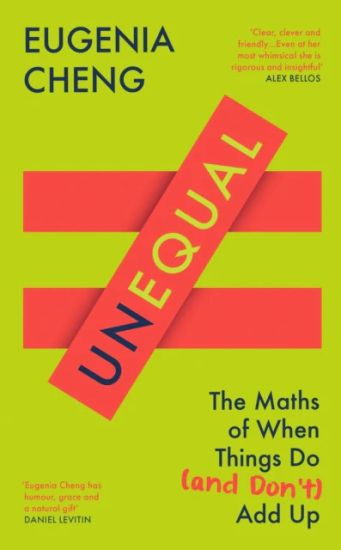
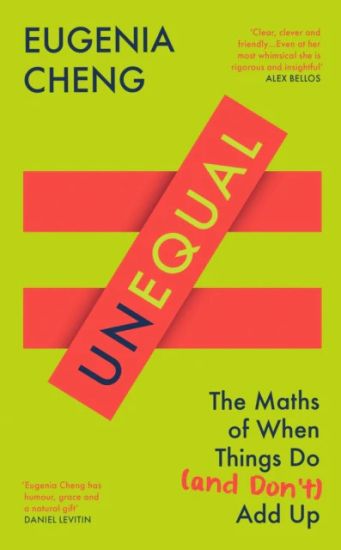
Why the familiar equal sign isn't just a marker of sameness but a gateway into math's--and humanity's--most profound questions Math is famous for its equations: 1 + 1 = 2, a 2 + b 2 = c 2, or y = mx + b. Much of the time it can seem like that's all mathematics is: following steps to show that what's on one side of an equation is the same as what's on the other. In Unequal, Eugenia Cheng shows that's just part of the story, and the boring part to boot. Mathematics isn't only about showing how numbers and symbols are the same. It isn't even just about numbers and symbols at all, but a world of shapes, symmetries, logical ideas, and more. And in that world, the boundary between things being equal and unequal is a gray area, or perhaps a rainbow of beautiful, vibrant, subtly nuanced color. As Unequal shows, once you go over that rainbow, almost everything can be considered equal and unequal at the same time, whether it's shapes (seen from the right perspective, a circle is the same as an ellipse), words (synonyms), or people--even numbers It all depends on what features we care about. And it's up to us what we do about it. That's because mathematics isn't a series of rules, facts, or answers. It's an invitation to a more powerful way of thinking.

Das Buch, von dem du dir wünschst, dein Mathe-Lehrer hätte es gelesen
Eugenia Cheng
C.H. BECK
2025
sidottu

Is Math Real?: How Simple Questions Lead Us to Mathematics' Deepest Truths
Eugenia Cheng
BASIC BOOKS
2025
nidottu
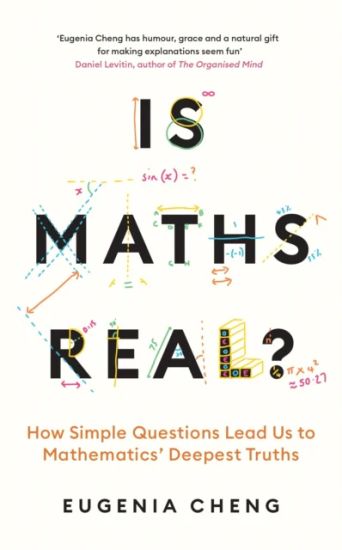
One of the world's most creative mathematicians offers a "brilliant" and "mesmerizing" (Popular Science) new way to look at math--focusing on questions, not answers Winner of the Los Angeles Times Book Prize and a New Scientist Best Book of the Year Where do we learn math: From rules in a textbook? From logic and deduction? Not really, according to mathematician Eugenia Cheng: we learn it from human curiosity--most importantly, from asking questions. This may come as a surprise to those who think that math is about finding the one right answer, or those who were told that the "dumb" question they asked just proved they were bad at math. But Cheng shows why people who ask questions like "Why does 1 + 1 = 2?" are at the very heart of the search for mathematical truth. Is Math Real? is a much-needed repudiation of the rigid ways we're taught to do math, and a celebration of the true, curious spirit of the discipline. Written with intelligence and passion, Is Math Real? brings us math as we've never seen it before, revealing how profound insights can emerge from seemingly unlikely sources.
One of the world's most creative mathematicians offers new ways to look at maths - focusing on questions, not answers
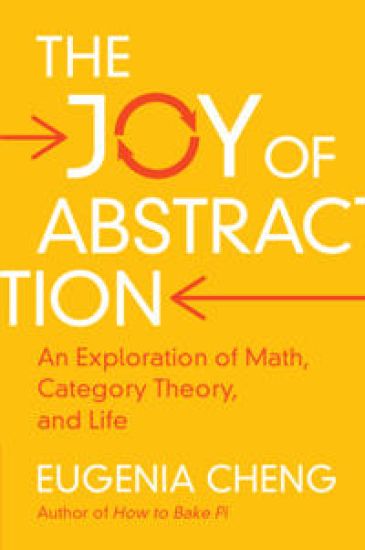
Mathematician and popular science author Eugenia Cheng is on a mission to show you that mathematics can be flexible, creative, and visual. This joyful journey through the world of abstract mathematics into category theory will demystify mathematical thought processes and help you develop your own thinking, with no formal mathematical background needed. The book brings abstract mathematical ideas down to earth using examples of social justice, current events, and everyday life – from privilege to COVID-19 to driving routes. The journey begins with the ideas and workings of abstract mathematics, after which you will gently climb toward more technical material, learning everything needed to understand category theory, and then key concepts in category theory like natural transformations, duality, and even a glimpse of ongoing research in higher-dimensional category theory. For fans of How to Bake Pi, this will help you dig deeper into mathematical concepts and build your mathematical background.

Is Math Real?: How Simple Questions Lead Us to Mathematics' Deepest Truths
Eugenia Cheng
BASIC BOOKS
2023
sidottu
One of the world's most creative mathematicians offers a "brilliant" and "mesmerizing" (Popular Science) new way to look at math--focusing on questions, not answers Winner of the Los Angeles Times Book Prize and a New Scientist Best Book of the Year Where do we learn math: From rules in a textbook? From logic and deduction? Not really, according to mathematician Eugenia Cheng: we learn it from human curiosity--most importantly, from asking questions. This may come as a surprise to those who think that math is about finding the one right answer, or those who were told that the "dumb" question they asked just proved they were bad at math. But Cheng shows why people who ask questions like "Why does 1 + 1 = 2?" are at the very heart of the search for mathematical truth. Is Math Real? is a much-needed repudiation of the rigid ways we're taught to do math, and a celebration of the true, curious spirit of the discipline. Written with intelligence and passion, Is Math Real? brings us math as we've never seen it before, revealing how profound insights can emerge from seemingly unlikely sources.
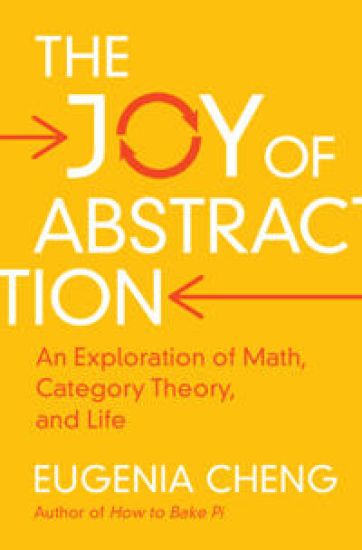
Mathematician and popular science author Eugenia Cheng is on a mission to show you that mathematics can be flexible, creative, and visual. This joyful journey through the world of abstract mathematics into category theory will demystify mathematical thought processes and help you develop your own thinking, with no formal mathematical background needed. The book brings abstract mathematical ideas down to earth using examples of social justice, current events, and everyday life – from privilege to COVID-19 to driving routes. The journey begins with the ideas and workings of abstract mathematics, after which you will gently climb toward more technical material, learning everything needed to understand category theory, and then key concepts in category theory like natural transformations, duality, and even a glimpse of ongoing research in higher-dimensional category theory. For fans of How to Bake Pi, this will help you dig deeper into mathematical concepts and build your mathematical background.

Aspiring bakers will embrace this charming picture book about baking pie by using simple math, from one of the world's most creative and celebrated mathematicians.X + Y are dreaming of baking infinite pie...But they don't know if infinite pie is real.With the help of quirky and uber-smart Aunt Z, a whole lot of flour and butter, X and Y will learn that by using math they can bake their way to success!This charming and tasty story from mathematician and author of How to Bake Pi, Eugenia Cheng, reassures young readers that math doesn't have to be scary-especially when paired with pie!Additional back matter includes: a letter from Eugenia encouraging readers not to be intimidated by math, explanations of the math concepts explored in the book, and a recipe for Banana Butterscotch Pie!
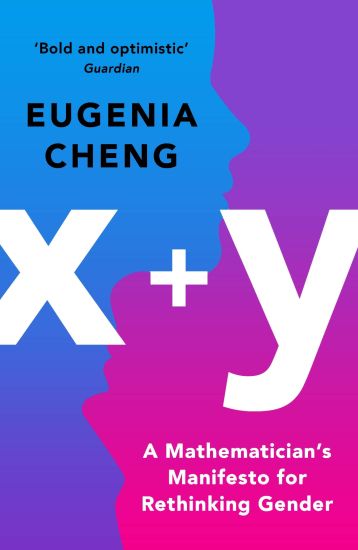
From imaginary numbers to the fourth dimension and beyond, mathematics has always been about imagining things that seem impossible at first glance. In x+y, Eugenia Cheng draws on the insights of higher-dimensional mathematics to reveal a transformative new way of talking about the patriarchy, mansplaining and sexism: a way that empowers all of us to make the world a better place. Using precise mathematical reasoning to uncover everything from the sexist assumptions that make society a harder place for women to live to the limitations of science and statistics in helping us understand the link between gender and society, Cheng's analysis replaces confusion with clarity, brings original thinking to well worn arguments - and provides a radical, illuminating and liberating new way of thinking about the world and women's place in it.
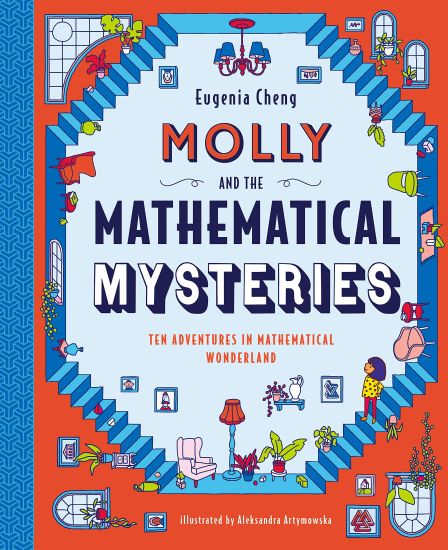
Molly and the Mathematical Mysteries: Ten Interactive Adventures in Mathematical Wonderland
Eugenia Cheng
Big Picture Press
2021
sidottu
Find the clues and lift the flaps on this mathematical mystery Join Molly as she ventures into a curious world where nothing is quite as it seems. A trail of clues leads from scene to scene, presenting Molly with a number of challenges. But who is leaving the clues, and where will they lead? This interactive mystery shows math isn't just about numbers--it's about imagination An explorative and creative approach to the world of mathematics.
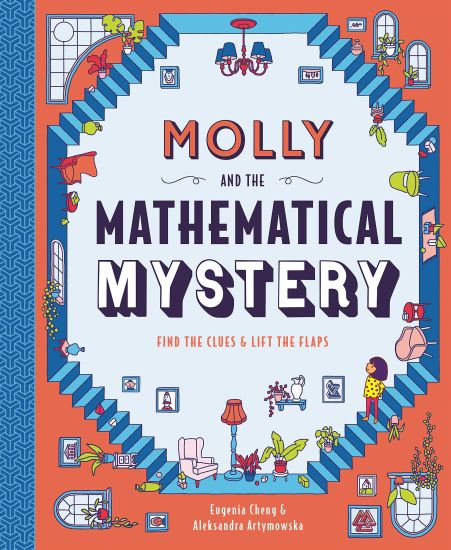
Join Molly as she ventures into a curious world where nothing is quite as it seems... A trail of clues lead from scene to scene, presenting Molly with a number of challenges. But who is leaving the clues and where will they lead? This interactive mystery shows maths isn't just about numbers and sums - its about imagination! An explorative and creative approach to the sometimes daunting topic of maths.

How both logical and emotional reasoning can help us live better in our post-truth world In a world where fake news stories change election outcomes, has rationality become futile? In The Art of Logic in an Illogical World, Eugenia Cheng throws a lifeline to readers drowning in the illogic of contemporary life. Cheng is a mathematician, so she knows how to make an airtight argument. But even for her, logic sometimes falls prey to emotion, which is why she still fears flying and eats more cookies than she should. If a mathematician can't be logical, what are we to do? In this book, Cheng reveals the inner workings and limitations of logic, and explains why alogic -- for example, emotion -- is vital to how we think and communicate. Cheng shows us how to use logic and alogic together to navigate a world awash in bigotry, mansplaining, and manipulative memes. Insightful, useful, and funny, this essential book is for anyone who wants to think more clearly.
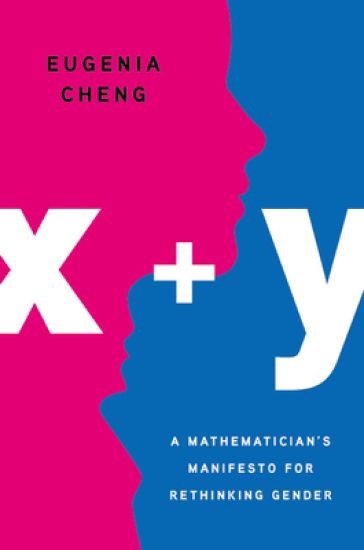
Shortlisted for the 2021 Phi Beta Kappa Book Award for Science One of NPR's Best Books of 2020 One of the Most Fascinating Books WIRED Read in 2020 A brilliant mathematician examines the complexity of gender and society and forges a path out of inequality. Why are men in charge? After years in the male-dominated field of mathematics and in the female-dominated field of art, Eugenia Cheng has heard the question many times. In x + y, Cheng argues that her mathematical specialty -- category theory -- reveals why. Category theory deals more with context, relationships, and nuanced versions of equality than with intrinsic characteristics. Category theory also emphasizes dimensionality: much as a cube can cast a square or diamond shadow, depending on your perspective, so too do gender politics appear to change with how we examine them. Because society often rewards traits that it associates with males, such as competitiveness, we treat the problems those traits can create as male. But putting competitive women in charge will leave many unjust relationships in place. If we want real change, we need to transform the contexts in which we all exist, and not simply who we think we are. Praise for Eugenia Cheng " Eugenia Cheng's] tone is clear, clever and friendly . . . she is rigorous and insightful. . . . She is] a lucid and nimble expositor."--- Alex Bellos, New York Times Book Review "Dr. Cheng . . . has a knack for brushing aside conventions and edicts, like so many pie crumbs from a cutting board."--- Natalie Angier, New York Times
For thousands of years, mathematicians have used the timeless art of logic to see the world more clearly. In The Art of Logic, Royal Society Science Book Prize nominee Eugenia Cheng shows how anyone can think like a mathematician - and see, argue and think better. Learn how to simplify complex decisions without over-simplifying them. Discover the power of analogies and the dangers of false equivalences. Find out how people construct misleading arguments, and how we can argue back. Eugenia Cheng teaches us how to find clarity without losing nuance, taking a careful scalpel to the complexities of politics, privilege, sexism and dozens of other real-world situations. Her Art of Logic is a practical and inspiring guide to decoding the modern world.
How both logical and emotional reasoning can help us live better in our post-truth world In a world where fake news stories change election outcomes, has rationality become futile? In The Art of Logic in an Illogical World, Eugenia Cheng throws a lifeline to readers drowning in the illogic of contemporary life. Cheng is a mathematician, so she knows how to make an airtight argument. But even for her, logic sometimes falls prey to emotion, which is why she still fears flying and eats more cookies than she should. If a mathematician can't be logical, what are we to do? In this book, Cheng reveals the inner workings and limitations of logic, and explains why alogic -- for example, emotion -- is vital to how we think and communicate. Cheng shows us how to use logic and alogic together to navigate a world awash in bigotry, mansplaining, and manipulative memes. Insightful, useful, and funny, this essential book is for anyone who wants to think more clearly.
Beyond Infinity: An Expedition to the Outer Limits of Mathematics
Eugenia Cheng
BASIC BOOKS
2018
nidottu
How one powerful concept reveals the biggest (and smallest) mathematical truths How big is the universe? How many numbers are there? And is infinity + 1 is the same as 1 + infinity? Such questions occur to young children and our greatest minds. And they are all the same question: What is infinity? In Beyond Infinity, Eugenia Cheng takes us on a staggering journey from elemental math to its loftiest abstractions. Along the way, she considers how to use a chessboard to plan a worldwide dinner party, how to make a chicken-sandwich sandwich, and how to create infinite cookies from a finite ball of dough. Beyond Infinity shows how one little symbol holds the biggest idea of all.
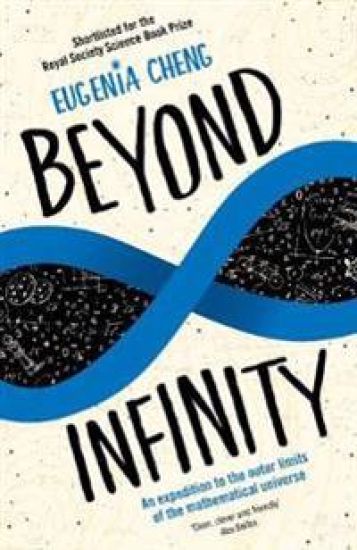
Even small children know there are infinitely many whole numbers - start counting and you'll never reach the end. But there are also infinitely many decimal numbers between zero and one. Are these two types of infinity the same? Are they larger or smaller than each other? Can we even talk about 'larger' and 'smaller' when we talk about infinity? In Beyond Infinity, international maths sensation Eugenia Cheng reveals the inner workings of infinity. What happens when a new guest arrives at your infinite hotel - but you already have an infinite number of guests? How does infinity give Zeno's tortoise the edge in a paradoxical foot-race with Achilles? And can we really make an infinite number of cookies from a finite amount of cookie dough? Wielding an armoury of inventive, intuitive metaphor, Cheng draws beginners and enthusiasts alike into the heart of this mysterious, powerful concept to reveal fundamental truths about mathematics, all the way from the infinitely large down to the infinitely small.
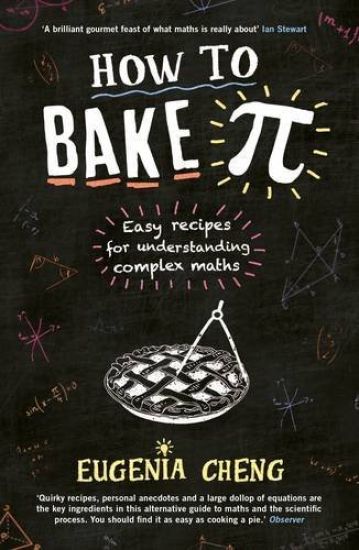
Möbius bagels, Euclid's flourless chocolate cake and apple pi - this is maths, but not as you know it. In How to Bake Pi, mathematical crusader and star baker Eugenia Cheng has rustled up a batch of delicious culinary insights into everything from simple numeracy to category theory ('the mathematics of mathematics'), via Fermat, Poincaré and Riemann. Maths is much more than simultaneous equations and pr2 : it is an incredibly powerful tool for thinking about the world around us. And once you learn how to think mathematically, you'll never think about anything - cakes, custard, bagels or doughnuts; not to mention fruit crumble, kitchen clutter and Yorkshire puddings - the same way again. Stuffed with moreish puzzles and topped with a generous dusting of wit and charm, How to Bake Pi is a foolproof recipe for a mathematical feast. *Previously published under the title Cakes, Custard & Category Theory*