Kirjojen hintavertailu. Mukana 12 309 950 kirjaa ja 12 kauppaa.

Kirjailija

Eve Gregory

Kirjat ja teokset yhdessä paikassa: 6 kirjaa, julkaisuja vuosilta 2000-2008, suosituimpien joukossa City Literacies. Vertaile teosten hintoja ja tarkista saatavuus suomalaisista kirjakaupoista.

6 kirjaa

Kirjojen julkaisuhaarukka 2000-2008.

Learning to Read in a New Language

Learning to Read in a New Language

Eve Gregory

SAGE Publications Inc
2008
sidottu
'[This book] is a helpful edition to a field where there is a limited amount of good literature to support teachers dealing with second language acquisition in the classroom' - ESCalate `Gregory's book is an important and timely contribution to the literature on literacy, biliteracy, second language learning and early childhood education, synthesizing cutting-edge research, perspectives and teaching approaches in a clear and accessible way. Overall, it is a terrific resource' - Dinah Volk Across the world, an increasing number of young children are learning to read in languages different from their mother tongue, and there is a clear need for a book which addresses the ways in which these children should be taught. Eve Gregory's book is unique in doing so. Building upon the ideas proposed in Making Sense of a New World, this second edition widens its scope, arguing for the limitations of policies designed for 'monolingual minds' in favour of methodologies which put plurilingualism at the centre of literacy tuition. This book offers a practical reading programme -- an 'Inside-Out' (starting from experience) and 'Outside-In' (starting from literature) approach to teaching which can be used with individuals, small groups and whole classes. It uses current sociocultural theory, while drawing on examples of children from America, Australia, Britain, China, France, Singapore, South Africa and Thailand who are engaged in learning to read nursery rhymes and songs, storybooks, letters, the Bible and the Qur'an as well as school texts, in languages they do not speak fluently. Gregory argues that, in order for literacy tuition to be successful, reading must make sense -- children must feel part of a community of readers. There is no common method which they use to learn, but rather a shared aim to which they aspire: making sense of a new world through new words. Eve Gregory is Professor of Language and Culture in Education at Goldsmiths, University of London.
Learning to Read in a New Language

Learning to Read in a New Language

Eve Gregory

SAGE Publications Inc
2008
nidottu
'[This book] is a helpful edition to a field where there is a limited amount of good literature to support teachers dealing with second language acquisition in the classroom' - ESCalate `Gregory's book is an important and timely contribution to the literature on literacy, biliteracy, second language learning and early childhood education, synthesizing cutting-edge research, perspectives and teaching approaches in a clear and accessible way. Overall, it is a terrific resource' - Dinah Volk Across the world, an increasing number of young children are learning to read in languages different from their mother tongue, and there is a clear need for a book which addresses the ways in which these children should be taught. Eve Gregory's book is unique in doing so. Building upon the ideas proposed in Making Sense of a New World, this second edition widens its scope, arguing for the limitations of policies designed for 'monolingual minds' in favour of methodologies which put plurilingualism at the centre of literacy tuition. This book offers a practical reading programme -- an 'Inside-Out' (starting from experience) and 'Outside-In' (starting from literature) approach to teaching which can be used with individuals, small groups and whole classes. It uses current sociocultural theory, while drawing on examples of children from America, Australia, Britain, China, France, Singapore, South Africa and Thailand who are engaged in learning to read nursery rhymes and songs, storybooks, letters, the Bible and the Qur'an as well as school texts, in languages they do not speak fluently. Gregory argues that, in order for literacy tuition to be successful, reading must make sense -- children must feel part of a community of readers. There is no common method which they use to learn, but rather a shared aim to which they aspire: making sense of a new world through new words. Eve Gregory is Professor of Language and Culture in Education at Goldsmiths, University of London.
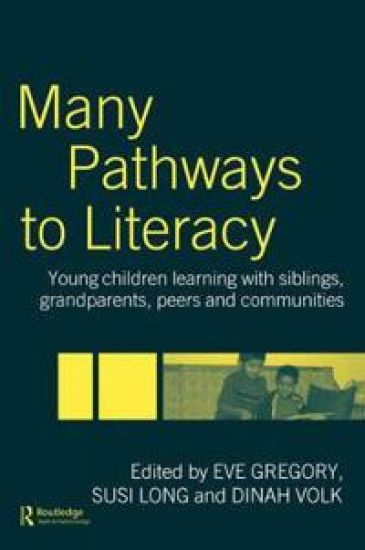
Many Pathways to Literacy

Many Pathways to Literacy

Eve Gregory; Susi Long; Dinah Volk

Routledge
2004
nidottu
This unique and visionary text is a compilation of fascinating studies conducted in a variety of cross-cultural settings where children learn language and literacy with siblings, grandparents, peers and community members. Focusing on the knowledge and skills of children often invisible to educators, these illuminating studies highlight how children skilfully draw from their varied cultural and linguistic worlds to make sense of new experiences.The vastly experienced team of contributors provide powerful demonstrations of the generative activity of young children and their mediating partners - family members, peers, and community members - as they syncretise languages, literacies and cultural practices from varied contexts. Through studies grounded in home, school, community school, nursery and church settings, we see how children create for themselves radical forms of teaching and learning in ways that are not typically recognised, understood or valued in schools. This book will be invaluable reading for teachers, teacher educators, researchers and policy-makers who seek to understand the many pathways to literacy and use that knowledge to affect real change in schools.
Many Pathways to Literacy

Many Pathways to Literacy

Eve Gregory; Susi Long; Dinah Volk

Routledge
2004
sidottu
This unique and visionary text is a compilation of fascinating studies conducted in a variety of cross-cultural settings where children learn language and literacy with siblings, grandparents, peers and community members. Focusing on the knowledge and skills of children often invisible to educators, these illuminating studies highlight how children skilfully draw from their varied cultural and linguistic worlds to make sense of new experiences.The vastly experienced team of contributors provide powerful demonstrations of the generative activity of young children and their mediating partners - family members, peers, and community members - as they syncretise languages, literacies and cultural practices from varied contexts. Through studies grounded in home, school, community school, nursery and church settings, we see how children create for themselves radical forms of teaching and learning in ways that are not typically recognised, understood or valued in schools. This book will be invaluable reading for teachers, teacher educators, researchers and policy-makers who seek to understand the many pathways to literacy and use that knowledge to affect real change in schools.
City Literacies

City Literacies

Eve Gregory; Ann Williams

Routledge
2000
sidottu
City Literacies explores the lives and literacies of different generations of people living in two contrasting areas of London at the end of the 20th century: Spitalfields and the City. This contrast outwardly symbolizes the huge difference between poverty and wealth existing in Britain at this time. The book presents a study of living, learning and reading as it has taken place in public settings, including the school classroom, clubs, places of worship, theatres, and in the home. Over fifty people recount their memories of learning to read in different contexts and circumstances.
City Literacies

City Literacies

Eve Gregory; Ann Williams

Routledge
2000
nidottu
City Literacies explores the lives and literacies of different generations of people living in two contrasting areas of London at the end of the 20th century: Spitalfields and the City. This contrast outwardly symbolizes the huge difference between poverty and wealth existing in Britain at this time. The book presents a study of living, learning and reading as it has taken place in public settings, including the school classroom, clubs, places of worship, theatres, and in the home. Over fifty people recount their memories of learning to read in different contexts and circumstances.