Kirjojen hintavertailu. Mukana 12 152 606 kirjaa ja 12 kauppaa.

Kirjailija

Eyal Lewin

Kirjat ja teokset yhdessä paikassa: 5 kirjaa, julkaisuja vuosilta 2011-2024, suosituimpien joukossa Patriotism. Vertaile teosten hintoja ja tarkista saatavuus suomalaisista kirjakaupoista.

5 kirjaa

Kirjojen julkaisuhaarukka 2011-2024.

Israeli Society

Israeli Society

Eyal Lewin

Universal Publishers
2024
pokkari
This work constitutes a groundbreaking contribution to the literature of Israel studies. It examines Israeli society's journey through 2023, highlighting its swift transformation from political fragmentation, turmoil, and civil unrest to national unity and complete mobilization. This sudden change that occurred on October 7, 2023, is described in a broader historical and cultural context. Readers of this groundbreaking work are treated to an in-depth analysis of the significant events of 2023, ranging from the legal and political implications of the announcement of judicial reform plans to the political disruptions that followed. Drawing on Jonathan Sacks's notion of a national covenant, David Ben-Gurion's concept of Halutzim, and Henri de Saint-Simon's ideas on avant-garde groups, this study makes sense of several seemingly incomprehensible aspects of recent events. This publication will enlighten those keen on exploring Israeli society and deciphering its complex behaviors across various temporal dimensions. Students, scholars, and educators alike will discover essential readings on pivotal Israel studies topics within its pages.
Warsaw and Jerusalem

Warsaw and Jerusalem

Nitza Davidovitch; Eyal Lewin

Brown Walker Press (FL)
2019
pokkari
Warsaw and Jerusalem deals with different aspects of the inherent paradoxes of Jewish-Polish relations. Written by scholars from Israel and from Poland, who study history, culture, education, and politics, this book forms a unique interdisciplinary collage. Thus, it has a twofold advantage: as an academic insight in the field of Jewish studies; and as a social bonder of an academic community that has its representatives in universities in Israel and in Poland. This project is bound to be an inspiring source for scholars of Jewish studies and Jewish history. In college or university classes, the collection of a variety of chapters will aid students who compose their assignments and need brainwave resources in the field. With a contribution to the deep comprehension of the ongoing discourse about historical as well as nowadays relations between Israel - that represents the Jewish people - and Poland, this book will also appeal to institutes that commemorate Jewish community life in Poland, particularly those who concentrate on Holocaust memorial and Holocaust studies. Many of these institutes aim to be centers where life before and after the Holocaust can be studied, and this book certainly falls within the framework of a resource-book for such cause. As opposed to other volumes in this field, this book forms - to a certain extent - a primary source. It talks less about Jewish culture or education from a scholarly examining angle, and prefers to present Jewish culture and education with a broad variety of examples. Additionally, it is highly updated, it tells the full story not only about pre-Holocaust Jewish culture in Poland, but also about current educational projects. All in all, it is not a stand-alone handbook for Jewish-Polish studies; but it can certainly function as an initial source-book for anyone who studies the subject.
Ethos Clash in Israeli Society

Ethos Clash in Israeli Society

Eyal Lewin

Lexington Books
2013
sidottu
The question of whether Israel is capable of coping with long-term warfare has long haunted scholars of Israel studies. This book tackles the question through a thorough analysis of the Israeli national ethos. The national ethos of a people is the integrating element that defines a nation's identity and bonds it into a coherent social group. However, in the Israeli case, two competing forms of national ethos threaten to tear society apart and weaken it: a republican ethos that cherishes the national group and a liberal ethos that puts the individual above all. In creating an account of Israel's ability to fight possible future wars, this book carefully examines these two competing forms of national ethos that create an ideological dichotomy in Israel. Each ethos has its reasoning, its inherent logic, its historic origins, and theories of social science that can explain the background for its development. This book offers a comprehensive analysis of each ethos that takes account of the environment, setting, and circumstances through which it ought to be understood. The deep inquiry into the dynamics of Israel's national ethos enables a new comprehension of the wobbliness of Israeli politics, and leads to certain conclusions about the fatal question that this book set out to find—whether Israel will eventually survive its international struggles or perish.
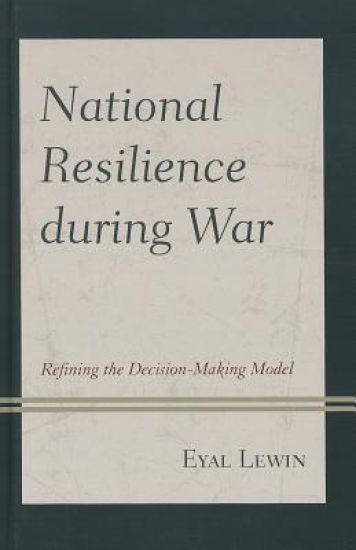
National Resilience during War

National Resilience during War

Eyal Lewin

Lexington Books
2012
sidottu
In political science, war is generally considered the most traumatic event a nation faces, often posing threats to a nation’s very existence. The challenge of surviving the war may, therefore, prove central to the life of a nation. However, national resilience during war has not yet been fully investigated. National Resilience during War: Refining the Decision-Making Model, by Eyal Lewin, searches for the mechanisms of national resilience through a deep inquiry into nine different case studies taken from the scenery of World War II. Following a multi-disciplinary attitude, a business management model is adopted (the PEST and SWOT model) and political, economic, social, and military-technological factors are analyzed for each of the case studies. The result is a comprehensive political decision-making model on a national level that can serve as a means for leaders to navigate successfully in geopolitical turbulence as well as for social scientists to better understand the defeats that different countries suffer and the victories that others demonstrate. This research, however, goes further by refining the model and pointing to the exact combination of factors that are crucial for a nation's ability to win its wars. Using a qualitative comparative analysis technique, the exact combination is traced. The results emphasize that the winning scheme blends political and social factors together: leadership, positive psychology and an inspiring national ethos prove to be a necessary, though not a sufficient, conditional combination for success. National Resilience during War fills a significant gap in the literature on the politics of war.