Kirjojen hintavertailu. Mukana 12 595 353 kirjaa ja 12 kauppaa.

Kirjailija

Ezio Faccioli

Kirjat ja teokset yhdessä paikassa: 5 kirjaa, julkaisuja vuosilta 2005-2020, suosituimpien joukossa The Messina Strait Bridge. Vertaile teosten hintoja ja tarkista saatavuus suomalaisista kirjakaupoista.

5 kirjaa

Kirjojen julkaisuhaarukka 2005-2020.

The Messina Strait Bridge

The Messina Strait Bridge

Fabio Brancaleoni; Giorgio Diana; Ezio Faccioli; Giuseppe Fiammenghi; Ian P.T. Firth; Niels J. Gimsing; Michele Jamiolkowski; Peter Sluszka; Giovanni Solari; Gianluca Valensise

CRC Press
2020
nidottu
This book describes the enormous depth of work carried out since the early 1970s on the Messina Strait Bridge, up to the recent award of the detailed design and construction contract. This important work has included extensive studies, concepts and design developments, with far reaching applications, which have all confirmed the feasibility of this huge endeavour and have led to the optimisation of costs and expected performance levels. Attention is focused not only on the design itself, but also on the context for the project (e.g. historical, geological, seismo-tectonic and wind conditions; structural and mechanical properties; project management and financial aspects; and environmental considerations), and on the great challenges involved. Thus, considering the innovations and specific solutions adopted in overcoming the challenges presented by constructing a world record span of 3,300 metres at this site, it becomes clear how the Messina Strait Crossing will take its place as a masterpiece in bridge engineering history.This book will be of interest to bridge and structural engineers, geotechnical and wind engineers, mechanical and earthquake engineers, graduate students in all these areas and all others with a broad interest in bridge design and engineering.
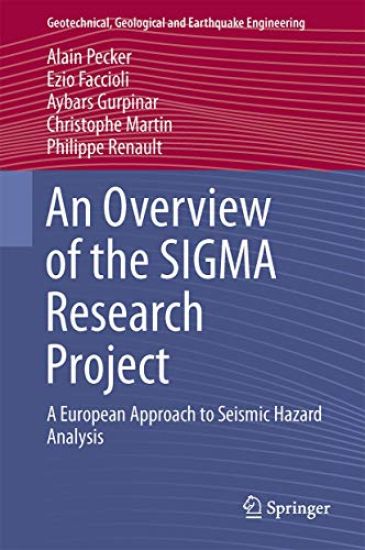
An Overview of the SIGMA Research Project

An Overview of the SIGMA Research Project

Alain Pecker; Ezio Faccioli; Aybars Gurpinar; Christophe Martin; Philippe Renault

Springer International Publishing AG
2018
nidottu
This book presents a summary of the important outcomes of the SIGMA project related to all aspects of Probabilistic Seismic Hazard Assessment: source characterization, rock motion characterization, site response characterization, and hazard calculations, with for all of them emphasis on the treatment of uncertainties. In recent years, attempts have been made to identify and quantify uncertainties in seismic hazard estimations for regions with moderate seismicity. These uncertainties, for which no estimation standards exist, create major difficulties and can lead to different interpretations and divergent opinions among experts. To address this matter, an international research project was launched in January 2011, by an industrial consortium composed of French and Italian organizations. This program, named SIGMA (Seismic Ground Motion Assessment) lasted for five years and involved a large number of international institutions.This book is intended for instructors running courses on engineering seismology, graduate students in the same field and practicing engineers involved in Probabilistic Seismic Hazard Analyses.
An Overview of the SIGMA Research Project

An Overview of the SIGMA Research Project

Alain Pecker; Ezio Faccioli; Aybars Gurpinar; Christophe Martin; Philippe Renault

Springer International Publishing AG
2017
sidottu
This book presents a summary of the important outcomes of the SIGMA project related to all aspects of Probabilistic Seismic Hazard Assessment: source characterization, rock motion characterization, site response characterization, and hazard calculations, with for all of them emphasis on the treatment of uncertainties. In recent years, attempts have been made to identify and quantify uncertainties in seismic hazard estimations for regions with moderate seismicity. These uncertainties, for which no estimation standards exist, create major difficulties and can lead to different interpretations and divergent opinions among experts. To address this matter, an international research project was launched in January 2011, by an industrial consortium composed of French and Italian organizations. This program, named SIGMA (Seismic Ground Motion Assessment) lasted for five years and involved a large number of international institutions.This book is intended for instructors running courses on engineering seismology, graduate students in the same field and practicing engineers involved in Probabilistic Seismic Hazard Analyses.
The Messina Strait Bridge

The Messina Strait Bridge

Fabio Brancaleoni; Giorgio Diana; Ezio Faccioli; Giuseppe Fiammenghi; Ian P.T. Firth; Niels J. Gimsing; Michele Jamiolkowski; Peter Sluszka; Giovanni Solari; Gianluca Valensise; Enzo Vullo

CRC Press
2009
sidottu
This book describes the enormous depth of work carried out since the early 1970s on the Messina Strait Bridge, up to the recent award of the detailed design and construction contract. This important work has included extensive studies, concepts and design developments, with far reaching applications, which have all confirmed the feasibility of this huge endeavour and have led to the optimisation of costs and expected performance levels. Attention is focused not only on the design itself, but also on the context for the project (e.g. historical, geological, seismo-tectonic and wind conditions; structural and mechanical properties; project management and financial aspects; and environmental considerations), and on the great challenges involved. Thus, considering the innovations and specific solutions adopted in overcoming the challenges presented by constructing a world record span of 3,300 metres at this site, it becomes clear how the Messina Strait Crossing will take its place as a masterpiece in bridge engineering history.This book will be of interest to bridge and structural engineers, geotechnical and wind engineers, mechanical and earthquake engineers, graduate students in all these areas and all others with a broad interest in bridge design and engineering.
Designer's Guide to EN 1998-1 and 1998-5

Designer's Guide to EN 1998-1 and 1998-5

Michael N Fardis; Eduardo Carvalho; Amr S Elnashai; Ezio Faccioli; Paolo Pinto; Andre Plumier; Haig Gulvanessian

Thomas Telford Ltd
2005
sidottu
This series of Designers Guides to the Eurocodes provides comprehensive guidance in the form of design aids, indications for the most convenient design procedures and worked examples. The books also include background information to aid the designer in understanding the reasoning behind and the objectives of the codes. All of the individual guides work in conjunction with the Designers’ Guide to EN1990 Eurocode: Basis of Structural Design. All aspects of seismic design are covered in Designers’ Guide to EN 1998-1 and 1998-5 Eurocode 8: Design provisions for earthquake resistant structures. General rules, seismic actions and rules for buildings, instead of being distributed across the Eurocodes on actions (EN 1991), design with specific materials (EN 1992 – 1996) or geographical design (EN 1997). This was for the convenience of countries with very low seismicity, as they may not need to apply Eurocode 8 at all. This present Designers’ Guide covers EN1998-1 (General Rules, seismic actions and rules for buildings) and EN1998-5 (Foundations, retaining structures, geotechnical aspects), both published by CEN at the end of 2004. These two parts of Eurocode 8 will be included, as service items, in all Eurocode packages (each package referring to a specific type of civil engineering structure and construction material) along with EN1990: Basis of Structural Design, EN1997: Geotechnical Design and the relevant parts of EN1991-1: Actions on Structures. The development of Eurocode 8 as the single seismic design code in Europe has been the focus of the European earthquake engineering community in the past twenty years. Its emergence as the European Standard is important not only for public safety in seismic southern regions of Europe, but also for competitiveness of the entire European consultancy and engineering services sector in seismic regions in Europe and beyond. This guide is essential reading for Civil and Structural EngineersCode-drafting committeesClientsStructural Design studentsPublic authorities Essentially, everyone who will be affected by the Eurocodes will find this book invaluable.