Kirjojen hintavertailu. Mukana 12 245 929 kirjaa ja 12 kauppaa.

Kirjailija

F. David Peat

Kirjat ja teokset yhdessä paikassa: 9 kirjaa, julkaisuja vuosilta 1979-2025, suosituimpien joukossa Science, Order and Creativity. Vertaile teosten hintoja ja tarkista saatavuus suomalaisista kirjakaupoista.

9 kirjaa

Kirjojen julkaisuhaarukka 1979-2025.

Science, Order and Creativity

Science, Order and Creativity

David Bohm; F. David Peat

Routledge
2016
sidottu
One of the foremost scientists and thinkers of our time, David Bohm worked alongside Oppenheimer and Einstein. In Science, Order and Creativity he and physicist F. David Peat propose a return to greater creativity and communication in the sciences. They ask for a renewed emphasis on ideas rather than formulae, on the whole rather than fragments, and on meaning rather than mere mechanics. Tracing the history of science from Aristotle to Einstein, from the Pythagorean theorem to quantum mechanics, the authors offer intriguing new insights into how scientific theories come into being, how to eliminate blocks to creativity and how science can lead to a deeper understanding of society, the human condition and the human mind itself. Science, Order and Creativity looks to the future of science with elegance, hope and enthusiasm.

Science, Order and Creativity

Science, Order and Creativity

David Bohm; F. David Peat

Routledge
2010
nidottu
One of the foremost scientists and thinkers of our time, David Bohm worked alongside Oppenheimer and Einstein. In Science, Order and Creativity he and physicist F. David Peat propose a return to greater creativity and communication in the sciences. They ask for a renewed emphasis on ideas rather than formulae, on the whole rather than fragments, and on meaning rather than mere mechanics. Tracing the history of science from Aristotle to Einstein, from the Pythagorean theorem to quantum mechanics, the authors offer intriguing new insights into how scientific theories come into being, how to eliminate blocks to creativity and how science can lead to a deeper understanding of society, the human condition and the human mind itself. Science, Order and Creativity looks to the future of science with elegance, hope and enthusiasm.
Science, Order and Creativity second edition

Science, Order and Creativity second edition

David Bohm; F. David Peat

Routledge
2000
nidottu
In Science, Order and Creativity, David Bohm and F. David Peat argue that science has lost its way in recent years and needs to go beyond a narrow and fragmented view of nature and embrace a wider holistic view that restores the importance of creativity and communication for all humanity - not just scientists. The result of a close collaboration by one of the 20th century's greatest physicists and thinkers, David Bohm, with leading science writer F. David Peat, provides a rare combination of profound reflection and clear exposition that can be appreciated by anyone concerned with science and its importance in our lives. This new edition includes a new preface and an extended additional chapter by Peat which draws upon further discussions with David Bohm before the latter's death in 1992. A fascinating diagnosis and considered proposal for a cure for science's ills, it is also very accessible entry point to the work of David Bohm. Bohm and Peat contend that science has lost its bearings in the last century in favour of a narrow, abstracted, fragmented approach to nature and reality. Tracing the history of science, Bohm and Peat offer intriguing new insights into how scientific theories come into being, how to eliminate blocks of creativity and how science can lead to a deeper understanding of society, the human condition and the human mind itself.
Science, Order and Creativity second edition

Science, Order and Creativity second edition

David Bohm; F. David Peat

Routledge
2000
sidottu
In Science, Order and Creativity, David Bohm and F. David Peat argue that science has lost its way in recent years and needs to go beyond a narrow and fragmented view of nature and embrace a wider holistic view that restores the importance of creativity and communication for all humanity - not just scientists. The result of a close collaboration by one of the 20th century's greatest physicists and thinkers, David Bohm, with leading science writer F. David Peat, provides a rare combination of profound reflection and clear exposition that can be appreciated by anyone concerned with science and its importance in our lives. This new edition includes a new preface and an extended additional chapter by Peat which draws upon further discussions with David Bohm before the latter's death in 1992. A fascinating diagnosis and considered proposal for a cure for science's ills, it is also very accessible entry point to the work of David Bohm. Bohm and Peat contend that science has lost its bearings in the last century in favour of a narrow, abstracted, fragmented approach to nature and reality. Tracing the history of science, Bohm and Peat offer intriguing new insights into how scientific theories come into being, how to eliminate blocks of creativity and how science can lead to a deeper understanding of society, the human condition and the human mind itself.
Gentle Action

Gentle Action

F. David Peat

Pari Publishing
2008
nidottu
How can we build a kinder world for our families, our businesses, our society and ourselves? "Gentle Action" explores ways in which we can exercise more effective, creative and non-invasive action from the local to the international level. The book is packed with examples of ways in which individuals and groups have totally transformed economies, societies and situations by means of gentle and creative actions. It also highlights those far-too-many cases in which well-meaning attempts to help or to provide aid have gone disastrously wrong; wrong because the organizations involved were over rigid, failed to understand the complexities involved and operated from 'outside the system'. This is an invaluable resource for everyone from CEOs, policy makers, community leaders, opinion makers, aid organizations, business groups, consultants and politicians as well as parents and indeed anyone who is trying to make a difference.
Infinite Potential

Infinite Potential

F. David Peat

Basic Books
1997
pokkari
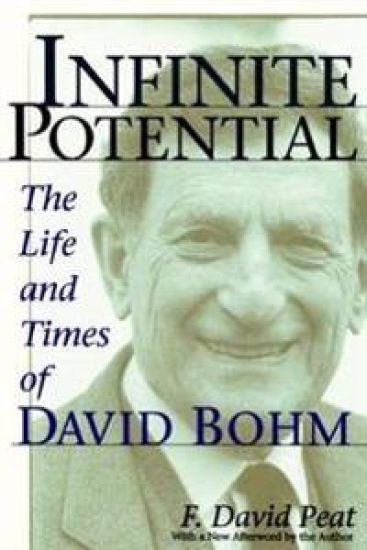
Infinite Potential is the first biography of David Bohm,brilliant physicist, explorer of consciousness, student of Oppenheimer, friend to Einstein, and enemy of the House Committee on Un-American Activities. Although he battled bouts of crippling depression, Bohm proved to be one of the twentieth century's most original thinkers, influencing the fields of physics, philosophy, psychology, language, and education. In this compelling narrative, David Peat explains Bohm's life and landmark scientific work, including his famous "hidden variables" causal interpretation of quantum mechanics, which created a storm of controversy, yet may well be the only theory that describes the true nature of reality.
Superstrings

Superstrings

F. David Peat

Abacus
1991
pokkari
Since Einstein, physicists have been pursuing a holy grail - a single theory that would order all the subatomic particles in the universe and unify the forces of nature. Such a theory would answer questions like: How did the universe begin? What is the origin of time? What is matter? What is the ultimate meaning of physical laws?F. David Peat explains the development and meaning of the theory they came up with - the Superstrings Theory - in a thoroughly readable, dramatic manner accessible to lay readers, even those with no knowledge of maths. The theory states that everything in the universe - matter, forces, even space itself - consists of minuscule strings of ten dimensions, six of which are so tightly curled up that only four are visible to us. The consequences of this theory are nothing less than astonishing.
A Question of Physics

A Question of Physics

Paul Buckley; F. David Peat

University of Toronto Press
1979
pokkari
This book contains interviews with physicists, biologists, and chemists who have been involved in some of the most exciting discoveries in modern scientific thought. The conversations-with Bohm, Pattee, Penrose, Rosen, Rosenfeld, Somorjai, WeizsÄcker, Wheeler, and Nobel prizewinners Heisenberg, Dirac, and Prigogine-explore issues which have shaped modern physics and those which hint at what may form the next scientific revolution. The discussions range over a set of basic problems in physical theory and their possible solutions-the understanding of space and time, quantum and relativity theories and recent attempts to unite them-and deal with related questions in theoretical biology. The approach is non-technical, with an emphasis on the assumptions of modern science and their implications for understanding the world we live in. The book, which originated in a highly successful radio series, provides a vivid first-hand account of some of the astounding and perplexing developments in modern science, a rare overview that will intrigue the informed non-scientist and the scientist alike.