
Kirjailija
F. W. J. Schelling
Kirjat ja teokset yhdessä paikassa: 31 kirjaa, julkaisuja vuosilta 1983-2025, suosituimpien joukossa Clara. Vertaile teosten hintoja ja tarkista saatavuus suomalaisista kirjakaupoista.
Mukana myös kirjoitusasut: F W J Schelling, F.W.J. Schelling
31 kirjaa
Kirjojen julkaisuhaarukka 1983-2025.
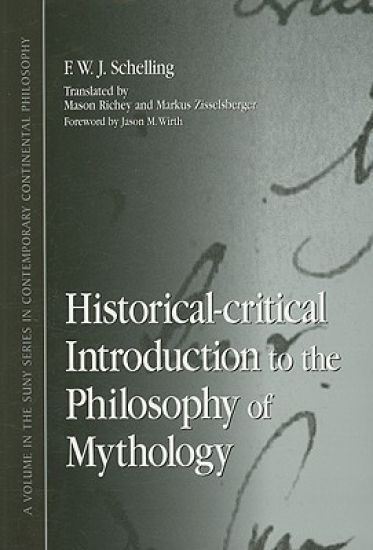
Historical-critical Introduction to the Philosophy of Mythology
F. W. J. Schelling; Jason M. Wirth
State University of New York Press
2008
pokkari
Appearing in English for the first time, Schelling's 1842 lectures develop the idea that many philosophical concepts are born of religious-mythological notions.Translated here into English for the first time, F. W. J. Schelling's 1842 lectures on the Philosophy of Mythology are an early example of interdisciplinary thinking. In seeking to show the development of the concept of the divine Godhead in and through various mythological systems (particularly of ancient Greece, Egypt, and the Near East), Schelling develops the idea that many philosophical concepts are born of religious-mythological notions. In so doing, he brings together the essential relatedness of the development of philosophical systems, human language, history, ancient art forms, and religious thought. Along the way, he engages in analyses of modern philosophical views about the origins of philosophy's conceptual abstractions, as well as literary and philological analyses of ancient literature and poetry.

Sets out an ordered system of the arts - music, painting, sculpture, narrative, poetry and tragedy - based on the precepts of German Idealism.
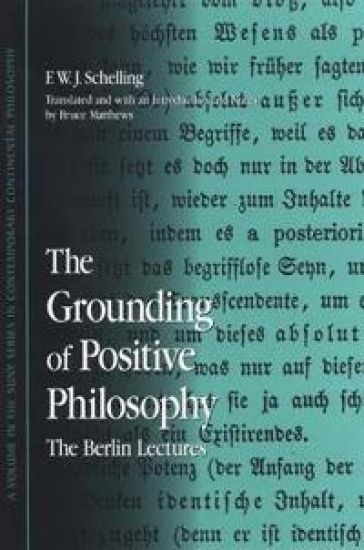
The Grounding of Positive Philosophy
F. W. J. Schelling
State University of New York Press
2007
sidottu
The first English translation of Schelling's final "existential system." The Berlin lectures in The Grounding of Positive Philosophy, appearing here for the first time in English, advance Schelling's final "existential system" as an alternative to modernity's reduction of philosophy to a purely formal science of reason. The onetime protégé of Fichte and benefactor of Hegel, Schelling accuses German Idealism of dealing "with the world of lived experience just as a surgeon who promises to cure your ailing leg by amputating it." Schelling's appeal in Berlin for a positive, existential philosophy found an interested audience in Kierkegaard, Engels, Feuerbach, Marx, and Bakunin. His account of the ecstatic nature of existence and reason proved to be decisive for the work of Paul Tillich and Martin Heidegger. Also, Schelling's critique of reason's quixotic attempt at self-grounding anticipates similar criticisms leveled by poststructuralism, but without sacrificing philosophy's power to provide a positive account of truth and meaning. The Berlin lectures provide fascinating insight into the thought processes of one of the most provocative yet least understood thinkers of nineteenth-century German philosophy.
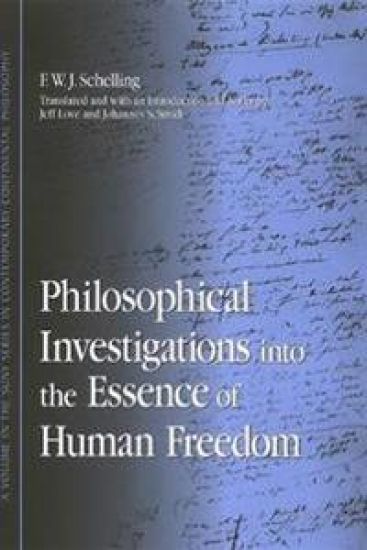
Philosophical Investigations into the Essence of Human Freedom
F. W. J. Schelling
State University of New York Press
2006
sidottu
Schelling's masterpiece investigating evil and freedom. Jeff Love and Johannes Schmidt offer a fresh translation of Schelling's enigmatic and influential masterpiece, widely recognized as an indispensable work of German Idealism. The text is an embarrassment of riches-both wildly adventurous and somberly prescient. Martin Heidegger claimed that it was "one of the deepest works of German and thus also of Western philosophy" and that it utterly undermined Hegel's monumental Science of Logic before the latter had even appeared in print. Schelling carefully investigates the problem of evil by building on Kant's notion of radical evil, while also developing an astonishingly original conception of freedom and personality that exerted an enormous (if subterranean) influence on the later course of European philosophy from Schopenhauer and Kierkegaard through Heidegger to important contemporary theorists like Slavoj Zðizûek. This translation of Schelling's notoriously difficult and densely allusive work provides extensive annotations and translations of a series of texts (by Boehme, Baader, Lessing, Jacobi, and Herder), hard to find or previously unavailable in English, whose presence in the Philosophical Investigations is unmistakable and highly significant. This handy study edition of Schelling's masterpiece will prove useful for scholars and students alike.

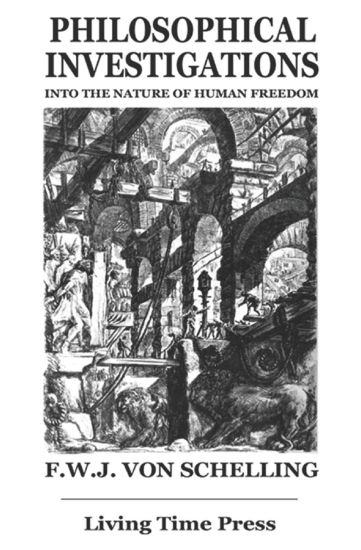
Philosophical Investigations into the Nature of Human Freedom
F. W. J. Schelling
Living Time Press
2002
nidottu

System of Transcendental Idealism is probably Schelling's most important philosophical work. A central text in the history of German idealism, its original German publication in 1800 came seven years after Fichte's ""Wissenschaftslehre"" and seven years before Hegel's ""Phenomenology of Spirit"". Translated into English for the first time in 1978, it is now being offered in paperback. Students of English literature should value this translation, since it was from this work of Schelling's that Coleridge ""borrowed"" extensively in his ""Biographia Literaria"". Schelling's philosophy of art, which forms the concluding section of the work, is also of cardinal importance to the intellectual history of the German Romantic movement.