

Kirjailija
Fania Oz-Salzberger
Kirjat ja teokset yhdessä paikassa: 5 kirjaa, julkaisuja vuosilta 1995-2024, suosituimpien joukossa Israelis in Berlin. Vertaile teosten hintoja ja tarkista saatavuus suomalaisista kirjakaupoista.
5 kirjaa
Kirjojen julkaisuhaarukka 1995-2024.


A celebrated novelist and an acclaimed historian of ideas, father and daughter, unravel the chain of words at the core of Jewish life, history, and culture Why are words so important to so many Jews? Novelist Amos Oz and historian Fania Oz-Salzberger roam the gamut of Jewish history to explain the integral relationship of Jews and words. Through a blend of storytelling and scholarship, conversation and argument, father and daughter tell the tales behind Judaism’s most enduring names, adages, disputes, texts, and quips. These words, they argue, compose the chain connecting Abraham with the Jews of every subsequent generation. Framing the discussion within such topics as continuity, women, timelessness, and individualism, Oz and Oz-Salzberger deftly engage Jewish personalities across the ages, from the unnamed, possibly female author of the Song of Songs through obscure Talmudists to contemporary writers. They suggest that Jewish continuity, even Jewish uniqueness, depends not on central places, monuments, heroic personalities, or rituals but rather on written words and an ongoing debate between the generations. Full of learning, lyricism, and humor, Jews and Words offers an extraordinary tour of the words at the heart of Jewish culture and extends a hand to the reader, any reader, to join the conversation.

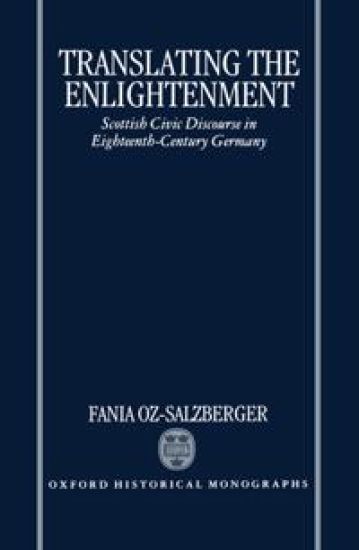
This is a study of the transmission of political ideas across languages and cultures, and in particular of a notably fruitful encounter between two distinct branches of eighteenth-century political discourse: the reception of Scottish civic ideas, developed most powerfully in the works of the Edinburgh historian-philosopher Adam Ferguson, by Geman intellectuals of the Enlightenment and Romantic eras. Fania Oz-Salzberger's detailed and challenging analysis places Ferguson in the context of the Scottish Enlightenment, and explores the impact of his theories on German Enlightenment thinkers. She traces the passage of Ferguson's civic humanism across linguistic and cultural borders, and highlights the linguistic stumbling-blocks and conceptual tensions that resulted. Dr Oz-Salzberger argues that there resulted a complex and largely unintentional shift of Scottish civic concepts into a German vocabulary of spiritual perfection and inner life, and that the misreading of Ferguson and other Scottish thinkers contributed much to the richness of German intellectual life in the late eighteenth and early nineteenth centuries.