
Kirjailija
Fareed Zakaria
Kirjat ja teokset yhdessä paikassa: 26 kirjaa, julkaisuja vuosilta 1998-2026, suosituimpien joukossa La Era de Las Revoluciones / Age of Revolutions. Vertaile teosten hintoja ja tarkista saatavuus suomalaisista kirjakaupoista.
26 kirjaa
Kirjojen julkaisuhaarukka 1998-2026.
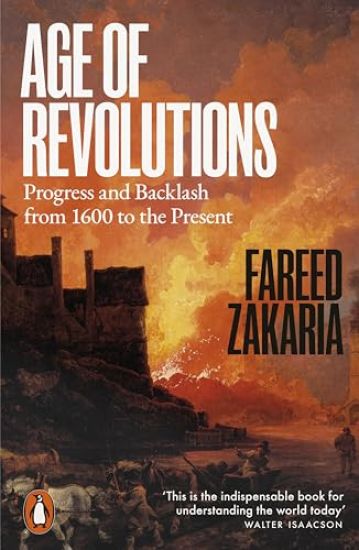
Fareed Zakaria first warned of the threat of “illiberal democracy” two decades ago. In Age of Revolutions: Progress and Backlash from 1600 to the Present, he sets our era of populist chaos into the sweep of history.Based on deep research and conversations with world leaders from Emmanuel Macron to Lee Kuan Yew, this book tells the story of progress and backlash, of the rise of classical liberalism and of the many periods of rage and counter-revolution that followed seismic change. From the Dutch Republic – the first modern republic, techno-superpower, and haven for liberalism almost snuffed out by force – and the French Revolution to the Industrial Revolution in Britain and the United States, it traces the rise of the world’s modern superpowers, the birth of the political divides we know today, and the ways in which technology unsettled society and caused backlash from those who felt threatened by this new world. Zakaria also details the revolutions that have convulsed our times: globalization in overdrive, digital transformation, the rise of identity politics, the return of great power politics with a vengeful Russia and an ascendant China, and the democratic decay at home which threatens the very foundations of the world built by the Enlightenment.The book warns us that liberalism’s great strength has been freeing people from arbitrary constraints – but its great weakness has been leaving individuals isolated, a void that can all too easily be filled by tribalism, populism, and identity politics. Today’s revolutions in technology and culture can even leave people so adrift that they turn against modernity itself.
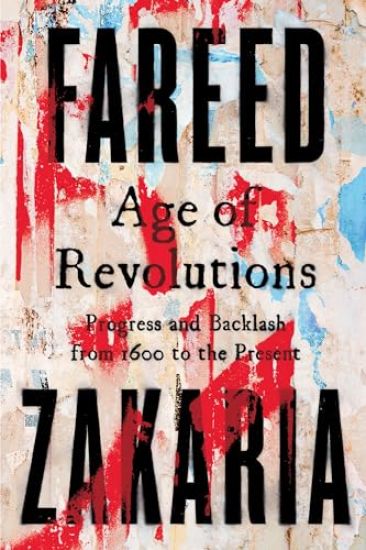
Age of Revolutions: Progress and Backlash from 1600 to the Present
Fareed Zakaria
W. W. Norton Company
2025
nidottu
Populist rage, ideological fracture, economic and technological shocks, war, and an international system studded with catastrophic risk--the early decades of the twenty-first century may be the most revolutionary period in modern history. But it is not the first. Humans have lived, and thrived, through more than one great realignment. What are these revolutions, and how can they help us to understand our fraught world?In this major work, Fareed Zakaria masterfully investigates the eras and movements that have shaken norms while shaping the modern world. Three such periods hold profound lessons for today. First, in the seventeenth-century Netherlands, a fascinating series of transformations made that tiny land the richest in the world--and created politics as we know it today. Next, the French Revolution, an explosive era that devoured its ideological children and left a bloody legacy that haunts us today. Finally, the mother of all revolutions, the Industrial Revolution, which catapulted Great Britain and the US to global dominance and created the modern world.Alongside these paradigm-shifting historical events, Zakaria probes four present-day revolutions: globalization, technology, identity, and geopolitics. For all their benefits, the globalization and technology revolutions have produced profound disruptions and pervasive anxiety and our identity. And increasingly, identity is the battlefield on which the twenty-first century's polarized politics are fought. All this is set against a geopolitical revolution as great as the one that catapulted the United States to world power in the late nineteenth century. Now we are entering a world in which the US is no longer the dominant power. As we find ourselves at the nexus of four seismic revolutions, we can easily imagine a dark future. But Zakaria proves that pessimism is premature. If we act wisely, the liberal international order can be revived and populism relegated to the ash heap of history.As few public intellectuals can, Zakaria combines intellectual range, deep historical insight, and uncanny prescience to once again reframe and illuminate our turbulent present. His bold, compelling arguments make this book essential reading in our age of revolutions.
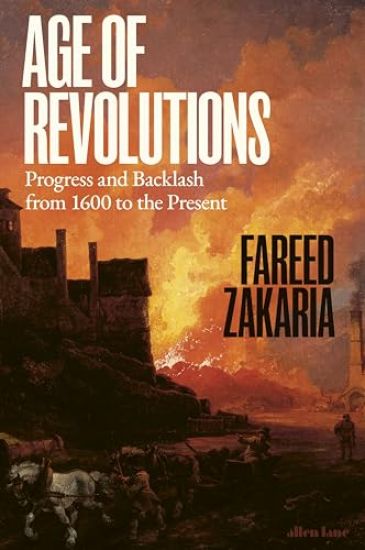
The international best-selling author explores the revolutions—past and present—that define the chaotic, polarized and unstable age in which we livePopulist rage, ideological fracture, economic and technological shocks, geopolitical dangers and an international system studded with catastrophic risk — the early decades of the 21st century may be one of the most revolutionary periods in modern history. But they are not the first. Humans have lived, and thrived, through more than one great realignment. What makes an age a revolutionary one? And how do they end?In this major new work, Fareed Zakaria masterfully investigates eras that have shattered and shaped humanity. Four such periods hold profound lessons for today. First, in seventeenth-century Netherlands a series of transformations made that tiny land the richest in thew world — and created modern politics as we know it today. The ‘Glorious Revolution’ in Britain showed that major political change could happen peacefully. Next, the French Revolution, a dramatic decade and a half that devoured its ideological children and left a bloody legacy that haunts us to this day. Finally, the mother of all revolutions, the Industrial Revolution, which catapulted Britain and the U.S. to global dominance and created the modern world. Against these paradigm-shifting historical eras, Zakaria describes our current situation, unpacking the four revolutions we are living through now; in globalization, technology, identity, and geopolitics.As few public intellectuals can, Zakaria combines intellectual range, deep historical insight, and uncanny prescience to reframe and illuminate a turbulent present.
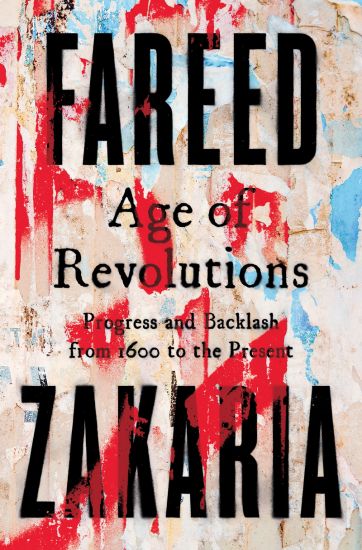
Age of Revolutions: Progress and Backlash from 1600 to the Present
Fareed Zakaria
W. W. Norton Company
2024
sidottu
Populist rage, ideological fracture, economic and technological shocks, war, and an international system studded with catastrophic risk--the early decades of the twenty-first century may be the most revolutionary period in modern history. But it is not the first. Humans have lived, and thrived, through more than one great realignment. What are these revolutions, and how can they help us to understand our fraught world?In this major work, Fareed Zakaria masterfully investigates the eras and movements that have shaken norms while shaping the modern world. Three such periods hold profound lessons for today. First, in the seventeenth-century Netherlands, a fascinating series of transformations made that tiny land the richest in the world--and created politics as we know it today. Next, the French Revolution, an explosive era that devoured its ideological children and left a bloody legacy that haunts us today. Finally, the mother of all revolutions, the Industrial Revolution, which catapulted Great Britain and the US to global dominance and created the modern world.Alongside these paradigm-shifting historical events, Zakaria probes four present-day revolutions: globalization, technology, identity, and geopolitics. For all their benefits, the globalization and technology revolutions have produced profound disruptions and pervasive anxiety and our identity. And increasingly, identity is the battlefield on which the twenty-first century's polarized politics are fought. All this is set against a geopolitical revolution as great as the one that catapulted the United States to world power in the late nineteenth century. Now we are entering a world in which the US is no longer the dominant power. As we find ourselves at the nexus of four seismic revolutions, we can easily imagine a dark future. But Zakaria proves that pessimism is premature. If we act wisely, the liberal international order can be revived and populism relegated to the ash heap of history.As few public intellectuals can, Zakaria combines intellectual range, deep historical insight, and uncanny prescience to once again reframe and illuminate our turbulent present. His bold, compelling arguments make this book essential reading in our age of revolutions.
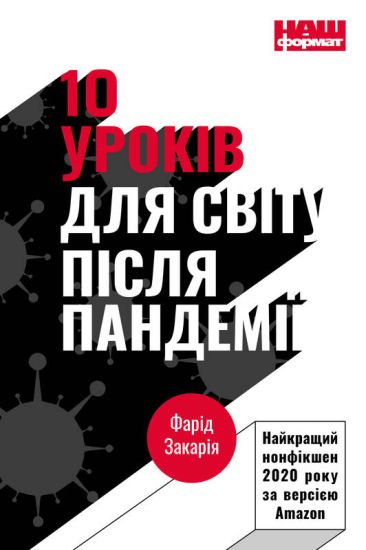
TEMATIKA KNIGIKrikhitnoji virusnoji chastinki dostatno, schob postaviti svit na kolina. Zakriti kordoni, "zliti" miljardi dolariv, ubiti desjatki tisjach ljudej, a na miljardi - nagnati paniku. Tse nashi vchorashni realiji. Jakimi zh budut zavtrashni i scho chekaje na ljudstvo v postpandemichnij chas? Chi mozhna vvazhati poshirennja Covid 19 pomstoju prirodi? Chomu Pivdennij Koreji i Tajvanju vdalosja shvidko priborkati poshirennja koronavirusu? Jak Merkel vidmovilasja vid lokdaunu? Jakikh ekspertiv slukhati, a vid jakikh trimatisja podali? Jak reaguvati na neviglastvo politikiv? Chi stane pobichnim efektom Covid-19 pochatok drugoji kholodnoji vijni? U tsij knizhtsi politichnij analitik Farid Zakarija operativno j vodnochas gruntovno reaguje na pandemiju ta jiji vikliki dlja majbutnogo. Vin proponuje 10 urokiv, scho bezpovorotno zminjat svit. Je nadija, scho ne na girshe.Bestseler New York Times, najkrascha knizhka Amazon za zhovten 2020 rokuCHOMU VARTO KUPUVATI TSJu KNIGUPandemichnij svit formujetsja na nashikh ochakh. Ale jakim bude majbutnje pislja Covid-19? Ekspert CNN i politichnij analitik Farid Zakarija pokazuje politichni, sotsialni, tekhnologichni ta ekonomichni naslidki, na podolannja jakikh mozhut piti roki. Vin opisuje jikh u formi 10 urokiv, scho okhopljujut rizni temi: vid prirodnikh i biologichnikh rizikiv do zrostannja "tsifrovogo zhittja" j pojavi poljarnogo porjadku u sviti.Farid Zakarija - odin z najbilsh vplivovikh i populjarnikh amerikanskikh politichnikh analitikiv, ekspert telekanalu CNN v galuzi mizhnarodnikh vidnosin. Avtor programi Fareed Zakaria GPS, redaktor kolonki u Washington Post. Napisav bestseleri "Postamerikanskij svit" (The Post-American World) i "Majbutnje svobodi" (The Future of Freedom).PerekladachAnna Markhovska, Orina Jemeljanova
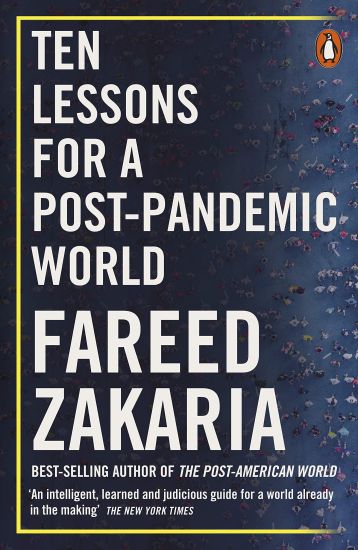
From the international bestselling author of The Post-American World 'An intelligent, learned and judicious guide for a world already in the making' The New York TimesSince the end of the Cold War, the world has been shaken to its core three times. 11 September 2001, the financial collapse of 2008 and - most of all - Covid-19. Each was an asymmetric threat, set in motion by something seemingly small, and different from anything the world had experienced before. Lenin is supposed to have said, 'There are decades when nothing happens and weeks when decades happen.' This is one of those times when history has sped up.In this urgent and timely book, Fareed Zakaria, one of the 'top ten global thinkers of the last decade' (Foreign Policy), foresees the nature of a post-pandemic world: the political, social, technological and economic consequences that may take years to unfold. In ten surprising, hopeful 'lessons', he writes about the acceleration of natural and biological risks, the obsolescence of the old political categories of right and left, the rise of 'digital life', the future of globalization and an emerging world order split between the United States and China. He invites us to think about how we are truly social animals with community embedded in our nature, and, above all, the degree to which nothing is written - the future is truly in our own hands.Ten Lessons for a Post-Pandemic World speaks to past, present and future, and will become an enduring reflection on life in the early twenty-first century.
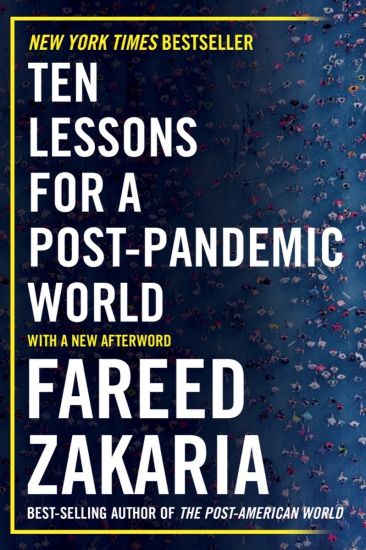
Lenin once said, "There are decades when nothing happens and weeks when decades happen." This is one of those times when history has sped up. CNN host and best-selling author Fareed Zakaria helps readers to understand the nature of a post-pandemic world: the political, social, technological, and economic consequences that may take years to unfold. Written in the form of ten "lessons," covering topics from natural and biological risks to the rise of "digital life" to an emerging bipolar world order, Zakaria helps readers to begin thinking beyond the immediate effects of COVID-19. Ten Lessons for a Post-Pandemic World speaks to past, present, and future, and, while urgent and timely, is sure to become an enduring reflection on life in the early twenty-first century.
COVID-19 is speeding up history, but how? What is the shape of the world to come? Lenin once said, "There are decades when nothing happens and weeks when decades happen." This is one of those times when history has sped up. CNN host and bestselling author Fareed Zakaria helps listeners to understand the nature of a post-pandemic world: the political, social, technological, and economic impacts that may take years to unfold. In the form of ten straightforward "lessons," covering topics from globalization and threat-preparedness to inequality and technological advancement, Zakaria creates a structure for listeners to begin thinking beyond the immediate impacts of COVID-19. Ten Lessons for a Post-Pandemic World speaks to past, present, and future, and, while urgent and timely, is sure to become an enduring staple.
Lenin once said, "There are decades when nothing happens and weeks when decades happen." This is one of those times when history has sped up. CNN host and best-selling author Fareed Zakaria helps readers to understand the nature of a post-pandemic world: the political, social, technological, and economic consequences that may take years to unfold. Written in the form of ten "lessons," covering topics from natural and biological risks to the rise of "digital life" to an emerging bipolar world order, Zakaria helps readers to begin thinking beyond the immediate effects of COVID-19. Ten Lessons for a Post-Pandemic World speaks to past, present, and future, and, while urgent and timely, is sure to become an enduring reflection on life in the early twenty-first century.
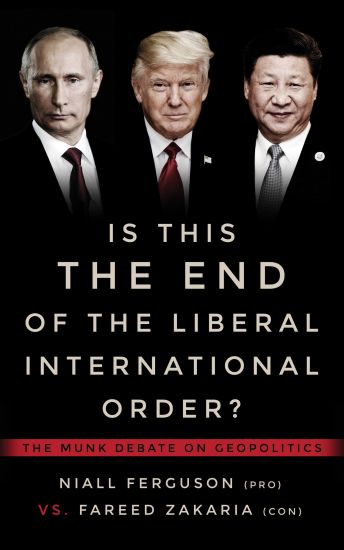
Is This the End of the Liberal International Order?
Niall Ferguson; Fareed Zakaria
House of Anansi Press Ltd ,Canada
2017
nidottu
Be it resolved, the liberal international order is over...Since the end of World War II, global affairs have been shaped by three broad trends: the increasing free movement of people and goods, international rules setting, and a broad appreciation of the mutual benefits of a more interconnected, interdependent world. Together these factors defined the liberal international order and sustained an era of rising global prosperity and declining international conflict. But is this order now being supplanted by a new global reality; one defined by the assertion of national borders, national interests and protectionist trade polices? More fundamentally, is liberal internationalism a historical aberration; the product of a unique set of forces that are now in retreat? Or, can it survive these challenges and remain the defining rules-based system of the future?The twentieth semi-annual Munk Debate, held on April 28th, 2017, pits prominent historian Niall Ferguson against CNN's Fareed Zakaria to debate the future of liberal internationalism.

Is it time to reaffirm our liberal values? Or are we seeing the birth-pangs of a new era? Two great thinkers debate the question burning behind headlines across the world. ‘No civilization, no matter how mighty it may appear to itself, is indestructible.’ –Niall Ferguson ‘We do not need to invent the world anew. The international order established by the United States after World War II is in need of expansion and repair, but not reconception.’ –Fareed Zakaria Fears of a globalized world are rampant. Across the West, borders are being reasserted and old alliances tested to their limits. Could this be the end of the liberal order or will the major crises of the twenty-first century strengthen our resolve?
The Irony of Vietnam
Leslie H. Gelb; Richard K. Betts; Fareed Zakaria
Brookings Institution
2016
nidottu
"""If a historian were allowed but one book on the American involvement in Vietnam, this would be it."" — Foreign Affairs When first published in 1979, four years after the end of one of the most divisive conflicts in the United States, The Irony of Vietnam raised eyebrows. Most students of the war argued that the United States had ""stumbled into a quagmire in Vietnam through hubris and miscalculation,"" as the New York Times's Fox Butterfield put it. But the perspective of time and the opening of documentary sources, including the Pentagon Papers, had allowed Gelb and Betts to probe deep into the decisionmaking leading to escalation of military action in Vietnam. The failure of Vietnam could be laid at the door of American foreign policy, they said, but the decisions that led to the failure were made by presidents aware of the risks, clear about their aims, knowledgeable about the weaknesses of their allies, and under no illusion about the outcome.The book offers a picture of a steely resolve in government circles that, while useful in creating consensus, did not allow for alternative perspectives. In the years since its publication, The Irony of Vietnam has come to be considered the seminal work on the Vietnam War."
The liberal arts are under attack. Degree courses like English and history, once very popular and highly respected, are in steep decline. In the US President Obama recently urged students to keep in mind that technical training could be more valuable than a degree in art history. In this urgently needed book, Fareed Zakaria argues that this turn away from the liberal arts is a mistake. A liberal education teaches you how to write, how to speak your mind and how to learn—immensely valuable tools no matter what your profession. Technology and globalisation are actually making these skills even more valuable as routine mechanical and even computing tasks can be done by machines or workers in low-wage countries. More than just a path to a career, a liberal education is an exercise in freedom. Above all, it is an expression of the most basic urge of the human spirit—to know.
The liberal arts are under attack. Degree courses like English and history, once very popular and highly respected, are in steep decline. In the US President Obama recently urged students to keep in mind that technical training could be more valuable than a degree in art history. In this urgently needed book, Fareed Zakaria argues that this turn away from the liberal arts is a mistake. A liberal education teaches you how to write, how to speak your mind and how to learn—immensely valuable tools no matter what your profession. Technology and globalisation are actually making these skills even more valuable as routine mechanical and even computing tasks can be done by machines or workers in low-wage countries. More than just a path to a career, a liberal education is an exercise in freedom. Above all, it is an expression of the most basic urge of the human spirit—to know.
Has Obama Made the World a More Dangerous Place?
Bret Stephens; Fareed Zakaria; Robert Kagan; Anne-Marie Slaughter
House of Anansi Press Ltd ,Canada
2015
pokkari
The fourteenth semi-annual Munk Debate, which will be held in Toronto on November 5, 2014, pits Bret Stephens and Robert Kagan against Fareed Zakaria and Anne-Marie Slaughter to debate the legacy of President Obama.From Ukraine to the Middle East to China, the United States is redefining its role in international affairs. Alliance building, public diplomacy, and eschewing traditional warfare in favour of the focused use of hard power such as drones and special forces are all hallmarks of the so-called Obama Doctrine. Is this a farsighted foreign policy for the United States and the world in the twenty-first century — one that acknowledges and embraces the increasing diffusion of power among states and non-state actors? Or, is an America “leading from behind” a boon for the nations and blocs who want to roll back economic globalization, international law, and the spread of democracy and human rights?In this edition of the Munk Debates, Pulitzer Prize–winning journalist Bret Stephens and famed historian and foreign policy commentator Robert Kagan square off against CNN’s Fareed Zakaria and noted academic and political commentator Anne-Marie Slaughter to debate the legacy of President Obama. With ISIS looking to reshape the Middle East, Russia increasingly at odds with the rest of the West, and the Israeli-Palestinian conflict at a standstill, the Munk Debate on Foreign Policy asks: Has Obama’s foreign policy taken the U.S. in the right direction?
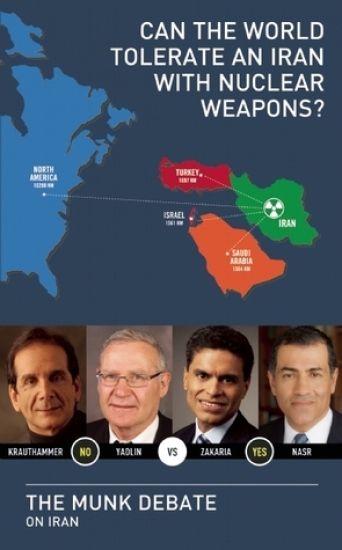
Can the World Tolerate an Iran with Nuclear Weapons?
Amos Yadlin; Charles Krauthammer; Fareed Zakaria; Vali Nasr
House of Anansi Press Ltd ,Canada
2013
pokkari
With tensions between Iran, Israel, and Western powers reaching new highs over the Islamic Republic’s nuclear enrichment program, the tenth edition of the Munk Debates investigates how the world should respond to Iran’s nuclear ambitions. For some, the case for a pre-emptive strike on Iran is ironclad. An Iranian bomb would flood the volatile Middle East with nuclear weapons and trap Israel in a state of perilous insecurity — along with much of the world’s oil supply. Others argue that a nuclear Iran could be the very stabilizing force that the region needs, as the threat of nuclear war makes conventional conflicts more risky. These same voices also ask: can the West and Israel afford to attack Iran when doing so could roll back the Arab Spring and re-entrench reactionary forces throughout the Middle East? In this edition of the Munk Debates — Canada’s premier international debate series — former Israel Defense Forces head of military intelligence Amos Yadlin, Pulitzer Prize–winning political commentator Charles Krauthammer, CNN host Fareed Zakaria, and Iranian-born academic Vali Nasr debate the consequences of a nuclear-armed Iran. For the first time ever, this electrifying debate, which played to a sold-out audience, is now available in print, along with candid interviews with the debaters. With tempers flaring between governments, the world’s oil supply in peril, and global security at risk, the Munk Debate on Iran tries to answer: Can the world tolerate an Iran with nuclear weapons?
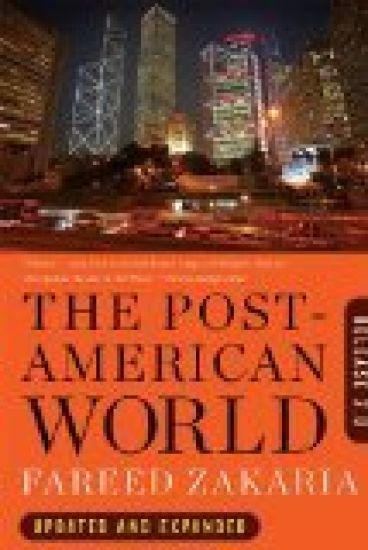
This is not a book about the decline of America, but rather about the rise of everyone else. So begins Fareed Zakaria s blockbuster on the United States in the twenty-first century, and the trends he identifies have proceeded faster than anyone anticipated. How might the nation continue to thrive in a truly global era? In this fully updated 2.0 edition, Zakaria answers these questions with his customary lucidity, insight, and imagination."

Does the 21st Century Belong to China?
Henry Kissinger; Niall Ferguson; David Li; Fareed Zakaria
House of Anansi Press Ltd ,Canada
2011
pokkari
Is China's rise unstoppable? Powered by the human capital of 1.3 billion citizens, the latest technological advances, and a comparatively efficient system of state-directed capitalism, China seems poised to become the global superpower this century. But the Middle Kingdom also faces a series of challenges. From energy scarcity to environmental degradation to political unrest and growing global security burdens, a host of factors could derail China's global ascent. In this edition of The Munk Debates — Canada's premier international debate series — former U.S. Secretary of State Henry Kissinger and CNN's Fareed Zakaria square off against leading historian Niall Ferguson and world-renowned economist David Daokui Li to debate the biggest geopolitical issue of our time: Does the 21st century belong to China? Highly electrifying and thoroughly engrossing, the Munk Debate on China is the first formal public debate Dr. Kissinger has participated in on China's future, and includes exclusive interviews with Henry Kissinger and David Daokui Li.