Kirjailija
Fazal Rizvi
Kirjat ja teokset yhdessä paikassa: 11 kirjaa, julkaisuja vuosilta 1997-2023, suosituimpien joukossa Educational Policy and the Politics of Change. Vertaile teosten hintoja ja tarkista saatavuus suomalaisista kirjakaupoista.
11 kirjaa
Kirjojen julkaisuhaarukka 1997-2023.
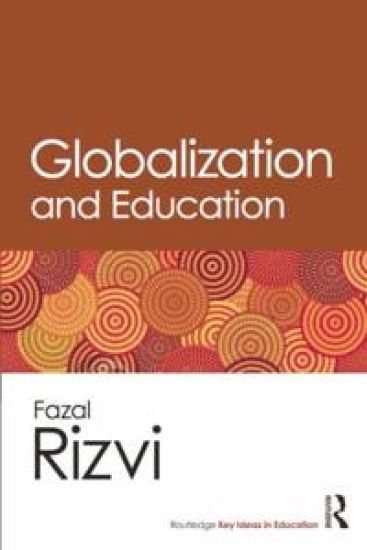
Globalization and Education provides a critical introduction to various theories of globalization and the implications they are assumed to have for educational policy and practice. Using the current global financial crisis as a backdrop, internationally renowned author Fazal Razvi examine a series of questions about the ways in which globalization has been variously represented in theoretical, policy and popular discourses. In clear, concise language, Rizvi argues that the problem is not the idea of globalization itself but a particular ideological representation of the manner in which educational policy and practice should be aligned to its dictates. Both an introduction to the topic and a fresh analysis designed to elicit wide-ranging discussions, the book opens with discussion of some of the key contemporary theories of globalization and education in order to show these are shaped by a neo-liberal social imaginary. The second half of the book describes some of the discontents such a social imaginary has produced among particular groups of people, relegating them to the edges of the global community and resulting in vast and unacceptably high levels of inequalities. Not content to accept the popular assumption that there is no alternative to a neoliberal view of globalization, the book concludes with an overview of the many alternatives already proposed and the role that education might need to play in articulating a better, more democratic and just, way of imagining the interconnected and interdependent world. Ideal for courses in education policy and education studies, this valuable teaching resource is essential reading for anyone who wishes to read more about the issues and controversies at the intersection of globalization, education, and society.

In the World Library of Educationalists, international experts compile career-long collections of what they judge to be their finest pieces – extracts from books, key articles, salient research findings, major theoretical and practical contributions – so the world can read them in a single manageable volume. Readers will be able to follow the themes and strands and see how their work contributes to the development of the field. This volume brings together the selected works of Fazal Rizvi.Born in India, Fazal Rizvi has lived and worked in a number of countries, including Australia, England and the United States. Most of his educational encounters have been 'in the global'. He has developed a keen sense of the multiple and conflicting ways in which transnational ties and interactions are transforming the spaces in which identities and cultures are forged and performed, and in which education takes place. Much of his research has sought to examine how educational systems around the world have interpreted and responded to the challenges and opportunities of globalization. In this collection of his papers, written over a period of more than two decades, Fazal Rizvi seeks to understand the shifting discourses and practices of globalization and education, critically examining the ways in which these are: reshaping our sense of identity and citizenship, and our communities creating transnational systems of ties, networks and exchange taken into account in the development of policies and programs of educational reform producing uneven social effects that benefit some communities more than others.Fazal Rizvi's analysis shows how recent global transformations have mostly been interpreted through the conceptual prism of a neo-liberal imaginary that have undermined education's democratic and cosmopolitan possibilities.
Class Choreographies
Jane Kenway; Johannah Fahey; Debbie Epstein; Aaron Koh; Cameron McCarthy; Fazal Rizvi
Palgrave Macmillan
2018
nidottu
Awarded Best Book prize by CIES Globalization and Education SIGAwarded 2nd Prize in the Society of Educational Studies Annual Book PrizeElite schools have always been social choreographers par excellence. The world over, they put together highly dexterous performances as they stage and restage changing relations of ruling. They are adept at aligning their social choreographies to shifting historical conditions and cultural tastes. In multiple theatres, they now regularly rehearse the irregular art of being global. Elite schools around the world are positioned at the intersecting pinnacles of various scales, systems and regimes of social, cultural, political and economic power. They have much in common but are also diverse. They illustrate how various modalities of power are enjoyed and put to work and how educational and social inequalities are shaped and shifted. They, thus, speak to the social zeitgeist. Thisbook dissects this intricate choreography.
Class Choreographies
Jane Kenway; Johannah Fahey; Debbie Epstein; Aaron Koh; Cameron McCarthy; Fazal Rizvi
Palgrave Macmillan
2017
sidottu
Awarded Best Book prize by CIES Globalization and Education SIGAwarded 2nd Prize in the Society of Educational Studies Annual Book PrizeElite schools have always been social choreographers par excellence. The world over, they put together highly dexterous performances as they stage and restage changing relations of ruling. They are adept at aligning their social choreographies to shifting historical conditions and cultural tastes. In multiple theatres, they now regularly rehearse the irregular art of being global. Elite schools around the world are positioned at the intersecting pinnacles of various scales, systems and regimes of social, cultural, political and economic power. They have much in common but are also diverse. They illustrate how various modalities of power are enjoyed and put to work and how educational and social inequalities are shaped and shifted. They, thus, speak to the social zeitgeist. Thisbook dissects this intricate choreography.
In the World Library of Educationalists, international experts compile career-long collections of what they judge to be their finest pieces – extracts from books, key articles, salient research findings, major theoretical and practical contributions – so the world can read them in a single manageable volume. Readers will be able to follow the themes and strands and see how their work contributes to the development of the field. This volume brings together the selected works of Fazal Rizvi.Born in India, Fazal Rizvi has lived and worked in a number of countries, including Australia, England and the United States. Most of his educational encounters have been 'in the global'. He has developed a keen sense of the multiple and conflicting ways in which transnational ties and interactions are transforming the spaces in which identities and cultures are forged and performed, and in which education takes place. Much of his research has sought to examine how educational systems around the world have interpreted and responded to the challenges and opportunities of globalization. In this collection of his papers, written over a period of more than two decades, Fazal Rizvi seeks to understand the shifting discourses and practices of globalization and education, critically examining the ways in which these are: reshaping our sense of identity and citizenship, and our communities creating transnational systems of ties, networks and exchange taken into account in the development of policies and programs of educational reform producing uneven social effects that benefit some communities more than others.Fazal Rizvi's analysis shows how recent global transformations have mostly been interpreted through the conceptual prism of a neo-liberal imaginary that have undermined education's democratic and cosmopolitan possibilities.
Rizvi and Lingard's account of the global politics of education is thoughtful, complex and compelling. It is the first really comprehensive discussion and analysis of global trends in education policy, their effects - structural and individual - and resistance to them. In the enormous body of writing on globalisation this book stands out and will become a basic text in education policy courses around the world.- Stephen J Ball, Karl Mannheim Professor of Sociology of Education, Institute of Education, University of London, UKIn what ways have the processes of globalization reshaped the educational policy terrain? How might we analyse education policies located within this new terrain, which is at once local, national, regional and global?In Globalizing Education Policy, the authors explore the key global drivers of policy change in education, and suggest that these do not operate in the same way in all nation-states. They examine the transformative effects of globalization on the discursive terrain within which educational policies are developed and enacted, arguing that this terrain is increasingly informed by a range of neo-liberal precepts which have fundamentally changed the ways in which we think about educational governance. They also suggest that whilst in some countries these precepts are resisted, to some extent, they have nonetheless become hegemonic, and provide an overview of some critical issues in educational policy to which this hegemonic view of globalization has given rise, including:devolution and decentralization new forms of governance the balance between public and private funding of education access and equity and the education of girls curriculum particularly with respect to the teaching of English language and technology pedagogies and high stakes testing and the global trade in education. These issues are explored within the context of major shifts in global processes and ideological discourses currently being experienced, and negotiated by all countries. The book also provides an approach to education policy analysis in an age of globalization and will be of interest to those studying globalization and education policy across the social sciences.
The OECD, Globalisation and Education Policy
M. Henry; Bob Lingard; Fazal Rizvi; S. Taylor
Pergamon Press
2001
sidottu
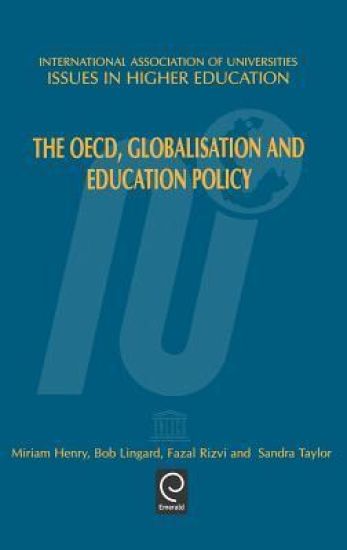
The increasing significance of the OECD in the development of national education policies has received much attention in recent years. Although it is recognised that certain international agencies such as the OECD as key "globalizing agencies", have acquired the capacity to "persuade" nation states towards certain policy priorities, little attention has been paid to making clear how these processes of persuasion may work. This volume investigates such processes, drawing on a study of the relationship between the OECD and educational policy directions in Australia. It investigates the link between three elements of education policy, the nation state, the OECD and globalization. These links are explored through case studies in higher education and vocational education and training policy developments, drawing on the Australian experience. The book also generates questions about educational purposes and decision making in the contemporary contexts which have wider applicability.
Educational Policy and the Politics of Change
Miriam Henry; Bob Lingard; Fazal Rizvi; Sandra Taylor
Routledge
1997
nidottu
Governments around the world are trying to come to terms with new technologies, new social movements and a changing global economy. As a result, educational policy finds itself at the centre of a major political struggle between those who see it only for its instrumental outcomes and those who see its potential for human emancipation. This book is a successor to the best-selling Understanding Schooling (1988). It provides a readable account of how educational policies are developed by the state in response to broader social, cultural, economic and political changes which are taking place. It examines the way in which schools live and work with these changes, and the policies which result from them. The book examines policy making at each level, from perspectives both inside and outside the state bureaucracy. It has a particular focus on social justice. Both undergraduate and postgraduate students will find that this book enables them to understand the reasoning behind the changes they are expected to implement. It will help to prepare them to confront an uncertain educational world, whilst still retaining their enthusiasm for education.
Educational Policy and the Politics of Change
Miriam Henry; Bob Lingard; Fazal Rizvi; Sandra Taylor
Routledge
1997
sidottu
Governments around the world are trying to come to terms with new technologies, new social movements and a changing global economy. As a result, educational policy finds itself at the centre of a major political struggle between those who see it only for its instrumental outcomes and those who see its potential for human emancipation. This book is a successor to the best-selling Understanding Schooling (1988). It provides a readable account of how educational policies are developed by the state in response to broader social, cultural, economic and political changes which are taking place. It examines the way in which schools live and work with these changes, and the policies which result from them. The book examines policy making at each level, from perspectives both inside and outside the state bureaucracy. It has a particular focus on social justice. Both undergraduate and postgraduate students will find that this book enables them to understand the reasoning behind the changes they are expected to implement. It will help to prepare them to confront an uncertain educational world, whilst still retaining their enthusiasm for education.