Kirjailija
Felicity Meakins
Kirjat ja teokset yhdessä paikassa: 9 kirjaa, julkaisuja vuosilta 2013-2024, suosituimpien joukossa A Grammar of Gurindji. Vertaile teosten hintoja ja tarkista saatavuus suomalaisista kirjakaupoista.
9 kirjaa
Kirjojen julkaisuhaarukka 2013-2024.
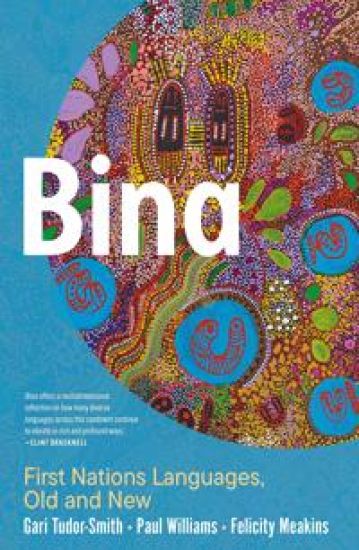
The incredible story of the resilience and recovery of Australia's First Nations languages Australia's language diversity is truly breathtaking. This continent lays claim to the world's longest continuous collection of cultures, including over 440 unique languages and many more dialects. Sadly, European invasion has had severe consequences for the vitality of these languages. Amid devastating loss, there has also been the birth of new languages such as Kriol and Yumplatok, both English-based Creoles. Aboriginal English dialects are spoken widely, and recently there has been an inspiring renaissance of First Nations languages, as communities reclaim and renew them.Bina: First Nations Languages Old and New tells this story, from the earliest exchange of words between colonists and First Nations people to today's reclamations. It is a creative and exciting introduction to a vital and dynamic world of language.With a foreword by Nardi Simpson, author of Song of the Crocodile.
Tamarra
Violet Wadrill; Topsy Dodd Ngarnjal; Leah Leaman; Cecelia Edwards; Cassandra Algy; Felicity Meakins; Briony Barr; Gregory Crocetti
Hardie Grant Explore
2023
sidottu
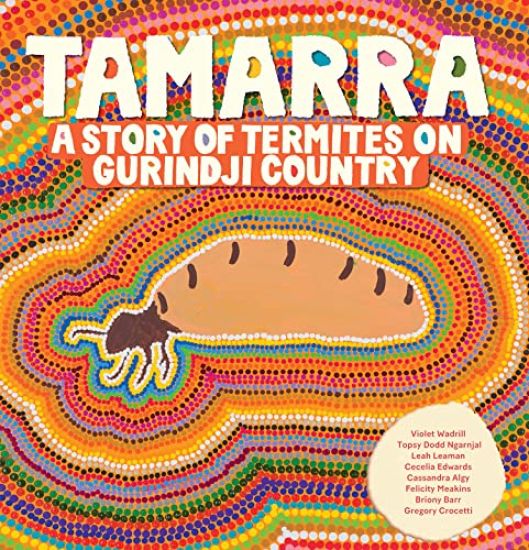
Tamarra: A Story of Termites on Gurindji Country is a fascinating, illustrated science book that takes kids inside the life of termites through storytelling from the Gurindji People. Did you know there are four types of termite poo? Or that a warm paste made from termite mound is used to strengthen a Gurindji baby’s body and spirit? Or that spinifex (which termites eat) is one of the strongest plants in the world? Created as a collaboration between over 30 First Nations and non-Indigenous contributors, the story and artworks explore how termites and their mounds connect different parts of Country, from tiny Gurindji babies and their loving grandmothers, to spiky spinifex plants growing in the hot sun. Written in traditional Gurindji, Gurindj Kriol and English (with a QR code to an audio version spoken in language), Tamarra is a truly original story with beautiful artworks that takes readers on an educational and cultural journey through Gurindji Country. Suitable for children aged 7 to 12 years.
Felicity Meakins was awarded the Kenneth L. Hale Award 2021by the Linguistic Society of America (LSA) for outstanding work on the documentation of endangered languages Gurindji is a Pama-Nyungan language of north-central Australia. It is a member of the Ngumpin subgroup which forms a part of the Ngumpin-Yapa group. The phonology is typically Pama-Nyungan; the phoneme inventory contains five places of articulation for stops which have corresponding nasals. It also has three laterals, two rhotics and three vowels. There are no fricatives and, among the stops, voicing is not phonemically distinctive. One striking morpho-phonological process is a nasal cluster dissimilation (NCD) rule. Gurindji is morphologically agglutinative and suffixing, exhibiting a mix of dependent-marking and head-marking. Nominals pattern according to an ergative system and bound pronouns show an accusative pattern. Gurindji marks a further 10 cases. Free and bound pronouns distinguish person (1st inclusive and exclusive, 2nd and 3rd) and three numbers (minimal, unit augmented and augmented). The Gurindji verb complex consists of an inflecting verb and coverb. Inflecting verbs belong to a closed class of 34 verbs which are grammatically obligatory. Coverbs form an open class, numbering in the hundreds and carrying the semantic weight of the complex verb
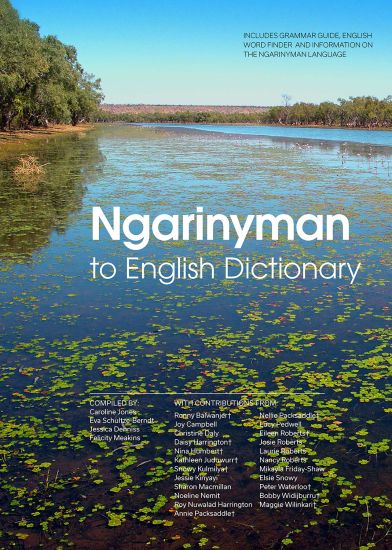
Ngarinyman to English Dictionary
Caroline Jones; Eva Schultze-Berndt; Jessica Denniss; Felicity Meakins
ATF Press
2019
nidottu
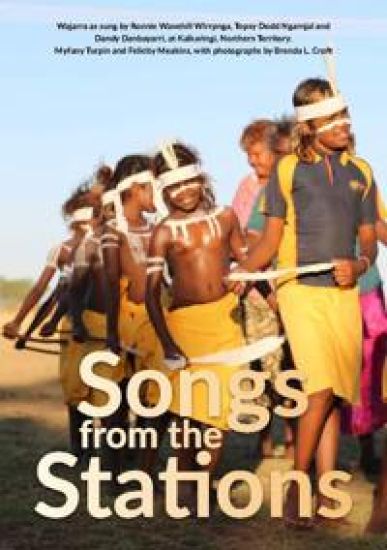
The Gurindji people of the Northern Territory are best known for their walk-off of Wave Hill Station in 1966, protesting against mistreatment by the station managers. The strike would become the first major victory of the Indigenous land rights movement. Many discussions of station life are focused on the harsh treatment of Aboriginal workers. Songs from the Stations describes another side of life on Wave Hill Station. Among the harsh conditions and decades of mistreatment, an eclectic ceremonial life flourished during the first half of the 20th century. Constant travel between cattle stations by Aboriginal workers across north-western and central Australia meant that Wave Hill Station became a crossroad of desert and Top End musical styles. As a result, the Gurindji people learnt songs from the Mudburra who came further east, the Bilinarra from the north, Western Desert speakers from the west, and the Warlpiri from the south.This book is the first detailed documentation of wajarra, public songs performed by the Gurindji people. Featuring five song sets known as Laka, Mintiwarra, Kamul, Juntara, and Freedom Day, it is an exploration of the cultural exchange between Indigenous communities that was fostered by their involvement in the pastoral industry.Songs from the Stations presents musical and textual analysis of the five sets of wajarra songs below. These five song sets were recorded at Kalkaringi in 1998, 2007, 2015 and 2016, and can be streamed by visiting https://open.sydneyuniversitypress.com.au/songs-stations.html
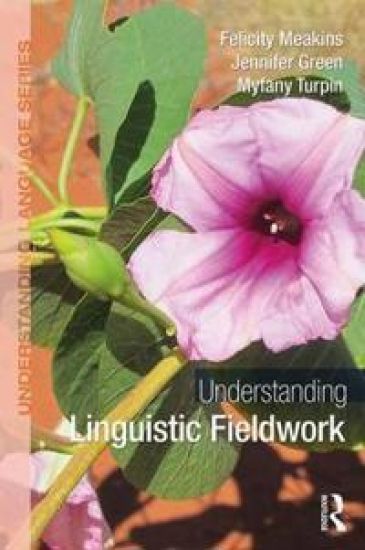
Understanding Linguistic Fieldwork
Felicity Meakins; Jennifer Green; Myfany Turpin
Routledge
2018
sidottu
Understanding Linguistic Fieldwork offers a diverse and practical introduction to research methods used in field linguistics. Designed to teach students how to collect quality linguistic data in an ethical and responsible manner, the key features include:A focus on fieldwork in countries and continents that have undergone colonial expansion, including Australia, the United States of America, Canada, South America and AfricaA description of specialist methods used to conduct research on phonological, grammatical and lexical description, but also including methods for research on gesture and sign, language acquisition, language contact and the verbal artsExamples of resources that have resulted from collaborations with language communities and which both advance linguistic understanding and support language revitalisation workAnnotated guidance on sources for further readingThis book is essential reading for students studying modules relating to linguistic fieldwork or those looking to embark upon field research.
Understanding Linguistic Fieldwork
Felicity Meakins; Jennifer Green; Myfany Turpin
Routledge
2018
nidottu
Understanding Linguistic Fieldwork offers a diverse and practical introduction to research methods used in field linguistics. Designed to teach students how to collect quality linguistic data in an ethical and responsible manner, the key features include:A focus on fieldwork in countries and continents that have undergone colonial expansion, including Australia, the United States of America, Canada, South America and AfricaA description of specialist methods used to conduct research on phonological, grammatical and lexical description, but also including methods for research on gesture and sign, language acquisition, language contact and the verbal artsExamples of resources that have resulted from collaborations with language communities and which both advance linguistic understanding and support language revitalisation workAnnotated guidance on sources for further readingThis book is essential reading for students studying modules relating to linguistic fieldwork or those looking to embark upon field research.
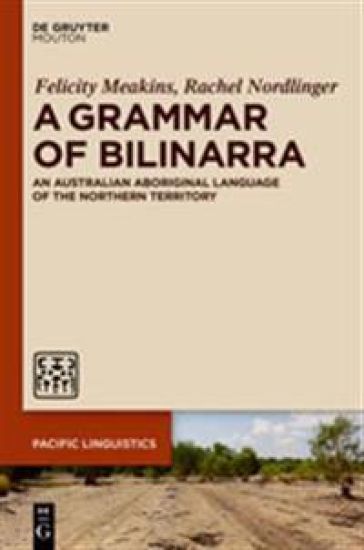
Felicity Meakins was awarded the Kenneth L. Hale Award 2021by the Linguistic Society of America (LSA) for outstanding work on the documentation of endangered languages This volume provides the first comprehensive description of Bilinarra, a Pama-Nyungan language of the Victoria River District of the Northern Territory (Australia). Bilinarra is a highly endangered language with only one speaker remaining in 2012 and no child learners. The materials on which this grammatical description is based were collected by the authors over a 20 year period from the last first-language speakers of the language, most of whom have since passed away. Bilinarra is a member of the Ngumpin subgroup of Pama-Nyungan which forms a part of the Ngumpin-Yapa family, which also includes Warlpiri. It is non-configurational, with nominals commonly omitted, arguments cross-referenced by pronominal clitics and word order grammatically free and largely determined by information structure. In this grammatical description much attention is paid to its morphosyntax, including case morphology, the pronominal clitic system and complex predicates. A particular strength of the volume is the provision of sound files for example sentences, allowing the reader access to the language itself.