Kirjojen hintavertailu. Mukana 12 595 353 kirjaa ja 12 kauppaa.

Kirjailija

Felipe Cucker

Kirjat ja teokset yhdessä paikassa: 7 kirjaa, julkaisuja vuosilta 1997-2015, suosituimpien joukossa Learning Theory. Vertaile teosten hintoja ja tarkista saatavuus suomalaisista kirjakaupoista.

7 kirjaa

Kirjojen julkaisuhaarukka 1997-2015.

Learning Theory

Learning Theory

Felipe Cucker; Ding Xuan Zhou

Cambridge University Press
2007
sidottu
The goal of learning theory is to approximate a function from sample values. To attain this goal learning theory draws on a variety of diverse subjects, specifically statistics, approximation theory, and algorithmics. Ideas from all these areas blended to form a subject whose many successful applications have triggered a rapid growth during the last two decades. This is the first book to give a general overview of the theoretical foundations of the subject emphasizing the approximation theory, while still giving a balanced overview. It is based on courses taught by the authors, and is reasonably self-contained so will appeal to a broad spectrum of researchers in learning theory and adjacent fields. It will also serve as an introduction for graduate students and others entering the field, who wish to see how the problems raised in learning theory relate to other disciplines.
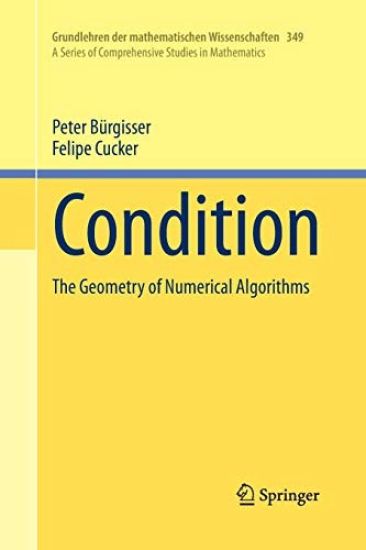
Condition

Condition

Peter Bürgisser; Felipe Cucker

Springer-Verlag Berlin and Heidelberg GmbH Co. K
2015
nidottu
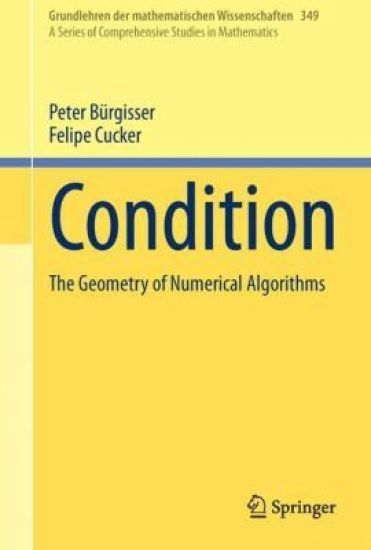
This book gathers threads that have evolved across different mathematical disciplines into seamless narrative. It deals with condition as a main aspect in the understanding of the performance ---regarding both stability and complexity--- of numerical algorithms. While the role of condition was shaped in the last half-century, so far there has not been a monograph treating this subject in a uniform and systematic way. The book puts special emphasis on the probabilistic analysis of numerical algorithms via the analysis of the corresponding condition. The exposition's level increases along the book, starting in the context of linear algebra at an undergraduate level and reaching in its third part the recent developments and partial solutions for Smale's 17th problem which can be explained within a graduate course. Its middle part contains a condition-based course on linear programming that fills a gap between the current elementary expositions of the subject based on the simplex method and those focusing on convex programming.
Condition

Condition

Peter Bürgisser; Felipe Cucker

Springer-Verlag Berlin and Heidelberg GmbH Co. K
2013
sidottu
This book gathers threads that have evolved across different mathematical disciplines into seamless narrative. It deals with condition as a main aspect in the understanding of the performance ---regarding both stability and complexity--- of numerical algorithms. While the role of condition was shaped in the last half-century, so far there has not been a monograph treating this subject in a uniform and systematic way. The book puts special emphasis on the probabilistic analysis of numerical algorithms via the analysis of the corresponding condition. The exposition's level increases along the book, starting in the context of linear algebra at an undergraduate level and reaching in its third part the recent developments and partial solutions for Smale's 17th problem which can be explained within a graduate course. Its middle part contains a condition-based course on linear programming that fills a gap between the current elementary expositions of the subject based on the simplex method and those focusing on convex programming.
Manifold Mirrors

Manifold Mirrors

Felipe Cucker

Cambridge University Press
2013
pokkari
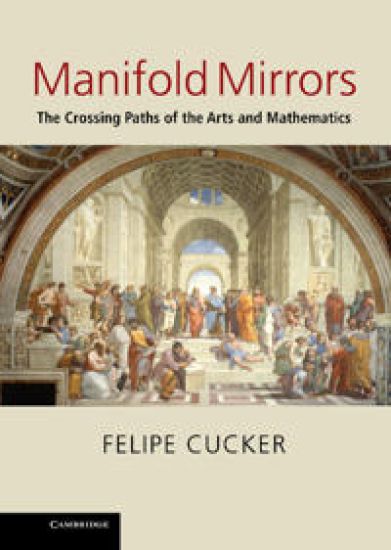
Most works of art, whether illustrative, musical or literary, are created subject to a set of constraints. In many (but not all) cases, these constraints have a mathematical nature, for example, the geometric transformations governing the canons of J. S. Bach, the various projection systems used in classical painting, the catalog of symmetries found in Islamic art, or the rules concerning poetic structure. This fascinating book describes geometric frameworks underlying this constraint-based creation. The author provides both a development in geometry and a description of how these frameworks fit the creative process within several art practices. He furthermore discusses the perceptual effects derived from the presence of particular geometric characteristics. The book began life as a liberal arts course and it is certainly suitable as a textbook. However, anyone interested in the power and ubiquity of mathematics will enjoy this revealing insight into the relationship between mathematics and the arts.
Manifold Mirrors

Manifold Mirrors

Felipe Cucker

Cambridge University Press
2013
sidottu
Most works of art, whether illustrative, musical or literary, are created subject to a set of constraints. In many (but not all) cases, these constraints have a mathematical nature, for example, the geometric transformations governing the canons of J. S. Bach, the various projection systems used in classical painting, the catalog of symmetries found in Islamic art, or the rules concerning poetic structure. This fascinating book describes geometric frameworks underlying this constraint-based creation. The author provides both a development in geometry and a description of how these frameworks fit the creative process within several art practices. He furthermore discusses the perceptual effects derived from the presence of particular geometric characteristics. The book began life as a liberal arts course and it is certainly suitable as a textbook. However, anyone interested in the power and ubiquity of mathematics will enjoy this revealing insight into the relationship between mathematics and the arts.
Complexity and Real Computation

Complexity and Real Computation

Lenore Blum; Felipe Cucker; Michael Shub; Steve Smale

Springer-Verlag New York Inc.
2012
nidottu
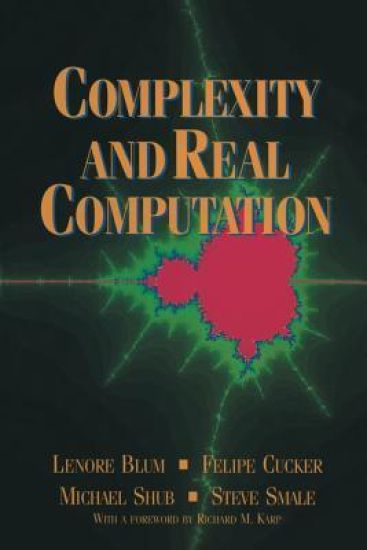
Computational complexity theory provides a framework for understanding the cost of solving computational problems, as measured by the requirement for resources such as time and space. The objects of study are algorithms defined within a formal model of computation. Upper bounds on the computational complexity of a problem are usually derived by constructing and analyzing specific algorithms. Meaningful lower bounds on computational complexity are harder to come by, and are not available for most problems of interest. The dominant approach in complexity theory is to consider algorithms as oper­ ating on finite strings of symbols from a finite alphabet. Such strings may represent various discrete objects such as integers or algebraic expressions, but cannot rep­ resent real or complex numbers, unless the numbers are rounded to approximate values from a discrete set. A major concern of the theory is the number of com­ putation steps required to solve a problem, as a function of the length of the input string.
Complexity and Real Computation

Complexity and Real Computation

Lenore Blum; Felipe Cucker; Michael Shub; Steve Smale

Springer-Verlag New York Inc.
1997
sidottu
Computational complexity theory provides a framework for understanding the cost of solving computational problems, as measured by the requirement for resources such as time and space. The objects of study are algorithms defined within a formal model of computation. Upper bounds on the computational complexity of a problem are usually derived by constructing and analyzing specific algorithms. Meaningful lower bounds on computational complexity are harder to come by, and are not available for most problems of interest. The dominant approach in complexity theory is to consider algorithms as oper­ ating on finite strings of symbols from a finite alphabet. Such strings may represent various discrete objects such as integers or algebraic expressions, but cannot rep­ resent real or complex numbers, unless the numbers are rounded to approximate values from a discrete set. A major concern of the theory is the number of com­ putation steps required to solve a problem, as a function of the length of the input string.