Kirjojen hintavertailu. Mukana 12 595 353 kirjaa ja 12 kauppaa.

Kirjailija

Félix Guattari

Kirjat ja teokset yhdessä paikassa: 41 kirjaa, julkaisuja vuosilta 1977-2026, suosituimpien joukossa Anti-Oidipus. Vertaile teosten hintoja ja tarkista saatavuus suomalaisista kirjakaupoista.

Mukana myös kirjoitusasut: Felix Guattari

41 kirjaa

Kirjojen julkaisuhaarukka 1977-2026.

Schizoanalytic Cartographies

Schizoanalytic Cartographies

Felix Guattari

Bloomsbury Academic USA
2012
sidottu
Schizoanalytic Cartographies represents Félix Guattari's most important later work and the most systematic and detailed account of his theoretical position and his therapeutic ideas. Guattari sets out to provide a complete account of the conditions of 'enunciation' - autonomous speech and self-expression - for subjects in the contemporary world. Over the course of eight closely argued chapters, he presents a breathtakingly new reformulation of the structures of individual and collective subjectivity. Based on research into information theory and new technologies, Guattari articulates a vision of a humanity finally reconciled with its relationship to machines. Schizoanalytic Cartographies is a visionary yet highly concrete work, providing a powerful vantage point on the upheavals of our present epoch, powerfully imagining a future 'post-media' era of technological development. This long overdue translation of this substantial work offers English-speaking readers the opportunity finally to fully assess Guattari's contribution to European thought.
Schizoanalytic Cartographies

Schizoanalytic Cartographies

Felix Guattari

Bloomsbury Academic USA
2012
nidottu
Schizoanalytic Cartographies represents Félix Guattari's most important later work and the most systematic and detailed account of his theoretical position and his therapeutic ideas. Guattari sets out to provide a complete account of the conditions of 'enunciation' - autonomous speech and self-expression - for subjects in the contemporary world. Over the course of eight closely argued chapters, he presents a breathtakingly new reformulation of the structures of individual and collective subjectivity. Based on research into information theory and new technologies, Guattari articulates a vision of a humanity finally reconciled with its relationship to machines. Schizoanalytic Cartographies is a visionary yet highly concrete work, providing a powerful vantage point on the upheavals of our present epoch, powerfully imagining a future 'post-media' era of technological development. This long overdue translation of this substantial work offers English-speaking readers the opportunity finally to fully assess Guattari's contribution to European thought.
Kafka. För en mindre litteratur

Kafka. För en mindre litteratur

Gilles Deleuze; Félix Guattari

Bokförlaget Daidalos
2012
nidottu
Gilles Deleuzes och Félix ­Guattaris Kafkabok är något av en modern klassiker som kan få äldre kafkaister att kräkas. Skälet är de ihärdiga slagen mot magtrakten. De två författarna vägrar läsa Kafka på existentialistiskt vis med skuld och ångest eller psykoanalytiskt som oidipala kriser. I stället vänder de ut och in på denna känsloladdade förståelse genom att se Kafkas romaner, noveller och brev som ett sammanhållet verk som skapade en politisk ?mind­re litteratur? i det marginaliserade judiska Prag. Verkets storhet är dess helt nya typ av fantasi. ? Mikael van Reis i Göteborgs-Posten
The Machinic Unconscious

The Machinic Unconscious

Félix Guattari

Semiotext (E)
2010
pokkari
An early work that lays the foundation for establishing a "polemical" dimension to psychoanalysis.We certainly have the unconscious that we deserve, an unconscious for specialists, ready-made for an institutionalized discourse. I would rather see it as something that wraps itself around us in everyday objects, something that is involved with day-to-day problems, with the world outside. It would be the possible itself, open to the socius, to the cosmos...-from The Machinic Unconscious: Essays in SchizoanalysisIn his seminal solo-authored work The Machinic Unconscious (originally published in French in 1979), Felix Guattari lays the groundwork for a general pragmatics capable of resisting the semiotic enslavement of subjectivity. Concluding that psychoanalytic theory had become part and parcel of a repressive, capitalist social order, Guattari here outlines a schizoanalytic theory to undo its capitalist structure and set the discipline back on its feet. Combining theoretical research from fields as diverse as cybernetics, semiotics, ethnology, and ethology, Guattari reintroduces into psychoanalysis a "polemical" dimension, at once transhuman, transsexual, and transcosmic, that brings out the social and political-the "machinic"-potential of the unconscious. To illustrate his theory, Guattari turns to literature and analyzes the various modes of subjectivization and semiotization at work in Proust's In Search of Lost Time, examining the novel as if he were undertaking a scientific exploration in the style of Freud or Newton. Casting Proust's figures as abstract ("hyper-deterritorialized") mental objects, Guattari maps the separation between literature and science, elaborating along the way such major Deleuze-Guattarian concepts as "faciality" and "refrain," which would be unpacked in their subsequent A Thousand Plateaus: Capitalism and Schizophrenia. Never before available in English, The Machinic Unconscious has for too long been the missing chapter from Deleuze and Guattari's Anti-Oedipus project: the most important political extension of May 1968 and one of the most important philosophical contributions of the twentieth century.
Soft Subversions

Soft Subversions

Félix Guattari

MIT Press
2009
pokkari
A new, expanded, and reorganized edition of a collection of texts that present a fuller scope to Guattari's thinking from 1977 to 1985.This new edition of Soft Subversions expands, reorganizes, and develops the original 1996 publication, offering a carefully organized arrangement of essays, interviews, and short texts that present a fuller scope to Guattari's thinking from 1977 to 1985. This period encompasses what Guattari himself called the "Winter Years" of the early 1980s-the ascent of the Right, the spread of environmental catastrophe, the rise of a disillusioned youth with diminished prospects for career and future, and the establishment of a postmodernist ideology that offered solutions toward adaptation rather than change-a period with discernible echoes twenty years later. Following Semiotext(e)'s release last season of the new, expanded edition of Chaosophy: Texts and Interviews 1972-1977, this book makes Guattari's central ideas and concepts fully available in the format that had been best suited to Guattari's temperament: the guerrilla-styled intervention of the short essay and interactive dialogue. This edition includes such previously unpublished, substantive texts as "Institutional Intervention" and "About Schools," along with new translations of "War, Crisis, or Life" and "The Nuclear State," interviews and essays on a range of topics including adolescence and Italy, dream analysis and schizo-analysis, Marcel Proust and Jimmy Carter, as well as invaluable autobiographical documents such as "I Am an Idea-Thief" and "So What."
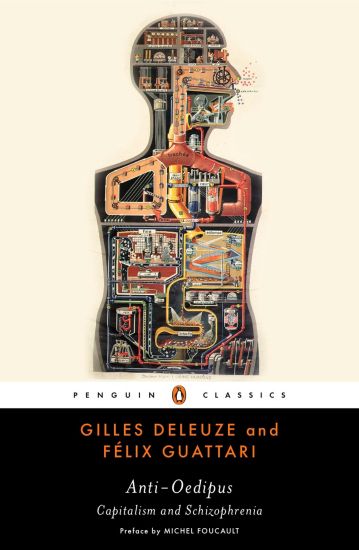
Anti-Oedipus: Capitalism and Schizophrenia

Anti-Oedipus: Capitalism and Schizophrenia

Gilles Deleuze; Felix Guattari

PENGUIN CLASSICS
2009
nidottu
An "introduction to the nonfascist life" (Michel Foucault, from the Preface) When it first appeared in France, Anti-Oedipus was hailed as a masterpiece by some and "a work of heretical madness" by others. In it, Gilles Deleuze and F lix Guattari set forth the following theory: Western society's innate herd instinct has allowed the government, the media, and even the principles of economics to take advantage of each person's unwillingness to be cut off from the group. What's more, those who suffer from mental disorders may not be insane, but could be individuals in the purest sense, because they are by nature isolated from society. More than twenty-five years after its original publication, Anti-Oedipus still stands as a controversial contribution to a much-needed dialogue on the nature of free thinking.
Chaosophy

Chaosophy

Félix Guattari

Semiotext (E)
2008
pokkari
Groundbreaking essays that introduce Guattari's theories of "schizo-analysis," in an expanded edition.Chaosophy is an introduction to Félix Guattari's groundbreaking theories of "schizo-analysis": a process meant to replace Freudian interpretation with a more pragmatic, experimental, and collective approach rooted in reality. Unlike Freud, who utilized neuroses as his working model, Guattari adopted the model of schizophrenia—which he believed to be an extreme mental state induced by the capitalist system itself, and one that enforces neurosis as a way of maintaining normality. Guattari's post-Marxist vision of capitalism provides a new definition not only of mental illness, but also of the micropolitical means for its subversion. Chaosophy includes such provocative pieces as "Everybody Wants to Be a Fascist," a group of texts on Guattari's collaborative work with Gilles Deleuze (including the appendix to Anti-Oedipus, not available in the English edition), and "How Martians Make Love," a roundtable discussion with Guattari, Lotringer, Catherine Clément, and Serge Leclaire from 1972 (still unpublished in French). This new, expanded edition features a new introduction by François Dosse (author of a new biography of Guattari and Gilles Deleuze) and a range of additional essays, including "Franco Basaglia: Guerrilla Psychiatrist," "The Transference," "Semiological Subjection, Semiotic Enslavement," "The Place of the Signifier in the Institution," and "Three Billion Perverts on the Stand."
The Three Ecologies

The Three Ecologies

Felix Guattari

Continuum International Publishing Group Ltd.
2008
nidottu
Extending the definition of ecology to encompass social relations and human subjectivity as well as environmental concerns, The Three Ecologies argues that the ecological crises that threaten our planet are the direct result of the expansion of a new form of capitalism and that a new ecosophical approach must be found which respects the differences between all living systems. A powerful critique of capitalism and a manifesto for a new way of thinking, the book is also an ideal introduction to the work of one of Europe's most radical thinkers. This edition includes a chronology of Guattari's life and work, introductions to both his general philosophy and to the work itself, and extended notes to the original text.
Molecular Revolution in Brazil

Molecular Revolution in Brazil

Félix Guattari; Suely Rolnik

MIT Press
2007
pokkari
The post-'68 psychoanalyst and philosopher visits a newly democratic Brazil in 1982 and meets future President Luis Ignacia Lula da Silva: a guide to the radical thought and optimism at the root of today's Brazil.Yes, I believe that there is a multiple people, a people of mutants, a people of potentialities that appears and disappears, that is embodied in social, literary, and musical events.... I think that we're in a period of productivity, proliferation, creation, utterly fabulous revolutions from the viewpoint of this emergence of a people. That's molecular revolution: it isn't a slogan or a program, it's something that I feel, that I live....-from Molecular Revolution in BrazilFollowing Brazil's first democratic election after two decades of military dictatorship, French philosopher Felix Guattari traveled through Brazil in 1982 with Brazilian psychoanalyst Suely Rolnik and discovered an exciting, new political vitality. In the infancy of its new republic, Brazil was moving against traditional hierarchies of control and totalitarian regimes and founding a revolution of ideas and politics. Molecular Revolution in Brazil documents the conversations, discussions, and debates that arose during the trip, including a dialogue between Guattari and Brazil's future President Luis Ignacia Lula da Silva, then a young gubernatorial candidate. Through these exchanges, Guattari cuts through to the shadowy practices of globalization gone awry and boldly charts a revolution in practice. Assembled and edited by Rolnik, Molecular Revolution in Brazil is organized thematically; aphoristic at times, it presents a lesser-known, more overtly political aspect of Guattari's work. Originally published in Brazil in 1986 as Micropolitica: Cartografias do desejo, the book became a crucial reference for political movements in Brazil in the 1980s and 1990s. It now provides English-speaking readers with an invaluable picture of the radical thought and optimism that lies at the root of Lula's Brazil.
Anti-Oidipus

Anti-Oidipus

Gilles Deleuze; Félix Guattari

TUTKIJALIITTO
2007
nidottu
Anti-Oidipus on modernin filosofian klassikko. Kirja yhdistää Deleuzen kehittelemän eron filosofian ja Guattarin pyrkimyksen kyseenalaistaa perinteinen tulkintakeskeinen psykoanalyysi. Heidän mukaansa Freud käsitti tiedostamattoman teatteriksi, jonka esitykset psykoanalyytikon on paljastettava ja tulkittava. Deleuzelle ja Guattarille tiedostamaton on pikemminkin tehdas kuin teatteri: se on kone, joka tuottaa niin henkilöyden kuin henkilön halun kohteetkin. Anti-Oidipuksessa skitsofrenia on keskeinen ongelma sekä filosofisesti että poliittisesti. Ensinnäkään perinteisen psykoanalyysin keinot eivät kykene käsittelemään skitsofreniaa. Toiseksi skitsofrenia on Deleuzen ja Guattarin mukaan elimellisessä yhteydessä kapitalistiseen tuotantotapaan: skitsofrenian tuottuminen on sisäänrakennettu kapitalismiin, halusipa kapitalismi sitä tai ei.
The Anti-×dipus Papers

The Anti-×dipus Papers

Félix Guattari

MIT Press
2006
pokkari
Notes and journal entries document Guattari and Deleuze's collaboration on their 1972 book Anti-Oedipus."The unconscious is not a theatre, but a factory," wrote Gilles Deleuze and Felix Guattari in Anti-Oedipus (1972), instigating one of the most daring intellectual adventures of the last half-century. Together, the well-known philosopher and the activist-psychiatrist were updating both psychoanalysis and Marxism in light of a more radical and "constructivist" vision of capitalism: "Capitalism is the exterior limit of all societies because it has no exterior limit itself. It works well as long as it keeps breaking down."Few people at the time believed, as they wrote in the often-quoted opening sentence of Rhizome, that "the two of us wrote Anti-Oedipus together." They added, "Since each of us was several, that became quite a crowd." These notes, addressed to Deleuze by Guattari in preparation for Anti-Oedipus, and annotated by Deleuze, substantiate their claim, finally bringing out the factory behind the theatre. They reveal Guattari as an inventive, highly analytical, mathematically-minded "conceptor," arguably one of the most prolific and enigmatic figures in philosophy and sociopolitical theory today. The Anti-Oedipus Papers (1969-1973) are supplemented by substantial journal entries in which Guattari describes his turbulent relationship with his analyst and teacher Jacques Lacan, his apprehensions about the publication of Anti-Oedipus and accounts of his personal and professional life as a private analyst and codirector with Jean Oury of the experimental clinic Laborde (created in the 1950s).
What Is Philosophy?

What Is Philosophy?

Gilles Deleuze; Félix Guattari

Columbia University Press
1996
pokkari
Called by many France's foremost philosopher, Gilles Deleuze is one of the leading thinkers in the Western World. His acclaimed works and celebrated collaborations with Felix Guattari have established him as a seminal figure in the fields of literary criticism and philosophy. The long-awaited publication of What Is Philosophy? in English marks the culmination of Deleuze's career. Deleuze and Guattari differentiate between philosophy, science, and the arts, seeing as means of confronting chaos, and challenge the common view that philosophy is an extension of logic. The authors also discuss the similarities and distinctions between creative and philosophical writing. Fresh anecdotes from the history of philosophy illuminate the book, along with engaging discussions of composers, painters, writers, and architects. A milestone in Deleuze's collaboration with Guattari, What Is Philosophy? brings a new perspective to Deleuze's studies of cinema, painting, and music, while setting a brilliant capstone upon his work.
Chaosmosis

Chaosmosis

Felix Guattari

Power Institute of Fine Arts
1995
nidottu
The final work by the author before his death in 1992, Chaosmosis is a radical and challenging work concerned with the reinvention and resingularization of subjectivity. It attempts to embody affective change, the short-circuiting of signification and the proliferation of sense necessary to engage with non-discursive, artistic, poetic and pathic intensities. It includes critical reflections on Lacanian psychoanalysis, structuralism, information theory, postmodernism, and the thought of Heidegger, Bakhtin, Barthes, and others.
What is Philosophy?

What is Philosophy?

Félix Guattari; Gilles Deleuze

Verso Books
1994
nidottu
"The question 'what is philosophy?' can perhaps only be posed late in life, with the arrival of old age and the time for speaking concretely. It is a question posed in a moment of quiet restlessness, at midnight, when there is no longer anything to ask."Posing that question, Deleuze and Guattari worked together for what turned out to be the last time, to produce a book which can be seen as a condensation of everything they had written before, together and separately. Twenty years on from their endlessly influential Anti-Oedipus, Deleuze and Guattari have lost none of their inspirational radicalism, only deepened it. Their book is a profound and careful interrogation of what it might mean to be a 'friend of wisdom', but it is also a devastating attack on the sterility of what has become, when 'the only events are exhibitions and the only concepts are products which can be sold'.Philosophy, they insist, is not contemplation, reflection or communication, but the creation of concepts. The first part of the book explores the concept, the 'plane of immanence' in which it can be born and the 'conceptual personae' which can activate it. It concludes with a brilliant account of philosophy's relation to social and economic development, from ancient Greece to the modern capitalist state. Part two considers other forms of thought: science, art, literature and music. By the light of its 'rivals', Deleuze and Guattari illuminate philosophy in all its distinctiveness, displaying the same light-footed erudition whether they are discussing Godel's Theorem, Proust and Pessoa, Mondrian or Boulez.Written with the energy and inventiveness that marked their earlier collaborations, What is Philosophy? is an enormous achievement. It is a vital book, not only for philosophers but for everyone concerned with the uses of human intelligence in a time when, as the authors remark, sales promotion has replaced critique.
Nomadology

Nomadology

Deleuze Gilles; Félix Guattari

Semiotext (E)
1986
pokkari
Gilles Deleuze and Felix Guattari redefine the relation between the state and its war machine. Far from being a part of the state, warriers (the army) are nomads who always come from the outside and keep threatening the authority of the state.In this daring essay inspired by Nietzsche, Gilles Deleuze and Felix Guattari redefine the relation between the state and its war machine. Far from being a part of the state, warriers (the army) are nomads who always come from the outside and keep threatening the authority of the state. In the same vein, nomadic science keeps infiltrating royal science, undermining its axioms and principles. Nomadology is a speedy, pocket-sized treatise that refuses to be pinned down. Theorizing a dynamic relationship between sedentary power and "schizophrenic lines of flight," this volume is meant to be read in transit, smuggled into urban nightclubs, offices, and subways. Deleuze and Guattari propose a creative and resistant ethics of becoming-imperceptible, strategizing a continuous invention of weapons on the run. An anarchic bricolage of ideas uprooted from anthropology, aesthetics, history, and military strategy, Nomadology carries out Deleuze's desire to "leave philosophy, but to leave it as a philosopher."