Kirjailija
Ferdinand De Saussure
Kirjat ja teokset yhdessä paikassa: 18 kirjaa, julkaisuja vuosilta 1989-2025, suosituimpien joukossa Cours de Linguistique Generale: Edition Critique. Vertaile teosten hintoja ja tarkista saatavuus suomalaisista kirjakaupoista.
18 kirjaa
Kirjojen julkaisuhaarukka 1989-2025.

Le Cours de linguistique g n rale de Ferdinand de Saussure est une oeuvre fondatrice qui a r volutionn la linguistique moderne et influenc profond ment les sciences humaines au XXe si cle. Publi titre posthume en 1916, ce livre rassemble les id es novatrices expos es par Saussure lors de ses cours l'Universit de Gen ve entre 1906 et 1911. Saussure y d veloppe des concepts cl s qui deviendront les piliers de la linguistique structurale. Il introduit la distinction cruciale entre langue et parole, d finissant la langue comme un syst me de signes et la parole comme son utilisation individuelle. Cette approche syst mique ouvre la voie l' tude de la langue en tant que structure, ind pendamment de son volution historique. L'auteur propose une th orie r volutionnaire du signe linguistique, compos du signifiant (image acoustique) et du signifi (concept), li s de mani re arbitraire. Cette notion d'arbitraire du signe remet en question les conceptions naturalistes du langage et pose les bases de la s miologie, science g n rale des signes dont la linguistique fait partie. Le Cours s'inscrit naturellement dans les cat gories Linguistique, Philosophie du langage et Sciences humaines . Saussure y introduit galement la distinction entre synchronie ( tude de la langue un moment donn ) et diachronie ( tude de son volution), ouvrant ainsi de nouvelles perspectives pour l'analyse linguistique. L'ouvrage aborde en profondeur la notion de valeur linguistique, soulignant que le sens des mots d coule de leurs relations au sein du syst me de la langue plut t que de leur r f rence au monde ext rieur. Cette approche relationnelle a eu un impact consid rable sur le d veloppement du structuralisme dans diverses disciplines.
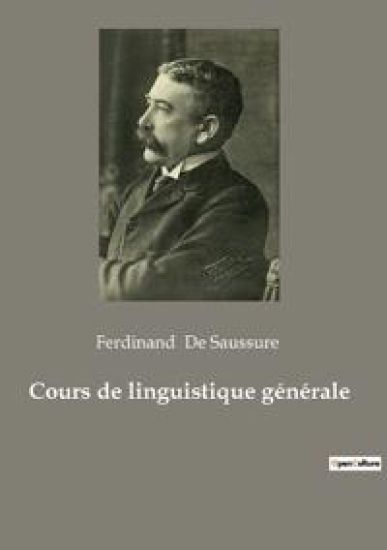
Monument des sciences humaines, le Cours de linguistique g n rale, publi en 1916, a boulevers les sciences du langage, mais aussi l'anthropologie, la pr histoire, l'ethnologie, la sociologie, la psychologie ou la psychanalyse, et jusqu' notre vision de l' tre humain. Mettant l'accent sur la dimension relationnelle du langage, con u fondamentalement comme un instrument de communication, Ferdinand de Saussure (1857-1913) y proposait une fa on r volutionnaire de penser la langue, une th orie du signe, et annon ait l'av nement d'une discipline nouvelle: la s miologie, cette "science qui tudie la vie des signes au sein de la vie sociale" et dont fait partie la linguistique.
Grundfragen der allgemeinen Sprachwissenschaft
Ferdinand de Saussure
Reclam Philipp Jun.
2016
pokkari

Ferdinand de Saussures Kurs i allmän lingvistik är en av 1900-talets mest inflytelserika vetenskapliga böcker. Den gavs ut av några kollegor till Saussure vid universitetet i Genève på grundval av anteckningar som hans studenter hade fört. Saussure betraktas allmänt som en av grundarna till 1900-talets lingvistik. Hans bok var en viktig inspiration när språkvetenskapen i början på seklet breddade sin domän från det historiska studiet av språken i deras släktsammanhang till att också omfatta ett mer teoretiskt och systematiskt närmande till språkets uppbyggnad. Kurs i allmän lingvistik har fått ett enormt inflytande också långt utöver lingvistikens område. Den lade grunden för hela den strukturalistiska strömningen, som format så mycket av vår moderna vetenskap. Litteraturvetare som Roland Barthes, psykoanalytiker som Jacques Lacan, och inte minst antropologen Claude Lévi-Strauss påverkades starkt av Saussures arbete. För Saussure var språkvetenskapen bara en del av semiologin, som numera under namnet semiotik blivit en viktig vetenskap i stora delar av världen, också i Sverige. Semiotiken studerar alla slags betydelser, till exempel gester, bilder och berättelsestrukturer. I ett nyskrivet förord ger professorn i semiotik Göran Sonesson en utförlig beskrivning av Saussures betydelse för språkvetenskapen och den moderna semiotiken.
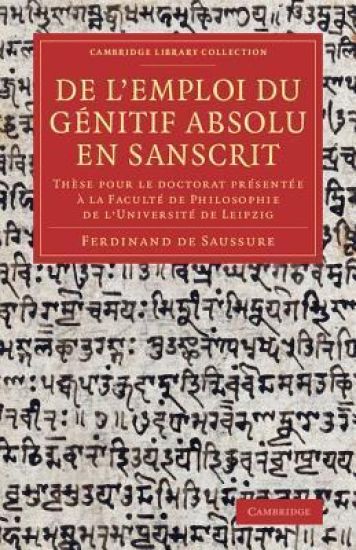
De l'emploi du génitif absolu en Sanscrit
Ferdinand de Saussure
Cambridge University Press
2014
pokkari
Ferdinand de Saussure (1857–1913), the founder of structuralist linguistics and pioneer of semiotics, began his career as a scholar of Indo-European languages (his early study of the Proto-Indo-European vowel system is also reissued in this series: ISBN 9781108006590). In 1880, Saussure was awarded a doctorate from the University of Leipzig for this study, which appeared in print in 1881. He published almost nothing more during his lifetime. Earlier Indo-Europeanists had noted the almost complete absence of the genitive absolute from Classical Sanskrit texts. Saussure argued that it must have been a feature of colloquial speech, as it appears in formulaic expressions in less 'purist' Sanskrit texts, as well as in Pali. He analyses different forms of the construction, and lists nearly 500 examples, many from the Mahabharata and the Ramayana. The thesis is also of interest as it reveals Saussure's early approach to problems of syntax.
Ferdinand de Saussure (1857-1913) oli sveitsiläinen kielitieteilijä, jota pidetään yleisesti strukturalismin ja semiotiikan edelläkävijänä. Kielitieteen puolella hänen työnsä edesauttoi siirtymää historiallis-vertailevasta kielitieteestä nykyaikaiseen kielitieteeseen. Yleisen kielitieteen kurssi koostuu hänen oppilaidensa luentomuistiinpanoista, jotka Saussuren kollegat Charles Bally ja Albert Sechehaye kokosivat kirjaksi vuonna 1916. Juuri tästä teoksesta ovat peräisin sittemmin kuuluisiksi tulleet erottelut kielenkäytön, kielen ja puheen välillä sekä käsitys kielestä merkitsevästä ja merkitystä koostuvien merkkien järjestelmänä.
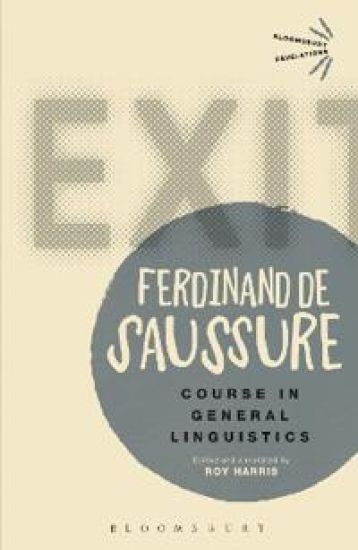
Ferdinand de Saussure is commonly regarded as one of the fathers of 20th Century Linguistics. His lectures, posthumously published as the Course in General Linguistics ushered in the structuralist mode which marked a key turning point in modern thought. Philosophers such as Jacques Derrida and Roland Barthes, psychoanalysts such as Jacques Lacan, the anthropologist ClaudeLevi-Strauss and linguists such as Noam Chomsky all found an important influence for their work in the pages of Saussure's text. Published 100 years after Saussure's death, this new edition of Roy Harris's authoritative translation is now available in the Bloomsbury Revelations series with a substantial new introduction exploring Saussure's contemporary influence and importance.
Mémoire Sur Le Système Primitif Des Voyelles Dans Les Langues Indo-Européennes (Éd.1879)
Ferdinand de Saussure
Hachette Livre - BNF
2012
pokkari

The founder of modern linguistics, Ferdinand de Saussure inaugurated semiology, structuralism, and deconstruction and made possible the work of Jacques Derrida, Roland Barthes, Michel Foucault, and Jacques Lacan, thus enabling the development of French feminism, gender studies, New Historicism, and postcolonialism. Based on Saussure's lectures, Course in General Linguistics (1916) traces the rise and fall of the historical linguistics in which Saussure was trained, the synchronic or structural linguistics with which he replaced it, and the new look of diachronic linguistics that followed this change. Most important, Saussure presents the principles of a new linguistic science that includes the invention of semiology, or the theory of the "signifier," the "signified," and the "sign" that they combine to produce. This is the first critical edition of Course in General Linguistics to appear in English and restores Wade Baskin's original translation of 1959, in which the terms "signifier" and "signified" are introduced into English in this precise way. Baskin renders Saussure clearly and accessibly, allowing readers to experience his shift of the theory of reference from mimesis to performance and his expansion of poetics to include all media, including the life sciences and environmentalism. An introduction situates Saussure within the history of ideas and describes the history of scholarship that made Course in General Linguistics legendary. New endnotes enlarge Saussure's contexts to include literary criticism, cultural studies, and philosophy.
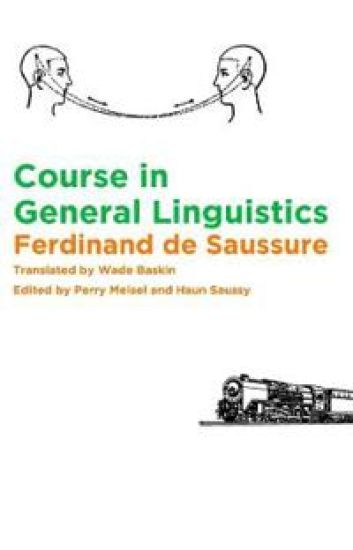
The founder of modern linguistics, Ferdinand de Saussure inaugurated semiology, structuralism, and deconstruction and made possible the work of Jacques Derrida, Roland Barthes, Michel Foucault, and Jacques Lacan, thus enabling the development of French feminism, gender studies, New Historicism, and postcolonialism. Based on Saussure's lectures, Course in General Linguistics (1916) traces the rise and fall of the historical linguistics in which Saussure was trained, the synchronic or structural linguistics with which he replaced it, and the new look of diachronic linguistics that followed this change. Most important, Saussure presents the principles of a new linguistic science that includes the invention of semiology, or the theory of the "signifier," the "signified," and the "sign" that they combine to produce. This is the first critical edition of Course in General Linguistics to appear in English and restores Wade Baskin's original translation of 1959, in which the terms "signifier" and "signified" are introduced into English in this precise way. Baskin renders Saussure clearly and accessibly, allowing readers to experience his shift of the theory of reference from mimesis to performance and his expansion of poetics to include all media, including the life sciences and environmentalism. An introduction situates Saussure within the history of ideas and describes the history of scholarship that made Course in General Linguistics legendary. New endnotes enlarge Saussure's contexts to include literary criticism, cultural studies, and philosophy.
Memoire Sur Le Systeme Primitif Des Voyelles Dans Les Langues Indo-Europeennes (1879)
Ferdinand De Saussure
KESSINGER PUBLISHING, LLC
2010
pokkari
De L'Emploi Du Genitif Absolu En Sanscrit (1881)
Ferdinand De Saussure
KESSINGER PUBLISHING, LLC
2010
pokkari
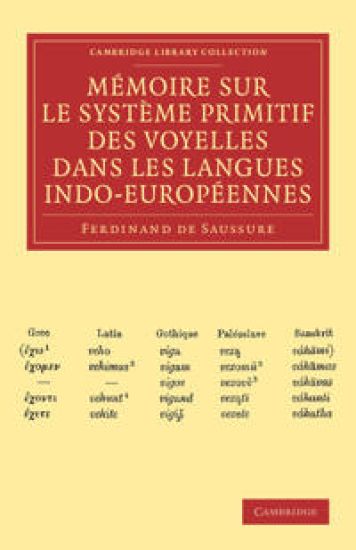
Mémoire sur le système primitif des voyelles dans les langues indo-européennes
Ferdinand de Saussure
Cambridge University Press
2009
pokkari
Written in 1878, while the author was a twenty-year-old student in Berlin, Saussure's only full-length work proposed the existence of two additional sonant coefficients in the Indo-European parent language. Applying the methods of comparison and internal reconstruction to Proto-Indo-European, Saussure argued that the long vowels had developed from a short vowel plus a sonant coefficient. A hypothesis far ahead of its time, his proposal was not confirmed until 1927 when a consonantal phoneme etymologically derived from Saussure's A was discovered in newly deciphered Hittite, the oldest attested Indo-European language. Not only is the Mémoire a dramatic demonstration of the method of internal reconstruction, but it also paved the way for further developments in historical phonology including laryngeal theory, and may have stimulated Saussure's later development of structuralism. This reissue includes, as an appendix, Antoine Meillet's 1913 obituary of Saussure.

Memoire Sur Le Systeme Primitif Des Voyelles Dans Les Langues Indo-Europeennes (1887)
Ferdinand De Saussure
KESSINGER PUBLISHING, LLC
2009
pokkari
Ferdinand de Saussure's Cours de linguistique générale was posthumously composed by his students from the notes they had made at his lectures. The book became one of the most influential works of the twentieth century, giving direction to modern linguistics and inspiration to literary and cultural theory. Before he died Saussure told friends he was writing up the lectures himself but no evidence of this was found. Eighty years later in 1996 a manuscript in Saussure's hand was discovered in the orangerie of his family house in Geneva. This proved to be the missing original of the great work. It is published now in English for the first time in an edition edited by Simon Bouquet and Rudolf Engler, and translated and introduced by Carol Sanders and Matthew Pires, all leading Saussure scholars. The book includes an earlier discovered manuscript on the philosophy of language, Saussure's own notes for lectures, and a comprehensive bibliography of major work on Saussure from 1970 to 2004. It is remarkable that for eighty years the understanding of Saussure's thought has depended on an incomplete and non-definitive text, the sometimes aphoristic formulations of which gave rise to many creative interpretations and arguments for and against Saussure. Did he, or did he not, see language as a-social and a-historical? Did he, or did he not, rule out the study of speech within linguistics? Was he a reductionist? These disputes and many others can now be resolved on basis of the work now published. This reveals new depth and subtetly in Saussure's thoughts on the nature and complex workings of language, particularly his famous binary oppositions between form and meaning, the sign and what is signified, and language (langue) and its performance (parole).
Grundfragen Der Allgemeinen Sprachwissenschaft
Ferdinand De Saussure; Peter Ernst
de Gruyter
2001
sidottu
Der beruhmte Text stellt den Ausgangspunkt fur die Beschaftigung mit dem Strukturalismus dar. Die deutsche Ubersetzung erschien 1931, die 2. Auflage von 1967 leitete im deutschsprachigen Raum die bis heute andauernde intensive Saussure-Rezeption ein. 1916 veroffentlichten zwei Schuler Saussures drei Vorlesungen unter dem Titel "Cours de linguistique generale." Der Text beruhte auf den Mitschriften von drei Vorlesungen uber allgemeine Sprachwissenschaft, die Saussure 1907 bis 1911 hielt. Der "Cours" wurde nicht nur zum Ausgangspunkt fur eine Reihe von neuen linguistischen Disziplinen (wie Phonologie, strukturalistische Morphologie, strukturalistische Syntax, strukturelle Semantik, Glossematik), sondern beeinflusste auch traditionelle Richtungen wie die Sprachgeschichte, Dialektologie und Sprachphilosophie. Aus dem Nachwort: Wie jedes grosse Werk lebt auch der "Cours" dadurch weiter, dass er vielerlei Interpretationen zulasst... Seine Bedeutung kann aber wohl noch immer am treffendsten mit jener knappen Formulierung umschrieben werden, die Leonard Bloomfield schon 1923 in seiner Rezension gab: Der Wert des "Cours" besteht in seiner klaren und genauen Darstellung der fundamentalen Prinzipien. Das meiste von dem, was der Autor sagt, lag schon seit langem "in der Luft," die Systematisierung aber stammt von ihm. ...] Der entscheidende Punkt aber ist, dass de Saussure hier zum ersten Mal die Welt ausgemessen hat, in der die historische Grammatik des Indo-Europaischen (die grosse Errungenschaft des vorigen Jahrhunderts) nur ein einzelnes Teilgebiet darstellt; er hat uns die theoretische Grundlage fur eine Wissenschaft von der menschlichen Sprache gegeben."