Kirjojen hintavertailu. Mukana 12 182 302 kirjaa ja 12 kauppaa.

Kirjailija

Fernando de Holanda Barbosa

Kirjat ja teokset yhdessä paikassa: 7 kirjaa, julkaisuja vuosilta 2016-2026, suosituimpien joukossa Workbook for Macroeconomic Theory. Vertaile teosten hintoja ja tarkista saatavuus suomalaisista kirjakaupoista.

7 kirjaa

Kirjojen julkaisuhaarukka 2016-2026.

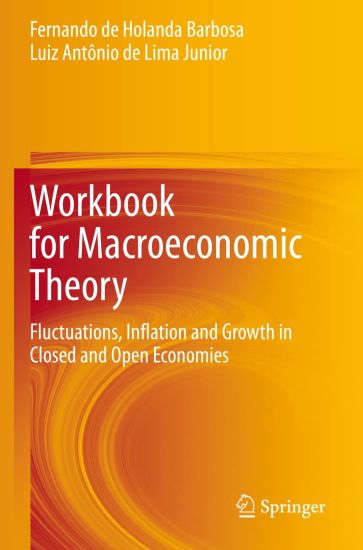
Workbook for Macroeconomic Theory

Workbook for Macroeconomic Theory

Fernando de Holanda Barbosa; Luiz Antônio de Lima Junior

Springer Nature Switzerland AG
2022
nidottu
This workbook presents the answers to the exercises in Macroeconomic Theory, Fluctuations, Inflation and Growth in Closed and Open Economies by Fernando de Holanda Barbosa (2018). Altogether, there are 172 exercises in eleven chapters and three appendices. The organization of this workbook follows the organization of the main text. The first part deals with flexible price models, including the representative agent model, the overlapping generations model, and the Solow growth model. The second part covers sticky price models; both Keynesian and Neoclassical. The third part presents exercises on the government budget constraint and monetary theory issues. There are two types of exercises in this workbook. The first type provides the student with material to practice for a full understanding the subjects presented in the text. The second type covers topics that are not dealt with in the main text, but are included for the sake of completeness. These exercises are marked with an asterisk and can be solved using the tools presented in the corresponding textbook chapter or appendix.
Workbook for Macroeconomic Theory

Workbook for Macroeconomic Theory

Fernando de Holanda Barbosa; Luiz Antônio de Lima Junior

Springer International Publishing AG
2025
sidottu
This book presents the answers to the exercises in Macroeconomic Theory, Fluctuations, Inflation and Growth in Closed and Open Economies, 2nd Edition, by Fernando de Holanda Barbosa (Cham, Switzerland: Springer, 2024), hereafter referred as Macro Theory. Altogether, there are 170 exercises in eleven chapters and three appendices. Many of these exercises are based on, or inspired in, the literature listed in the bibliography of Macro Theory, although the sources are not documented. The goal of a good number of exercises is to help the student to develop the skills necessary to obtain the model’s empirically testable predictions. You should try to solve each exercise by yourself but do not be upset if you cannot. Some exercises are very hard and take time to work out. However, to learn, you should persevere and try again and again. We hope that this workbook will help you in the learning process of macroeconomic theory. The most important change in this second edition is Part IV, which presents an abridged survey of the empirical evidence on macroeconomic models. This part has four chapters. Chapter 12 takes care of growth. Chapter 13 analyzes the main characteristics of business cycles. Chapter 14 presents the empirical evidence on Keynesian models, and Chapter 15 deals with several issues related to the budget constraint, such as chronic inflation, the pathologies of hyperinflation, public debt crises, external debt crises and the fiscal theory of the price level.
Macroeconomic Theory

Macroeconomic Theory

Fernando de Holanda Barbosa

Springer International Publishing AG
2024
sidottu
Macroeconomics is the application of economic theory to the study of the economy’s growth, cycle and price-level determination. Macroeconomics takes account of stylized facts observed in the real world and builds theoretical frameworks to explain such facts. Economic growth is a stylized fact of market economies, since England’s nineteenth-century industrial revolution. Until then, poverty was a common good for humanity. Economic growth consists in the persistent, smooth and sustained increase of per-capita income. A market economy shows periods of expanding and contracting economic activity. This phenomenon is the economic cycle. The price of money is the amount of goods bought with one unit of money, in other words, the inverse of the price level. Determination of the price level, or the value of money, is a fascinating subject in a fiat money economy. Revised and updated, the second edition introduces a number of new topics, including the New Keynesian IS Curve, Real BusinessCycles, and the Consumption Asset Pricing Model, as well as updated end-of-chapter exercises.
Macroeconomic Theory

Macroeconomic Theory

Fernando de Holanda Barbosa

Springer Nature Switzerland AG
2019
nidottu
Macroeconomics is the application of economic theory to the study of the economy’s growth, cycle and price-level determination. Macroeconomics takes account of stylized facts observed in the real world and builds theoretical frameworks to explain such facts. Economic growth is a stylized fact of market economies, since England’s nineteenth-century industrial revolution. Until then, poverty was a common good for humanity. Economic growth consists in the persistent, smooth and sustained increase of per-capita income. A market economy shows periods of expanding and contracting economic activity. This phenomenon is the economic cycle. The price of money is the amount of goods bought with one unit of money, in other words, the inverse of the price level. Determination of the price level, or the value of money, is a fascinating subject in a fiat money economy.
Macroeconomic Theory

Macroeconomic Theory

Fernando de Holanda Barbosa

Springer International Publishing AG
2018
sidottu
Macroeconomics is the application of economic theory to the study of the economy’s growth, cycle and price-level determination. Macroeconomics takes account of stylized facts observed in the real world and builds theoretical frameworks to explain such facts. Economic growth is a stylized fact of market economies, since England’s nineteenth-century industrial revolution. Until then, poverty was a common good for humanity. Economic growth consists in the persistent, smooth and sustained increase of per-capita income. A market economy shows periods of expanding and contracting economic activity. This phenomenon is the economic cycle. The price of money is the amount of goods bought with one unit of money, in other words, the inverse of the price level. Determination of the price level, or the value of money, is a fascinating subject in a fiat money economy.
Exploring the Mechanics of Chronic Inflation and Hyperinflation

Exploring the Mechanics of Chronic Inflation and Hyperinflation

Fernando de Holanda Barbosa

Springer International Publishing AG
2016
nidottu
This book presents a theoretical framework to explain chronic inflation and hyperinflation. The roots of these two phenomenon are a fiscal monetary regime in which money issues finance the public deficit. Chronic inflation is modeled by using both the old and the new Keynesian model, with a different policy rule. Instead of using the Taylor rule, the central bank policy rule states that money is issued to finance the public deficit. The chronic inflation models take into account the fact that indexation mechanisms adjust prices and wages, yielding the inertial component of inflation. The dynamics of these models can be very unstable under parameter changes or shocks that hit the economy. The previous hyperinflation models surveyed in this book attempt to explain hyperinflation as a bubble phenomenon because they assume a constant real deficit financed by money. The mechanics of hyperinflation models in this book explains hyperinflation by a fiscal crisis, characterized by an increasing fiscal deficit. This fiscal crisis yields an intertemporal budget constraint that is not sustainable. The analysis of the pathology of hyperinflation uses the same tools employed to understand the pathologies of public debt and external debt crises. The hyperinflation model allows a taxonomy of hyperinflations, namely bubble, weak and strong, that can be tested with the inflation tax revenue curve.