Kirjojen hintavertailu. Mukana 12 595 353 kirjaa ja 12 kauppaa.

Kirjailija

Flemming Poulfelt

Kirjat ja teokset yhdessä paikassa: 10 kirjaa, julkaisuja vuosilta 2006-2023, suosituimpien joukossa Managing the Knowledge-Intensive Firm. Vertaile teosten hintoja ja tarkista saatavuus suomalaisista kirjakaupoista.

10 kirjaa

Kirjojen julkaisuhaarukka 2006-2023.

Strategi - Sådan skabes værdi i en volatil verden

Strategi - Sådan skabes værdi i en volatil verden

Flemming Poulfelt; Michael Moesgaard Andersen

Lindhardt og Ringhof
2023
nidottu
Står I overfor at skulle forny eller opdatere jeres strategi, så giver STRATEGI et perfekt afsæt for indsatsen. I får en grundig indsigt i den nyeste viden om strategier i moderne virksomheder samt hele 101 strategiske værktøjer, som I kan bringe i spil med det samme. Med STRATEGI bringer Michael Moesgaard Andersen og Flemming Poulfelt jer direkte ind i det strategiske maskinrum og giver svar på en række centrale spørgsmål: • Hvorfor er det overhovedet nødvendigt at arbejde med strategi? • Hvordan kan der arbejdes med strategi, og hvem skal inddrages? • Hvilke metoder og værktøjer egner sig til forskellige situationer? • Hvordan kan en strategi eksekveres, så der opnås maksimal effekt? Bogens pointer illustreres med masser af referencer til kendte virksomheder, der har arbejdet mere eller mindre succesfuldt med deres strategi. For eksempel får du svar på, hvorfor danske B&O ikke har opnået Apples succes, på trods af at virksomhederne for år tilbage delte mange kernekompetencer. Du får også illustrationer af, hvordan der kan gennemføres digitale tjek af strategien bl.a. ved hjælp af AI. STRATEGI er oplagt læsning for ledere, medarbejdere, bestyrelsesmedlemmer og rådgivere, der tager aktiv del i virksomhedens strategiproces, og for studerende med interesse for strategisk arbejde og teori.
Beyond Strategy

Beyond Strategy

Michael Moesgaard Andersen; Flemming Poulfelt

Routledge
2014
nidottu
Why is it that some companies turn out to be more successful when doing the opposite of what is prescribed in many of the current books on management and strategy?Interestingly, many of the companies depicted as very successful companies in the standard literature end up not faring well over time - probably because they somehow end up in a dangerous autopilot mode. What this suggests is that the conventional literature cookbook isn’t telling us the whole story. Even if companies have temporarily developed from an ugly duckling to a white swan, the popular recipes for success may be clipping such companies’ wings. Conversely, companies adhering to disruptive business models are seen to be more agile and to possess a higher degree of actionability. Such next generation companies are labeled black swans. They thrive because they are bold and embrace the great unknowns of tomorrow with open minds and eyes. At the same time, they are able to take advantage of incumbents’ fears, risk-aversion and blindness to what’s coming. Beyond Strategy delves into the inner workings of such black swans as Apple, Aravind, Emirates, Huawei, Natura, Ryanair and Tata and addresses the rise and fall of Nokia. The authors provide explosive evidence of black swan companies working against the norms to enter unchartered waters, determined not to adhere to the best practice of others, but rather to create a genuine next generation practice.Next generation companies and their underlying philosophies are here to stay – are you?
Beyond Strategy

Beyond Strategy

Michael Moesgaard Andersen; Flemming Poulfelt

Routledge
2014
sidottu
Why is it that some companies turn out to be more successful when doing the opposite of what is prescribed in many of the current books on management and strategy?Interestingly, many of the companies depicted as very successful companies in the standard literature end up not faring well over time - probably because they somehow end up in a dangerous autopilot mode. What this suggests is that the conventional literature cookbook isn’t telling us the whole story. Even if companies have temporarily developed from an ugly duckling to a white swan, the popular recipes for success may be clipping such companies’ wings. Conversely, companies adhering to disruptive business models are seen to be more agile and to possess a higher degree of actionability. Such next generation companies are labeled black swans. They thrive because they are bold and embrace the great unknowns of tomorrow with open minds and eyes. At the same time, they are able to take advantage of incumbents’ fears, risk-aversion and blindness to what’s coming. Beyond Strategy delves into the inner workings of such black swans as Apple, Aravind, Emirates, Huawei, Natura, Ryanair and Tata and addresses the rise and fall of Nokia. The authors provide explosive evidence of black swan companies working against the norms to enter unchartered waters, determined not to adhere to the best practice of others, but rather to create a genuine next generation practice.Next generation companies and their underlying philosophies are here to stay – are you?
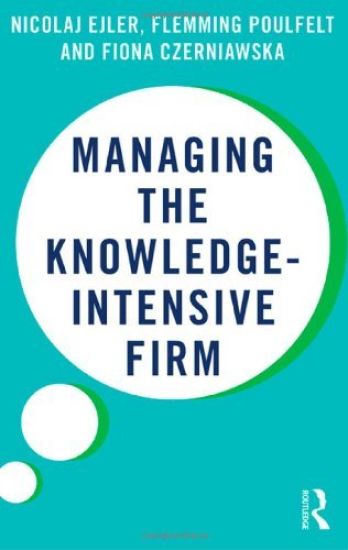
Managing the Knowledge-Intensive Firm

Managing the Knowledge-Intensive Firm

Nicolaj Ejler; Flemming Poulfelt; Fiona Czerniawska

Routledge
2011
sidottu
Over the last decade, there has been a substantial rise in the number of knowledge-intensive firms - constituted primarily of professionals. The core assets of these businesses are the people themselves. Handle them badly, and they may defect or stall. Successful managers of knowledge-intensive firms must create meaning among and inspire their employees, to ensure high performance. To achieve this, leaders must understand how to target each employee’s ambitions and challenges to facilitate their personal and professional development.This book examines what sets knowledge-intensive firms apart from other types of organizations, and the resultant organizational and strategic differences in business models, talent management, and client-handling approaches. The authors bring their own complementary perspectives on the subject: one, as the manager of a private consulting firm with a strong research background; another, as a business school professor whose practice-based skills are fundamental to his work; and a third, a world leading commentator on professional service firms acting as a consultant, business school researcher and a manager. Ejler, Poulfelt and Czerniawska present a new model for transforming the management of knowledge-intensive firms, which is supported throughout with practical examples and cases.
Managing the Knowledge-Intensive Firm

Managing the Knowledge-Intensive Firm

Nicolaj Ejler; Flemming Poulfelt; Fiona Czerniawska

Routledge
2011
nidottu
Over the last decade, there has been a substantial rise in the number of knowledge-intensive firms - constituted primarily of professionals. The core assets of these businesses are the people themselves. Handle them badly, and they may defect or stall. Successful managers of knowledge-intensive firms must create meaning among and inspire their employees, to ensure high performance. To achieve this, leaders must understand how to target each employee’s ambitions and challenges to facilitate their personal and professional development.This book examines what sets knowledge-intensive firms apart from other types of organizations, and the resultant organizational and strategic differences in business models, talent management, and client-handling approaches. The authors bring their own complementary perspectives on the subject: one, as the manager of a private consulting firm with a strong research background; another, as a business school professor whose practice-based skills are fundamental to his work; and a third, a world leading commentator on professional service firms acting as a consultant, business school researcher and a manager. Ejler, Poulfelt and Czerniawska present a new model for transforming the management of knowledge-intensive firms, which is supported throughout with practical examples and cases.
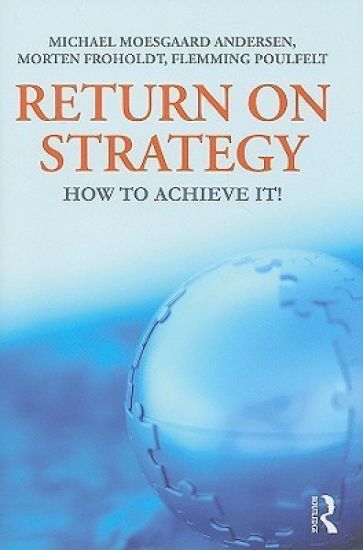
Return on Strategy

Return on Strategy

Flemming Poulfelt; Morten Froholdt & Michael Moesgaard Andersen

Lindhardt og Ringhof
2010
sidottu
Siden Michael Porter publicerede sine skoledannende tekster, har det været god strategi-latin, at en virksomhed, der ikke vælger en klar strategi, men for eksempel satser på både differentiering og omkostningslederskab, placerer sig et uhensigtsmæssigt sted: “i midten af det hele”. Men faktisk bygger yderst succesfulde virksomheder som Google, Saxo Bank, Huawei og Ryanair bro mellem strategier – ofte med disruptive virkninger til følge for markedet. Med udgangspunkt i europæiske, asiatiske og amerikanske virksomheder tager Return on Strategy læseren med på en fascinerende rejse i det udefinerbare X-faktorunivers, som kun firmaer, der behersker disruptive strategier, har adgang til. De tre forfattere fremlægger den tese, at det store udbytte, disse yderst succesfulde firmaer henter hjem, netop bliver opnået på baggrund af disruptive strategier – at der er tale om en egentlig Samtidig tager forfatterne et opsigtsvækkende opgør med strategilitteraturens klassikere som Good to Great og In Search of Excellence. Hvordan kan det være, spørger de, at mange af de firmaer, der engang var “fantastiske” og “excellente”, i dag er en skygge af sig selv – hvis de da overhovedet eksisterer? Return on Strategy - når strategi kan skabe afgørende resultater udkom i december 2009 på amerikansk.
Return on Strategy

Return on Strategy

Michael Moesgaard; Morten Froholdt; Flemming Poulfelt

Routledge
2009
sidottu
Why is it that many companies meticulously following recipes on management and strategy fail? Did Google, Skype, Ryanair, Huawei and a number of other successful companies buy into a well thought out strategy and adhered to that over time? How do companies deliberately opting out of the recipe game and opting into the out-of-the-box-thinking fare? In short, why is it that some companies achieve a higher Return on Strategy than others?Whereas Return on Investment (RoI) has attracted increased attention over the last couple of decades, little, if any, attention is being paid to whether companies do at all achieve Return on Strategy (RoS) and how. This book provides an overview of contemporary strategy literature and recipes brushed up with a view to identifying explanations as to how recipes has seldom worked as intended. One out of several reasons rests on the fact that recipes do not take the so-called X-factor into account.With the X-factor as the starting point the book examines a sample of 50 global companies of which some has achieved a remarkable high Return on Strategy and others failed. The 50 companies covers most continents as some are from the North America, some are from the European continent and others are from different parts of the emerging Asian region – threatening companies from the Western hemisphere.The book explains the reason behind success and failures and provides practical tools as to how companies may increase their Return on Strategy. In the toolbox, you will find a framework on how to increase the Return on Strategy as well a number of dynamic positioning tools, road maps and bearing points. Invariably, more and more companies - including consultants, business leaders and MBAs - now work diligently in order to increase their Return on Strategy and the best of them are here to stay successfully – are you?
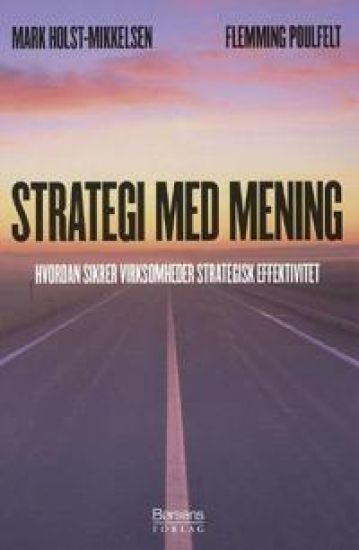
Strategi med mening

Strategi med mening

Flemming Poulfelt; Mark Holst-Mikkelsen

Lindhardt og Ringhof
2008
nidottu
Om Strategi med mening Strategi med mening giver værdifuld inspiration og dokumenteret viden, der gør virksomheder i stand til at lykkes bedre med deres strategier. Ny forskning dokumenterer, at når strategier giver mening, skaber virksomheder bedre resultater. Strategien skal af øverste ledelse, mellemledere og medarbejdere opleves som rigtig, fornuftig og nødvendig i forhold til virksomhedens særlige situation og udviklingsbehov. Derudover gælder det om at tænde lyset i øjnene på de ansatte og udvikle den strategiske handlekraft i hele organisationen. Strategi med mening tager hånd om den problemstilling, at virksomheder investerer masser af tid, energi og ressourcer på at udvikle og implementere nye strategier - uden nødvendigvis at nå den fulde effekt. Ja, faktisk oplever danske virksomheder kun at udnytte 60 % af deres potentiale. Bogen er spækket med dokumenteret viden, gode eksempler og praktiske ledererfaringer, der giver en præcis forståelse for danske virksomheders udfordringer med at udvikle og implementere strategier. Bogen gør det tydeligt, hvordan virksomheden udvikler det strategiske lederskab gennem fokuseret involvering af organisationen i de aktiviteter, som gør den største forskel. Det indebærer, at man på samme tid realiserer de fastlagte målsætninger og bruger færrest mulige ressourcer på det. Strategi med mening henvender sig til ledere og andre, som ønsker at bidrage på den mest effektive måde til at realisere virksomhedens målsætninger.
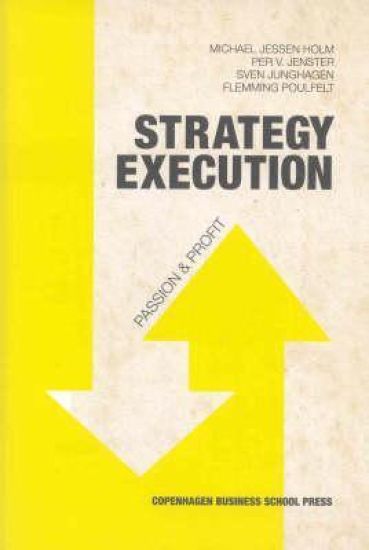
Strategy Execution

Strategy Execution

Michael Jessen Holm; Per V Jenster; Sven Junghagen; Flemming Poulfelt

Copenhagen Business School Press
2007
nidottu
The literature on strategy in small and medium-sized enterprises (SMEs) is fairly limited despite their great innovative talents. This book provides the reader with a thorough insight into six companies and their prerequisites for creating growth. Strategy Execution focuses on a varied picture of Scandinavian SMEs, and illustrates how this group of companies can contribute with new ways of managerial thinking and progress in the business community. It presents the best practice framework for strategic management.
Discount Business Strategy

Discount Business Strategy

Michael Moesgaard Andersen; Flemming Poulfelt

John Wiley Sons Inc
2006
sidottu
What people are saying about Discount Business Strategy: "Michael Andersen and Flemming Poulfelt provide a provocative discussion of the rapidly growing role of discounters across numerous industries: how they operate; how they create uniqueness; and how they can destroy value for incumbents. Understanding the specific moves and tools that the authors analyze will be valuable for attackers and incumbents alike." —Adrian J. Slywotzky, Director, Mercer Management Consulting USA "This book is very timely, dealing with today's most critical strategic issue: how to provide more value to the consumer through aggressive discounting. Those players in manufacturing and distribution who master this will be the winners; many established firms will fall by the wayside. A similar set of issues are facing many nations today - Europe vs. Asia!" —Peter Lorange, President, IMD, Switzerland "Andersen and Poulfelt have researched one of the most important themes in today's business world - how fundamentally new business models have wiped out establishments not with new products or technologies, but by creating new rules for conventional industries. Read this book and learn how to recognize the disruption of your industry before it is too late!" —Sigurd Liljenfeldt, Senior Partner, Monitor Group, France "This book asks if a firm can have its cake and eat it too - that is, maintain high quality at low prices. My favourite example and shopping place is big box Costco. Ikea is another. A must read for a broad audience concerned about corporate survival!" —Professor Larry E. Greiner, Marshall School of Business, University of Southern California, USA The aspiration to adopt the right strategy still prevails over the business world. But is there a single 'best' strategy for a company? Can an organization create sustainable competitive advantage from an 'off-the-peg' strategy? And are most companies likely to craft a strategy that genuinely creates uncontested market space and makes the competition irrelevant? The answer to all these questions is probably 'No'. And the rising tide of companies like Dell, CostCo, Skype and Linux means that asking them at all may soon be futile. While strategists have foundered in old paradigms, a new breed of competitors has emerged. Value destroyers. Old-style thinking understood value destruction when it was confined to an industry and driven by a new product or technology. But what are the implications when the destruction stems from a new way of thinking - from a strategy that simultaneously creates value? The implications are enormous. Every company in every industry is potentially at risk. This risk - or opportunity - is precisely the reason for this book and its focus on exploring why and how some companies have bridged the gap between differentiator and cost leader strategies to emerge as winners in hypercompetitive markets, and what this entails in terms of value destruction and creation. Discounting organizations are here to stay - are you?