Kirjojen hintavertailu. Mukana 12 628 103 kirjaa ja 12 kauppaa.

Kirjailija

Florin Mihai

Kirjat ja teokset yhdessä paikassa: 3 kirjaa, julkaisuja vuosilta 2016-2019, suosituimpien joukossa Language and Literacy Development. Vertaile teosten hintoja ja tarkista saatavuus suomalaisista kirjakaupoista.

3 kirjaa

Kirjojen julkaisuhaarukka 2016-2019.

Language and Literacy Development

Language and Literacy Development

Linda I. Rosa-Lugo; Florin Mihai; Joyce Nutta

Plural Publishing Inc
2019
nidottu
Language and Literacy Development: English Learners with Communication Disorders, From Theory to Application, Second Edition brings you the most useful, up-to-date information on best practices for English learners (ELs) with communication disorders from a variety of backgrounds—how to conduct assessment, intervention, and progress monitoring. The first edition of this text gave a comprehensive overview of the theory and practice of serving ELs with communication disorders, and the second edition is expanded to show the nuts and bolts of how to meet ELs' needs and how professionals can support their success at school. Continuing the perspective of the first edition, this text emphasizes collaboration between speech-language pathology (SLP) and English for speakers of other languages (ESOL) professionals. To place theory, policies, and best practices in a realistic, relatable context, this text presents engaging, detailed teaching cases that address common issues that SLPs and ESOL specialists encounter. More importantly, it shows how to apply the knowledge and implement the mechanics and practicalities of assessment, intervention, and progress monitoring. The new resources section includes many useful tools and references, such as a case history form for bilingual students, WIDA Can-do Descriptors and Performance Definitions, actual assessment instruments, and a table of intervention types and purposes. The primary audience for this text is the school-based speech-language pathologist. It is also intended for all professionals who are responsible for teaching language and literacy skills, such as the ESOL professional, general and special educators, bilingual teachers, reading coaches and school administrators. Language and Literacy Development, Second Edition can also be used as a textbook in academic programs.
Assessing English Learners in the Content Areas, Second Edition

Assessing English Learners in the Content Areas, Second Edition

Florin Mihai

The University of Michigan Press
2017
nidottu
The new edition of Assessing English Learners in the Content Areas: A Research-into-Practice Guide for Educators seeks to provide guidance to classroom teachers, staff developers, and test-item designers who want to improve ESL assessment outcomes, in the content areas of language arts, math, science and social studies. Significant modifications in education legislation since the publication of the first edition have necessitated this new volume, which includes updated EL demographics as they relate to the Common Core Standards and Every Student Succeeds Act and revised state-by-state test accommodation information. New to this edition is information about the assessment of language arts (in addition to math, science, and social studies). The Second Edition also features new research-based recommendations for large-scale and classroom-based assessments. Like the previous edition, the first two chapters of the book establish the background for the discussion of content-area assessment for ELs, examining several important characteristics of this rapidly growing student population and providing a description of various forms of assessment, including how EL assessment is different from the assessment of English-proficient students. Important assessment principles that educators should use in their evaluation of tests or other forms of measurement are provided. Other chapters review EL test accommodations nationwide (because, surprisingly, most teachers do not know what they can and cannot allow) and the research on the effectiveness of these types of accommodations. The book analyzes the characteristics of alternative assessment and makes recommendations as to how to increase the validity, reliability, and practicality of alternative assessments. The book proposes fundamental assessment practices to help content area teachers in their evaluation of their students’ progress. Two extensive appendixes outline TESOL Proficiency Standards and academic vocabulary for the content areas.
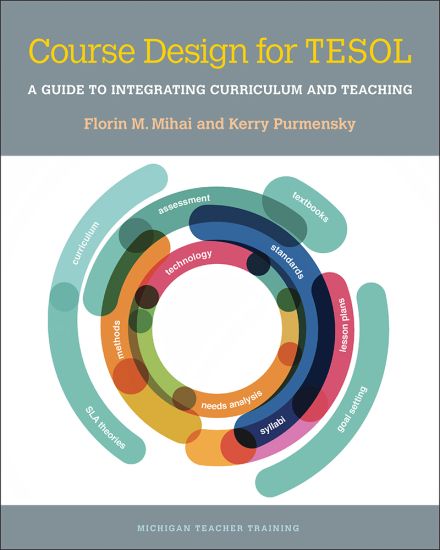
Course Design for TESOL

Course Design for TESOL

Florin Mihai; Kerry Purmensky

The University of Michigan Press
2016
nidottu
Course Design for TESOL offers a unique approach of integrating curriculum with teaching activities to allow language educators to utilize the text in a variety of courses in a TESOL program. Although the authors assume readers have a basic knowledge of English grammar, this textbook/resource is designed to be comprehensible to those who have not had an SLA or Applied Linguistics course. Because each language skill is discussed in detail in terms of important theories and concepts and actual teaching activities are included, the book can also be used in a Methods course or a combined Curriculum Design–Methods (or Methods and Materials) course. Part I explores the basic language acquisition theories and their influences on current teaching practices in the field. Part II then moves on to the core elements of designing a curriculum or course: conducting the needs analysis, setting of course goals/objectives, designing the syllabus, and writing lesson plans. Part III: Instructional Activities and Assessment Techniques features chapters on the teaching of listening, speaking, reading, writing, grammar, and culture. Within each of these chapters, the authors address the fundamental issues related to the teaching of each skill and then discuss the components of a good activity for that skill (and how to design one), and then offer four sample activities (one for each type of syllabus) and guidance on assessing that skill. The activities can be adapted for use in a variety of classrooms and settings. Part IV addresses contemporary trends—curriculum issues in North America and Europe (standards and educational policy), practices in teaching in Asia (particularly China and Korea), and technology-enhanced learning.