Kirjojen hintavertailu. Mukana 12 595 353 kirjaa ja 12 kauppaa.

Kirjailija

Francesco A Fabozzi

Kirjat ja teokset yhdessä paikassa: 6 kirjaa, julkaisuja vuosilta 2020-2022, suosituimpien joukossa Introduction To Finance: Financial Management And Investment Management. Vertaile teosten hintoja ja tarkista saatavuus suomalaisista kirjakaupoista.

Mukana myös kirjoitusasut: Francesco A. Fabozzi

6 kirjaa

Kirjojen julkaisuhaarukka 2020-2022.

Introduction To Finance: Financial Management And Investment Management

Introduction To Finance: Financial Management And Investment Management

Pamela Peterson Drake; Frank J Fabozzi; Francesco A Fabozzi

WORLD SCIENTIFIC PUBLISHING CO PTE LTD
2022
nidottu
This book covers the fundamentals of financial management and investment management without getting into the highly technical topics and mathematical rigor. It also provides a practitioner-oriented approach to financial and investment management.The field of finance covers several specialty areas. The two most important ones which set the foundations for the other specialty areas are financial management and investment management, and these are the two major topics covered in the book. After touching on the basics — the financial system and the players, financial statements, and mathematics of finance — the authors then cover financial management and investment management in greater depth. For financial management the authors focus on financial strategy and financial planning, dividend policy, corporate financing decisions, entrepreneurial finance, financial risk management, and capital budgeting decisions. The investment management coverage includes the different types of risks faced in investing, company analysis, valuing common stock, portfolio selection, asset pricing theory, and investing in common stocks and bonds. The last chapter of the book covers financial derivatives and how they are used in finance to control risk.
Introduction To Finance: Financial Management And Investment Management

Introduction To Finance: Financial Management And Investment Management

Pamela Peterson Drake; Frank J Fabozzi; Francesco A Fabozzi

World Scientific Publishing Co Pte Ltd
2022
sidottu
This book covers the fundamentals of financial management and investment management without getting into the highly technical topics and mathematical rigor. It also provides a practitioner-oriented approach to financial and investment management.The field of finance covers several specialty areas. The two most important ones which set the foundations for the other specialty areas are financial management and investment management, and these are the two major topics covered in the book. After touching on the basics — the financial system and the players, financial statements, and mathematics of finance — the authors then cover financial management and investment management in greater depth. For financial management the authors focus on financial strategy and financial planning, dividend policy, corporate financing decisions, entrepreneurial finance, financial risk management, and capital budgeting decisions. The investment management coverage includes the different types of risks faced in investing, company analysis, valuing common stock, portfolio selection, asset pricing theory, and investing in common stocks and bonds. The last chapter of the book covers financial derivatives and how they are used in finance to control risk.
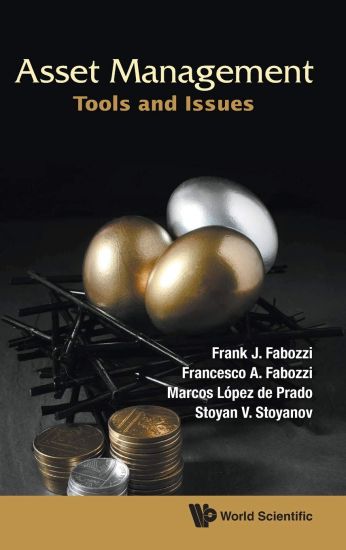
Asset Management: Tools And Issues

Asset Management: Tools And Issues

Frank J Fabozzi; Francesco A Fabozzi; Marcos Lopez De Prado; Stoyan V Stoyanov

World Scientific Publishing Co Pte Ltd
2021
sidottu
Long gone are the times when investors could make decisions based on intuition. Modern asset management draws on a wide-range of fields beyond financial theory: economics, financial accounting, econometrics/statistics, management science, operations research (optimization and Monte Carlo simulation), and more recently, data science (Big Data, machine learning, and artificial intelligence). The challenge in writing an institutional asset management book is that when tools from these different fields are applied in an investment strategy or an analytical framework for valuing securities, it is assumed that the reader is familiar with the fundamentals of these fields. Attempting to explain strategies and analytical concepts while also providing a primer on the tools from other fields is not the most effective way of describing the asset management process. Moreover, while an increasing number of investment models have been proposed in the asset management literature, there are challenges and issues in implementing these models. This book provides a description of the tools used in asset management as well as a more in-depth explanation of specialized topics and issues covered in the companion book, Fundamentals of Institutional Asset Management. The topics covered include the asset management business and its challenges, the basics of financial accounting, securitization technology, analytical tools (financial econometrics, Monte Carlo simulation, optimization models, and machine learning), alternative risk measures for asset allocation, securities finance, implementing quantitative research, quantitative equity strategies, transaction costs, multifactor models applied to equity and bond portfolio management, and backtesting methodologies. This pedagogic approach exposes the reader to the set of interdisciplinary tools that modern asset managers require in order to extract profits from data and processes.
Fundamentals Of Institutional Asset Management

Fundamentals Of Institutional Asset Management

Frank J Fabozzi; Francesco A Fabozzi

World Scientific Publishing Co Pte Ltd
2020
nidottu
This book provides the fundamentals of asset management. It takes a practical perspective in describing asset management. Besides the theoretical aspects of investment management, it provides in-depth insights into the actual implementation issues associated with investment strategies. The 19 chapters combine theory and practice based on the experience of the authors in the asset management industry. The book starts off with describing the key activities involved in asset management and the various forms of risk in managing a portfolio. There is then coverage of the different asset classes (common stock, bonds, and alternative assets), collective investment vehicles, financial derivatives, common stock analysis and valuation, bond analytics, equity beta strategies (including smart beta), equity alpha strategies (including quantitative/systematic strategies), bond indexing and active bond portfolio strategies, and multi-asset strategies. The methods of using financial derivatives (equity derivatives, interest rate derivatives, and credit derivatives) in managing the risks of a portfolio are clearly explained and illustrated.
Fundamentals Of Institutional Asset Management

Fundamentals Of Institutional Asset Management

Frank J Fabozzi; Francesco A Fabozzi

World Scientific Publishing Co Pte Ltd
2020
sidottu
This book provides the fundamentals of asset management. It takes a practical perspective in describing asset management. Besides the theoretical aspects of investment management, it provides in-depth insights into the actual implementation issues associated with investment strategies. The 19 chapters combine theory and practice based on the experience of the authors in the asset management industry. The book starts off with describing the key activities involved in asset management and the various forms of risk in managing a portfolio. There is then coverage of the different asset classes (common stock, bonds, and alternative assets), collective investment vehicles, financial derivatives, common stock analysis and valuation, bond analytics, equity beta strategies (including smart beta), equity alpha strategies (including quantitative/systematic strategies), bond indexing and active bond portfolio strategies, and multi-asset strategies. The methods of using financial derivatives (equity derivatives, interest rate derivatives, and credit derivatives) in managing the risks of a portfolio are clearly explained and illustrated.