

Kirjailija
Francis Bacon
Kirjat ja teokset yhdessä paikassa: 600 kirjaa, julkaisuja vuosilta 1810-2026, suosituimpien joukossa La Nueva Atlántida: Spanish Version. Vertaile teosten hintoja ja tarkista saatavuus suomalaisista kirjakaupoista.
600 kirjaa
Kirjojen julkaisuhaarukka 1810-2026.

The Works of Francis Bacon
Francis Bacon; James Spedding; Robert Leslie Ellis
Hansebooks
2018
nidottu




Histoire de la Vie Et de la Mort, Où Il Est Traitté de la Longue Et Courte Durée
Francis Bacon
Hachette Livre - BNF
2018
pokkari

Oeuvres, Fragments Et Extraits. Traduit de l'Anglais
Francis Bacon
Hachette Livre - BNF
2018
pokkari
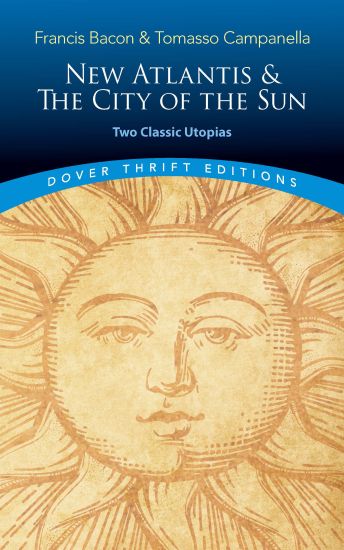
The New Atlantis and the City of the Sun: Two Classic Utopias
Francis Bacon
Dover Publications Inc.
2018
nidottu
In keeping with the inquisitive spirit of their times, two 17th-century writers envisioned their own philosophical and intellectual utopias. Tomasso Campanella, a Calabrian monk, published The City of the Sun in 1623, and Francis Bacon's The New Atlantis appeared in 1627. Campanella was a student of logic and physics; Bacon focused on politics and philosophy. Despite differences in setting and treatment, both authors employed the latest methods of scientific experimentation to restructure the social order, and both works abound in imaginative thought and expression.Campanella formulated the first scientifically based socialistic system -- one that furnished a model for subsequent ideal communities. Bacon focused on the duty of the state toward science, and his projections for state-sponsored research anticipated many advances in medicine and surgery, meteorology, and machinery. Both of these classics mirror their period's idealism and its revolutionary trends in thought.

The New Atlantis is a novel by Sir Francis Bacon. In this work, the author portrays a vision of the future of human discovery and knowledge, expressing his aspirations and ideals for humankind. The novel depicts the creation of a land where generosity and enlightenment, dignity and splendor, piety and public spirit are the commonly held qualities of the inhabitants of the island of Bensalem.In The New Atlantis, many aspects of the society and history of the island are described, such as the christian religion, which is reported to have being born there as a copy of the Bible and a letter from the Apostle Saint Bartholomew, arrived there miraculously, a few years after the Ascension of Jesus; a cultural feast in honor of the family institution, called "the Feast of the Family"; a college of sages, the Salomon's House, "the very eye of the kingdom."Editor's Note: In order to be more enjoyable during reading, this book is in 5" x 8" format. In the same spirit, the paper is cream-colored, which causes less fatigue to the eyes than white paper. All our publications are carefully handled both in terms of typography and design.
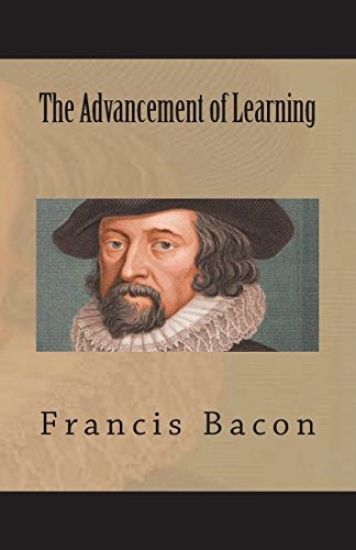
The Advancement of Learning (full title: Of the Proficience and Advancement of Learning, Divine and Human) is a 1605 book by Francis Bacon. It inspired the taxonomic structure of the highly influential Encyclop die by Jean le Rond d'Alembert and Denis Diderot, and is credited by Bacon's biographer-essayist Catherine Drinker Bowen with being a pioneering essay in support of empirical philosophy. The following passage from The Advancement of Learning was used as the foreword to a popular Cambridge textbook: So that as Tennis is a game of no use in itself, but of great use in respect it maketh a quick eye, and a body ready to put itself in all positions, so, in the Mathematics the use which is collateral, an intervenient, is no less worthy, than that which is principle and intended.
The New Atlantis: A Utopian Novel
Francis Bacon
Createspace Independent Publishing Platform
2018
nidottu
The New Atlantis by Sir Francis Bacon . New Atlantis is an incomplete utopian novel by Sir Francis Bacon, published in 1627. In this work, Bacon portrayed a vision of the future of human discovery and knowledge, expressing his aspirations and ideals for humankind. The novel depicts the creation of a utopian land where "generosity and enlightenment, dignity and splendour, piety and public spirit" are the commonly held qualities of the inhabitants of the mythical Bensalem. Bacon's literary executor, Dr. Rowley, published "The New Atlantis" in 1627, the year after the author's death. It seems to have been written about 1623, during that period of literary activity which followed Bacon's political fall. None of Bacon's writings gives in short apace so vivid a picture of his tastes and aspirations as this fragment of the plan of an ideal commonwealth. The generosity and enlightenment, the dignity and splendor, the piety and public spirit, of the inhabitants of Bensalem represent the ideal qualities which Bacon the statesman desired rather than hoped to see characteristic of his own country; and in Solomon's House we have Bacon the scientist indulging without restriction his prophetic vision of the future of human knowledge.
The Advancement of Learning by Francis Bacon. The Advancement of Learning (full title: Of the Proficience and Advancement of Learning, Divine and Human) is a 1605 book by Francis Bacon. It inspired the taxonomic structure of the highly influential Encyclopedie by Jean le Rond d'Alembert and Denis Diderot, and is credited by Bacon's biographer-essayist Catherine Drinker Bowen with being a pioneering essay in support of empirical philosophy. The following passage from The Advancement of Learning was used as the foreword to a popular Cambridge textbook: So that as Tennis is a game of no use in itself, but of great use in respect it maketh a quick eye, and a body ready to put itself in all positions, so, in the Mathematics the use which is collateral, an intervenient, is no less worthy, than that which is principle and intended.



The New Organon (in Latin, Novum Organum) is a historic work by Francis Bacon which lays out the system of logic which became known as the Baconian Method. Originally penned in Latin, this text discusses the various methods of reasoning one may use to come to a sound conclusion. The philosophical debate on the nature of inductive and reductive thinking has seen scholars deem The New Organon to be one of the first writings to signify the Enlightenment period of human development. It would also prove notable for its questioning of antiquity: until this time, Greek thought on logic had gone largely unchallenged. Perhaps most significantly of all is this work's impact upon the eventual formulation of the scientific method. Although strictly a text of philosophy, it was the intellectual rigors described by Bacon that were to become a forebear to the intensive development of the sciences in the 17th and 18th centuries.
The New Atlantis (Classic Books of Enlightenment Philosophy) (Hardcover)
Francis Bacon
Lulu.com
2018
sidottu
The New Atlantis by Francis Bacon details the ideas and vision of the scientific utopia conceived by the author, and is offered here in hardcover. This story sets out a process of discovery whereby sailors, lost off the Peruvian coastline, stumble across Bensalem. While the opening passages hold only the bare bones of plot, the emphasis once the explorers arrive in Bensalem is its university: Salomon's House. Promoted tenets include kindness, compassion and honesty, aesthetic beauty in public buildings and civic life, an intellectual spirit fostered among the population, a university named Salomon's House where sciences are studied and developed, and a strong sense of religious piety held by the population. Today, The New Atlantis is significant for statements of the ideals of the nascent Enlightenment era, in which Francis Bacon was an influential thinker. The text is also interpretative, with Bensalem's conversion to Christianity and the nature of its hierarchy poignant elements in the fiction.
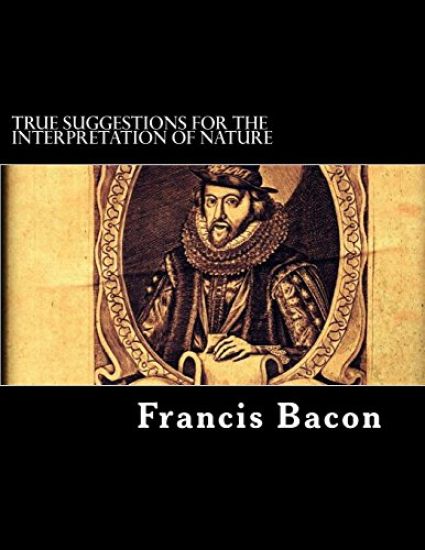
True Suggestions for the Interpretation of Nature
Francis Bacon
Createspace Independent Publishing Platform
2018
nidottu
They who have presumed to dogmatize on nature, as on some well investigated subject, either from self-conceit or arrogance, and in the professorial style, have inflicted the greatest injury on philosophy and learning. For they have tended to stifle and interrupt inquiry exactly in proportion as they have prevailed in bringing others to their opinion: and their own activity has not counterbalanced the mischief they have occasioned by corrupting and destroying that of others. They again who have entered upon a contrary course, and asserted that nothing whatever can be known, whether they have fallen into this opinion from their hatred of the ancient sophists, or from the hesitation of their minds, or from an exuberance of learning, have certainly adduced reasons for it which are by no means contemptible. They have not, however, derived their opinion from true sources, and, hurried on by their zeal and some affectation, have certainly exceeded due moderation. But the more ancient Greeks (whose writings have perished), held a more prudent mean, between the arrogance of dogmatism, and the despair of scepticism; and though too frequently intermingling complaints and indignation at the difficulty of inquiry, and the obscurity of things, and champing, as it were, the bit, have still persisted in pressing their point, and pursuing their intercourse with nature; thinking, as it seems, that the better method was not to dispute upon the very point of the possibility of anything being known, but to put it to the test of experience. Yet they themselves, by only employing the power of the understanding, have not adopted a fixed rule, but have laid their whole stress upon intense meditation, and a continual exercise and perpetual agitation of the mind.