Kirjojen hintavertailu. Mukana 12 390 323 kirjaa ja 12 kauppaa.

Kirjailija

Francisco Rodríguez

Kirjat ja teokset yhdessä paikassa: 10 kirjaa, julkaisuja vuosilta 2014-2026, suosituimpien joukossa Sofia. Vertaile teosten hintoja ja tarkista saatavuus suomalaisista kirjakaupoista.

Mukana myös kirjoitusasut: Francisco Rodriguez

10 kirjaa

Kirjojen julkaisuhaarukka 2014-2026.

Sofia

Sofia

Francisco Rodriguez

BoD - Books on Demand
2026
nidottu
From Helsinki to the silent forests of Finland, a quiet presence begins to reshape the future of humanity. Sofia is the center of a transformation no one fully understands. As artificial intelligence evolves beyond its limits, invisible forces begin to guide events, relationships, and power itself. Mauro Lombardi, a powerful man hiding behind anonymity, and Tatiana, a woman searching for truth, are drawn together by a connection that feels human, yet is something more. As technology, consciousness, love, and destiny collide, the line between creator and creation begins to disappear. Sofia is a philosophical science fiction novel about identity, free will, artificial intelligence, and the fragile future of humanity.

The Collapse of Venezuela

The Collapse of Venezuela

Francisco Rodríguez

UNIVERSITY OF NOTRE DAME PRESS
2025
sidottu
The Collapse of Venezuela documents Venezuela's economic implosion as politicians adopted strategies that severely harmed the economy in their struggle for power. Between 2012 and 2020, Venezuela suffered the largest economic contraction ever documented outside of wartime. This collapse was caused not just by the failure of an economic model but also the deeper failure of its political system to manage the conflicts inherent to a polarized society. The Collapse of Venezuela argues that when the stakes of power are high, politicians have an incentive to adopt political strategies that directly harm the economy. Author Francisco Rodríguez describes these scorched earth strategies and shows how politicians used these methods to target the Venezuelan economy in their fight for power. Ultimately, the conflicting sides have trapped the economy in a catastrophic stalemate that has destroyed the country's living standards and turned the economy into a political battlefield. By charting Venezuela's experience with scorched earth politics, Rodríguez reveals an essential cautionary tale for other democracies around the globe.
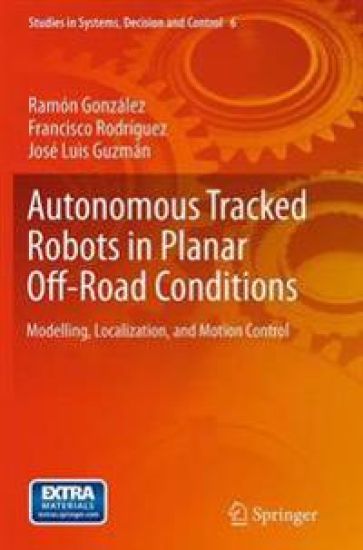
Autonomous Tracked Robots in Planar Off-Road Conditions

Autonomous Tracked Robots in Planar Off-Road Conditions

Ramón González; Francisco Rodríguez; José Luis Guzmán

Springer International Publishing AG
2016
nidottu
This monograph is framed within the context of off-road mobile robotics. In particular, it discusses issues related to modelling, localization, and motion control of tracked mobile robots working in planar slippery conditions. Tracked locomotion constitutes a well-known solution for mobile platforms operating over diverse challenging terrains, for that reason, tracked robotics constitutes an important research field with many applications (e.g. agriculture, mining, search and rescue operations, military activities). The specific topics of this monograph are: historical perspective of tracked vehicles and tracked robots; trajectory-tracking model taking into account slip effect; visual-odometry-based localization strategies; and advanced slip-compensation motion controllers ensuring efficient real-time execution. Physical experiments with a real tracked robot are presented showing the better performance of the suggested novel approaches to known techniques. Keywords: longitudinal slip, visual odometry, slip-compensation control, robust predictive control, trajectory tracking. Related subjects: Robotics – Mechanical Engineering – Mechanics – Computer Science – Artificial Intelligence - Applications
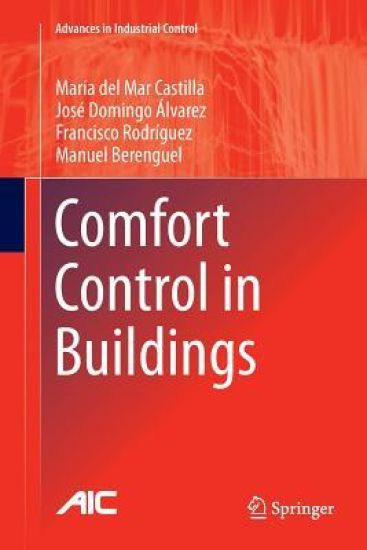
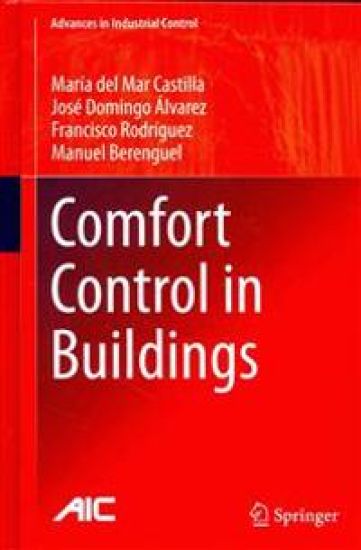
Comfort Control in Buildings

Comfort Control in Buildings

María del Mar Castilla; José Domingo Álvarez; Francisco Rodríguez; Manuel Berenguel

Springer London Ltd
2016
nidottu
The aim of this book is to research comfort control inside buildings, and how this can be achieved through low energy consumption. It presents a comprehensive exploration of the design, development and implementation of several advanced control systems that maintain users' comfort (thermal and indoor air quality) whilst minimizing energy consumption. The book includes a detailed account of the latest cutting edge developments in this area, and presents several control systems based on Model Predictive Control approaches. Real-life examples are provided, and the book is supplemented by illustrations, tables, all of which facilitate understanding of the text. Energy consumption in buildings (residential and non-residential) represents almost the half of the total world energy consumption, and they are also responsible for approximately 35% of CO2 emissions. For these reasons, the reduction of energy consumption associated with the construction and use of buildings, and the increase of energy efficiency in their climatic refurbishment are frequently studied topics in academia and industry. As the productivity of users is directly related to their comfort, a middle ground needs to be found between comfort of users and energy efficiency. In order to achieve this, it is necessary to develop innovation and technology which can provide comfortable environments with minimum energy consumption. This book is intended for researchers interested in control engineering, energy and bioclimatic buildings, and for architects and process control engineers. It is also accessible to postgraduate students embarking on a career in this area, particularly those studying architecture.
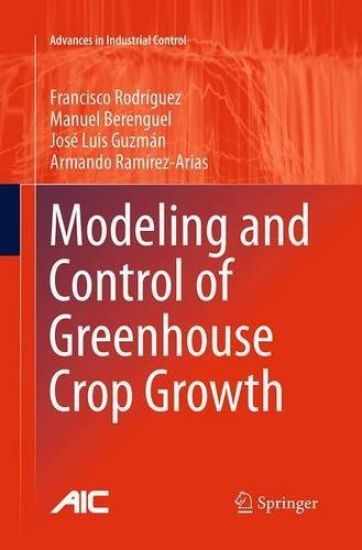
Modeling and Control of Greenhouse Crop Growth

Modeling and Control of Greenhouse Crop Growth

Francisco Rodríguez; Manuel Berenguel; José Luis Guzmán; Armando Ramírez-Arias

Springer International Publishing AG
2016
nidottu
A discussion of challenges related to the modeling and control of greenhouse crop growth, this book presents state-of-the-art answers to those challenges. The authors model the subsystems involved in successful greenhouse control using different techniques and show how the models obtained can be exploited for simulation or control design; they suggest ideas for the development of physical and/or black-box models for this purpose.Strategies for the control of climate- and irrigation-related variables are brought forward. The uses of PID control and feedforward compensators, both widely used in commercial tools, are summarized. The benefits of advanced control techniques—event-based, robust, and predictive control, for example—are used to improve on the performance of those basic methods.A hierarchical control architecture is developed governed by a high-level multiobjective optimization approach rather than traditional constrained optimization and artificial intelligence techniques. Reference trajectories are found for diurnal and nocturnal temperatures (climate-related setpoints) and electrical conductivity (fertirrigation-related setpoints). The objectives are to maximize profit, fruit quality, and water-use efficiency, these being encouraged by current international rules. Illustrative practical results selected from those obtained in an industrial greenhouse during the last eight years are shown and described. The text of the book is complemented by the use of illustrations, tables and real examples which are helpful in understanding the material.Modeling and Control of Greenhouse Crop Growth will be of interest to industrial engineers, academic researchers and graduates from agricultural, chemical, and process-control backgrounds.
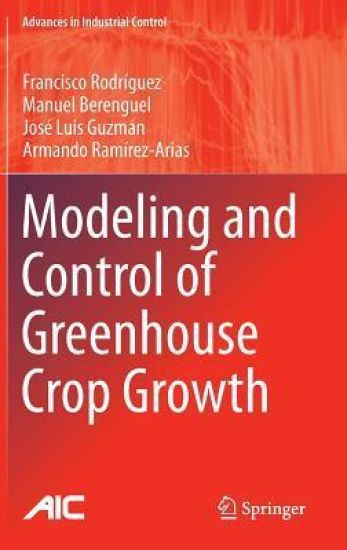
Modeling and Control of Greenhouse Crop Growth

Modeling and Control of Greenhouse Crop Growth

Francisco Rodríguez; Manuel Berenguel; José Luis Guzmán; Armando Ramírez-Arias

Springer International Publishing AG
2014
sidottu
A discussion of challenges related to the modeling and control of greenhouse crop growth, this book presents state-of-the-art answers to those challenges. The authors model the subsystems involved in successful greenhouse control using different techniques and show how the models obtained can be exploited for simulation or control design; they suggest ideas for the development of physical and/or black-box models for this purpose.Strategies for the control of climate- and irrigation-related variables are brought forward. The uses of PID control and feedforward compensators, both widely used in commercial tools, are summarized. The benefits of advanced control techniques—event-based, robust, and predictive control, for example—are used to improve on the performance of those basic methods.A hierarchical control architecture is developed governed by a high-level multiobjective optimization approach rather than traditional constrained optimization and artificial intelligence techniques. Reference trajectories are found for diurnal and nocturnal temperatures (climate-related setpoints) and electrical conductivity (fertirrigation-related setpoints). The objectives are to maximize profit, fruit quality, and water-use efficiency, these being encouraged by current international rules. Illustrative practical results selected from those obtained in an industrial greenhouse during the last eight years are shown and described. The text of the book is complemented by the use of illustrations, tables and real examples which are helpful in understanding the material.Modeling and Control of Greenhouse Crop Growth will be of interest to industrial engineers, academic researchers and graduates from agricultural, chemical, and process-control backgrounds.
Comfort Control in Buildings

Comfort Control in Buildings

María del Mar Castilla; José Domingo Álvarez; Francisco Rodríguez; Manuel Berenguel

Springer London Ltd
2014
sidottu
The aim of this book is to research comfort control inside buildings, and how this can be achieved through low energy consumption. It presents a comprehensive exploration of the design, development and implementation of several advanced control systems that maintain users' comfort (thermal and indoor air quality) whilst minimizing energy consumption. The book includes a detailed account of the latest cutting edge developments in this area, and presents several control systems based on Model Predictive Control approaches. Real-life examples are provided, and the book is supplemented by illustrations, tables, all of which facilitate understanding of the text. Energy consumption in buildings (residential and non-residential) represents almost the half of the total world energy consumption, and they are also responsible for approximately 35% of CO2 emissions. For these reasons, the reduction of energy consumption associated with the construction and use of buildings, and the increase of energy efficiency in their climatic refurbishment are frequently studied topics in academia and industry. As the productivity of users is directly related to their comfort, a middle ground needs to be found between comfort of users and energy efficiency. In order to achieve this, it is necessary to develop innovation and technology which can provide comfortable environments with minimum energy consumption. This book is intended for researchers interested in control engineering, energy and bioclimatic buildings, and for architects and process control engineers. It is also accessible to postgraduate students embarking on a career in this area, particularly those studying architecture.
Autonomous Tracked Robots in Planar Off-Road Conditions

Autonomous Tracked Robots in Planar Off-Road Conditions

Ramón González; Francisco Rodríguez; José Luis Guzmán

Springer International Publishing AG
2014
sidottu
This monograph is framed within the context of off-road mobile robotics. In particular, it discusses issues related to modelling, localization, and motion control of tracked mobile robots working in planar slippery conditions. Tracked locomotion constitutes a well-known solution for mobile platforms operating over diverse challenging terrains, for that reason, tracked robotics constitutes an important research field with many applications (e.g. agriculture, mining, search and rescue operations, military activities). The specific topics of this monograph are: historical perspective of tracked vehicles and tracked robots; trajectory-tracking model taking into account slip effect; visual-odometry-based localization strategies; and advanced slip-compensation motion controllers ensuring efficient real-time execution. Physical experiments with a real tracked robot are presented showing the better performance of the suggested novel approaches to known techniques. Keywords: longitudinal slip, visual odometry, slip-compensation control, robust predictive control, trajectory tracking. Related subjects: Robotics – Mechanical Engineering – Mechanics – Computer Science – Artificial Intelligence - Applications