Kirjojen hintavertailu. Mukana 12 200 363 kirjaa ja 12 kauppaa.

Kirjailija

Franco Barchiesi

Kirjat ja teokset yhdessä paikassa: 4 kirjaa, julkaisuja vuosilta 2011-2019, suosituimpien joukossa Ties that Bind. Vertaile teosten hintoja ja tarkista saatavuus suomalaisista kirjakaupoista.

4 kirjaa

Kirjojen julkaisuhaarukka 2011-2019.

Ties that Bind

Ties that Bind

Jon Soske; Shannon Walsh; Sisonke Msimang; Stacy Hardy; Lesego Rampolokeng; T. J. Tallie; Franco Barchiesi; Bridget Kenny; Daniel Magaziner; Neelika Jayawardane; Tsitsi Jaji; Mosa Phadi; Nomancotsho Pakade; Molemo Moiloa; Nare Mokgotho; Frank B. Wilderson

Wits University Press
2016
nidottu
What does friendship have to do with racial difference, settler colonialism and post-apartheid South Africa? While histories of apartheid and colonialism in South Africa have often focused on the ideologies of segregation and white supremacy, Ties that Bind explores how the intimacies of friendship create vital spaces for practices of power and resistance. Combining interviews, history poetry, visual arts, memoir and academic essay, the collection keeps alive the promise of friendship and its possibilities while investigating how affective relations are essential to the social reproduction of power. From the intimacy of personal relationships to the organising ideology of liberal colonial governance, the contributors explore the intersection of race and friendship from a kaleidoscope of viewpoints and scales. Insisting on a timeline that originates in settler colonialism, Ties that Bind uncovers the implication of anti-Blackness within nonracialism, and powerfully challenges a simple reading of the Mandela moment and the rainbow nation. In the wake of countrywide student protests calling for decolonization of the university, and reignited debates around racial inequality, this timely volume insists that the history of South African politics has always already been about friendship.Written in an accessible and engaging style, Ties that Bind will interest a wide audience of scholars, students, and activists, as well as general readers curious about contemporary South African debates around race and intimacy.
Rethinking the Labour Movement in the 'New South Africa'
Title first published in 2003. In recognition of the power of organised labour, the ANC Government elected in 1994 granted South Africa's unions unprecedented legal and constitutional rights. Despite these gains, the country's unions have faced a fresh set of challenges, many of them emanating from their political allies in Government. From Parliament to the factory floor, South Africa's unions are now confronted with threats as dangerous as those they confronted when organising illegally in the heyday of apartheid. The purpose of this book is to examine how South African unions have responded and how well prepared they are to meet the challenges that confront them in the new millennium.
Rethinking the Labour Movement in the 'New South Africa'
Title first published in 2003. In recognition of the power of organised labour, the ANC Government elected in 1994 granted South Africa's unions unprecedented legal and constitutional rights. Despite these gains, the country's unions have faced a fresh set of challenges, many of them emanating from their political allies in Government. From Parliament to the factory floor, South Africa's unions are now confronted with threats as dangerous as those they confronted when organising illegally in the heyday of apartheid. The purpose of this book is to examine how South African unions have responded and how well prepared they are to meet the challenges that confront them in the new millennium.
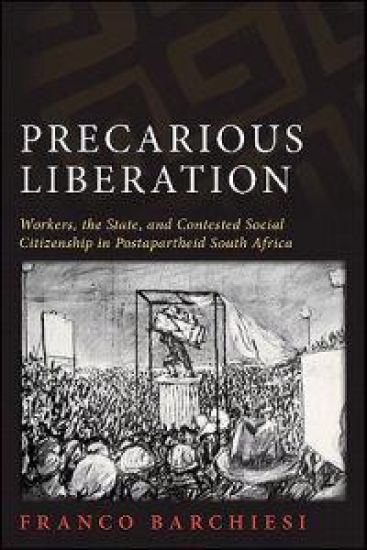
Precarious Liberation

Precarious Liberation

Franco Barchiesi

State University of New York Press
2011
pokkari
Examines the relationship of precarious employment to state policies on citizenship and social inclusion in the context of postapartheid South Africa. Winner of the 2012 CLR James Award presented by the Working Class Studies Association Millions of black South African workers struggled against apartheid to redeem employment and production from a history of abuse, insecurity, and racial despotism. Almost two decades later, however, the prospects of a dignified life of wage-earning work remain unattainable for most South Africans. Through extensive archival and ethnographic research, Franco Barchiesi documents and interrogates this important dilemma in the country's democratic transition: economic participation has gained centrality in the government's definition of virtuous citizenship, and yet for most workers, employment remains an elusive and insecure experience. In a context of market liberalization and persistent social and racial inequalities, as jobs in South Africa become increasingly flexible, fragmented, and unprotected, they depart from the promise of work with dignity and citizenship rights that once inspired opposition to apartheid. Barchiesi traces how the employment crisis and the responses of workers to it challenge the state's normative imagination of work, and raise decisive questions for the social foundations and prospects of South Africa's democratic experiment.