Kirjojen hintavertailu. Mukana 12 390 323 kirjaa ja 12 kauppaa.

Kirjailija

Francois Theberge

Kirjat ja teokset yhdessä paikassa: 3 kirjaa, julkaisuja vuosilta 2021-2024, suosituimpien joukossa Generative Methods for Social Media Analysis. Vertaile teosten hintoja ja tarkista saatavuus suomalaisista kirjakaupoista.

Mukana myös kirjoitusasut: François Théberge

3 kirjaa

Kirjojen julkaisuhaarukka 2021-2024.

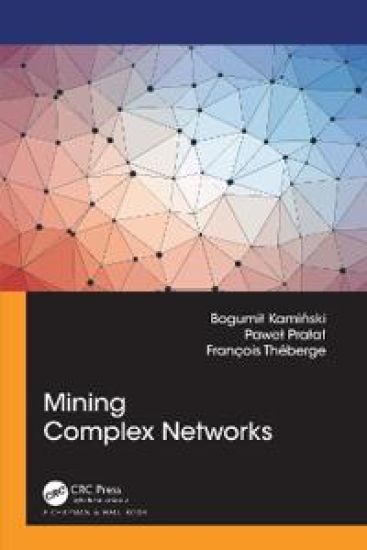
Mining Complex Networks

Mining Complex Networks

Bogumil Kaminski; Pawel Pralat; Francois Theberge

TAYLOR FRANCIS LTD
2024
nidottu
This book concentrates on mining networks, a subfield within data science. Data science uses scientific and computational tools to extract valuable knowledge from large data sets. Once data is processed and cleaned, it is analyzed and presented to support decision-making processes. Data science and machine learning tools have become widely used in companies of all sizes. Networks are often large-scale, decentralized, and evolve dynamically over time. Mining complex networks aim to understand the principles governing the organization and the behavior of such networks is crucial for a broad range of fields of study. Here are a few selected typical applications of mining networks: Community detection (which users on some social media platforms are close friends). Link prediction (who is likely to connect to whom on such platforms). Node attribute prediction (what advertisement should be shown to a given user of a particular platform to match their interests). Influential node detection (which social media users would be the best ambassadors of a specific product).This textbook is suitable for an upper-year undergraduate course or a graduate course in programs such as data science, mathematics, computer science, business, engineering, physics, statistics, and social science. This book can be successfully used by all enthusiasts of data science at various levels of sophistication to expand their knowledge or consider changing their career path. Jupiter notebooks (in Python and Julia) accompany the book and can be accessed on https://www.ryerson.ca/mining-complex-networks/. These not only contain all the experiments presented in the book, but also include additional material. Bogumil Kaminski is the Chairman of the Scientific Council for the Discipline of Economics and Finance at SGH Warsaw School of Economics. He is also an Adjunct Professor at the Data Science Laboratory at Ryerson University. Bogumil is an expert in applications of mathematical modeling to solving complex real-life problems. He is also a substantial open-source contributor to the development of the Julia language and its package ecosystem.Pawel Pralat is a Professor of Mathematics in Ryerson University, whose main research interests are in random graph theory, especially in modeling and mining complex networks. He is the Director of Fields-CQAM Lab on Computational Methods in Industrial Mathematics in The Fields Institute for Research in Mathematical Sciences and has pursued collaborations with various industry partners as well as the Government of Canada. He has written over 170 papers and three books with 130 plus collaborators.François Théberge holds a B.Sc. degree in applied mathematics from the University of Ottawa, a M.Sc. in telecommunications from INRS and a PhD in electrical engineering from McGill University. He has been employed by the Government of Canada since 1996 where he was involved in the creation of the data science team as well as the research group now known as the Tutte Institute for Mathematics and Computing. He also holds an adjunct professorial position in the Department of Mathematics and Statistics at the University of Ottawa. His current interests include relational-data mining and deep learning.
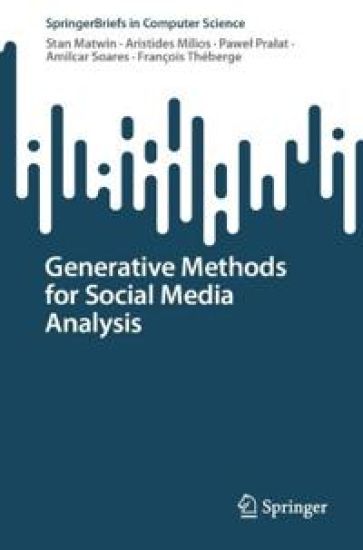
Generative Methods for Social Media Analysis

Generative Methods for Social Media Analysis

Stan Matwin; Aristides Milios; Pawel Pralat; Amilcar Soares; François Théberge

Springer International Publishing AG
2023
nidottu
This book provides a broad overview of the state of the art of the research in generative methods for the analysis of social media data. It especially includes two important aspects that currently gain importance in mining and modelling social media: dynamics and networks. The book is divided into five chapters and provides an extensive bibliography consisting of more than 250 papers. After a quick introduction and survey of the book in the first chapter, chapter 2 is devoted to the discussion of data models and ontologies for social network analysis. Next, chapter 3 deals with text generation and generative text models and the dangers they pose to social media and society at large. Chapter 4 then focuses on topic modelling and sentiment analysis in the context of social networks. Finally, Chapter 5 presents graph theory tools and approaches to mine and model social networks. Throughout the book, open problems, highlighting potential future directions, are clearly identified. The book aims at researchers and graduate students in social media analysis, information retrieval, and machine learning applications.
Mining Complex Networks

Mining Complex Networks

Bogumil Kaminski; Pawel Pralat; Francois Theberge

TAYLOR FRANCIS LTD
2021
sidottu
This book concentrates on mining networks, a subfield within data science. Data science uses scientific and computational tools to extract valuable knowledge from large data sets. Once data is processed and cleaned, it is analyzed and presented to support decision-making processes. Data science and machine learning tools have become widely used in companies of all sizes. Networks are often large-scale, decentralized, and evolve dynamically over time. Mining complex networks aim to understand the principles governing the organization and the behavior of such networks is crucial for a broad range of fields of study. Here are a few selected typical applications of mining networks: Community detection (which users on some social media platforms are close friends). Link prediction (who is likely to connect to whom on such platforms). Node attribute prediction (what advertisement should be shown to a given user of a particular platform to match their interests). Influential node detection (which social media users would be the best ambassadors of a specific product).This textbook is suitable for an upper-year undergraduate course or a graduate course in programs such as data science, mathematics, computer science, business, engineering, physics, statistics, and social science. This book can be successfully used by all enthusiasts of data science at various levels of sophistication to expand their knowledge or consider changing their career path. Jupiter notebooks (in Python and Julia) accompany the book and can be accessed on https://www.ryerson.ca/mining-complex-networks/. These not only contain all the experiments presented in the book, but also include additional material. Bogumil Kaminski is the Chairman of the Scientific Council for the Discipline of Economics and Finance at SGH Warsaw School of Economics. He is also an Adjunct Professor at the Data Science Laboratory at Ryerson University. Bogumil is an expert in applications of mathematical modeling to solving complex real-life problems. He is also a substantial open-source contributor to the development of the Julia language and its package ecosystem.Pawel Pralat is a Professor of Mathematics in Ryerson University, whose main research interests are in random graph theory, especially in modeling and mining complex networks. He is the Director of Fields-CQAM Lab on Computational Methods in Industrial Mathematics in The Fields Institute for Research in Mathematical Sciences and has pursued collaborations with various industry partners as well as the Government of Canada. He has written over 170 papers and three books with 130 plus collaborators.François Théberge holds a B.Sc. degree in applied mathematics from the University of Ottawa, a M.Sc. in telecommunications from INRS and a PhD in electrical engineering from McGill University. He has been employed by the Government of Canada since 1996 where he was involved in the creation of the data science team as well as the research group now known as the Tutte Institute for Mathematics and Computing. He also holds an adjunct professorial position in the Department of Mathematics and Statistics at the University of Ottawa. His current interests include relational-data mining and deep learning.