Kirjojen hintavertailu. Mukana 12 595 353 kirjaa ja 12 kauppaa.
Kirjailija
Francoise Dastur
Kirjat ja teokset yhdessä paikassa: 8 kirjaa, julkaisuja vuosilta 2000-2017, suosituimpien joukossa a la Naissance Des Choses: Art, Poesie Et Philosophie. Vertaile teosten hintoja ja tarkista saatavuus suomalaisista kirjakaupoista.
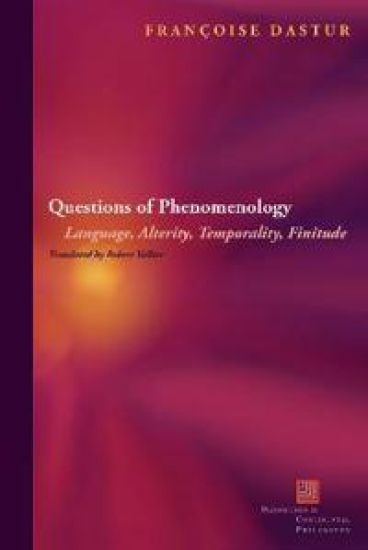
Françoise Dastur is well respected in France and Europe for her mastery of phenomenology as a movement and her clear and cogent explications of phenomenology in movement. These qualities are on display in this remarkable volume. Dastur guides the reader through a series of phenomenological questions—language and logic, self and other, temporality and history, finitude and mortality—that also call phenomenology itself into question, testing its limits and pushing it in new directions. Like Merleau-Ponty, Dastur sees phenomenology not as a doctrine, a catalogue of concepts and catchphrases authored by a single thinker, but as a movement in which several thinkers participate, each inflecting the movement in unique ways. In this regard, Dastur is both one of the clearest guides to phenomenology and one of its ablest practitioners.
Françoise Dastur is well respected in France and Europe for her mastery of phenomenology as a movement and her clear and cogent explications of phenomenology in movement. These qualities are on display in this remarkable volume. Dastur guides the reader through a series of phenomenological questions—language and logic, self and other, temporality and history, finitude and mortality—that also call phenomenology itself into question, testing its limits and pushing it in new directions. Like Merleau-Ponty, Dastur sees phenomenology not as a doctrine, a catalogue of concepts and catchphrases authored by a single thinker, but as a movement in which several thinkers participate, each inflecting the movement in unique ways. In this regard, Dastur is both one of the clearest guides to phenomenology and one of its ablest practitioners.
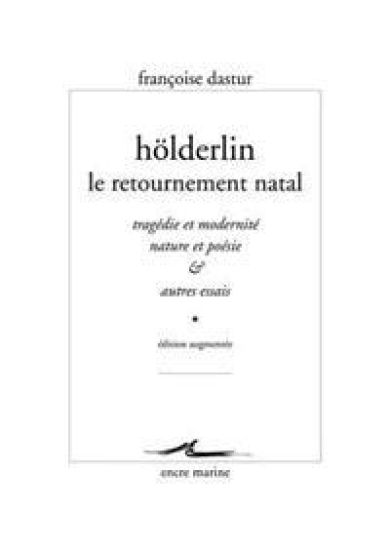
Ce que Holderlin cherche a montrer dans sa poesie, dans ses essais poetologiques et philosophiques, tout comme dans ses traductions de l'OEdipe-Roi et de l'Antigone de Sophocle et les Remarques qui les accompagnent, c'est la necessite d'accomplir ce qu'il nomme le retournement natal , qui consiste a abandonner la direction antinaturelle de la culture a ses debuts pour l'orientation vers le naturel. Alors que pour le Grec, le retournement natal s'accomplit de maniere tragique et dans la mort, pour le Moderne, il a le sens d'une assomption de la finitude et de l'existence terrestre. C'est la raison pour laquelle la poesie lyrique est dans la modernite plus appropriee que la tragedie a l'exposition de ce mouvement qui reconduit l'etre humain a la prise en garde de ses limites. Il ne s'agit pourtant pas, pour le poete moderne, de simplement chercher la reconciliation avec la nature, mais de la celebrer a travers l'epreuve de son inaccessibilite au cours de la nuit sacree de la modernite dont le divin s'est absente. Dans cette nouvelle edition s'ajoutent, aux textes des deux cours publies en 1997, ceux de conferences ponctuelles qui furent consacrees a l'approfondissement de certains points fondamentaux de l'interpretation qui est proposee ici de l'oeuvre de Holderlin.
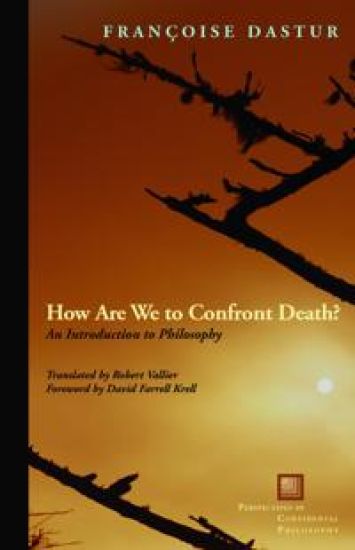
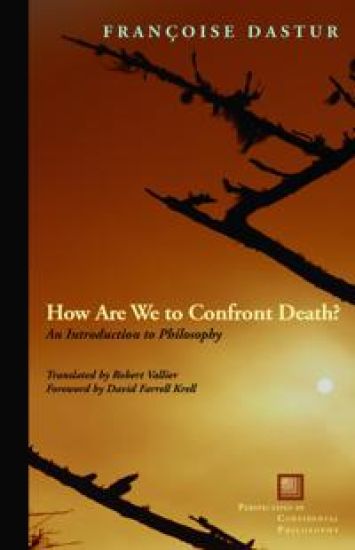
Confronting death means looking it squarely in the face. Contemporary society refuses to do so, preferring to hide it and hide from it. Funeral rites no longer function as a way to mediate death or to maintain a link between the living and dead. Today the disappearance of certain funerary practices attests to the denial of death as such. They reflect a preference for focusing on remembering the life of the deceased in order to neutralize death, thus displacing the value of mourning, now viewed as something to be done as quickly as possible. Moreover, science, like religion before it and like the contemporary "cult of the body," has fed our fantasies about immortality, promising us longer lives of better quality, and even the possibility of conquering death altogether. Despite all these attempts to overcome or neutralize death, humanity has been unable to eliminate its anxiety about death and nothingness. True to her roots in phenomenology, Dastur not only examines these contemporary tendencies with a critical eye but also argues that we must once again learn to assume death, to become mortal, to learn how to die. Death is not the last moment of human life, but rather its essential attribute. Dastur's skill as a "translator" of phenomenology into accessible and clear prose is nowhere more apparent than in her "little book on death"—indeed, the intended audience is less those who specialize in phenomenology or academic philosophy than a nonspecialist public hungry for philosophical reflection on what is closest to us. And nothing is closer to us than the ever-present possibility of our own imminent death. As its subtitle suggests, this book is an "introduction to philosophy," one that obliges the reader to ask what it means to be human and to embrace death and mortality as the defining essence of our humanity.
Confronting death means looking it squarely in the face. Contemporary society refuses to do so, preferring to hide it and hide from it. Funeral rites no longer function as a way to mediate death or to maintain a link between the living and dead. Today the disappearance of certain funerary practices attests to the denial of death as such. They reflect a preference for focusing on remembering the life of the deceased in order to neutralize death, thus displacing the value of mourning, now viewed as something to be done as quickly as possible. Moreover, science, like religion before it and like the contemporary "cult of the body," has fed our fantasies about immortality, promising us longer lives of better quality, and even the possibility of conquering death altogether. Despite all these attempts to overcome or neutralize death, humanity has been unable to eliminate its anxiety about death and nothingness. True to her roots in phenomenology, Dastur not only examines these contemporary tendencies with a critical eye but also argues that we must once again learn to assume death, to become mortal, to learn how to die. Death is not the last moment of human life, but rather its essential attribute. Dastur's skill as a "translator" of phenomenology into accessible and clear prose is nowhere more apparent than in her "little book on death"—indeed, the intended audience is less those who specialize in phenomenology or academic philosophy than a nonspecialist public hungry for philosophical reflection on what is closest to us. And nothing is closer to us than the ever-present possibility of our own imminent death. As its subtitle suggests, this book is an "introduction to philosophy," one that obliges the reader to ask what it means to be human and to embrace death and mortality as the defining essence of our humanity.
Les essais rassembles ici tentent de montrer que ce a quoi visent l'artiste et le poete tout autant que le philosophe, c'est a saisir par l'image, la parole ou le concept la venue au monde des choses. C'est dans cette perspective que sont d'abord interrogees les conceptions que se font de l'art certains philosophes du XXe siecle, Husserl, Heidegger et Gadamer, figures eminentes du mouvement phenomenologique, qui ont vu dans l'art non un pur jeu d'apparences, mais une manifestation de la verite. Il s'agit ensuite de laisser la parole aux poetes eux-memes, et en particulier a ces poetes avec lesquels Heidegger est entre en dialogue, Holderlin, Char et Trakl, afin de mettre en evidence cette capacite qu'a la poesie de faire voir le monde a son etat naissant.
Plato's "Phaedo", Hegel's "Phenomenology of Spirit" and Heidegger's "Being and Time" are three of the most profound meditations on variations of the ideas that to practice philosophy is to practice how to die. This study traces how these variations are connected with each other and with the reflections of this idea to be found in the works of other ancient and modern philosophers - including Neitzsche, Husserl, Sartre, Merleau-Ponty and levinas. The book also shows how this philosophical thanatology motivates or is motivated by experiences documented in psychoanalysis and in the anthropology of Western and Oriental religions and myths.
Telling Time takes up Heidegger's ideas of a "phenomenological chronology" in an attempt to pose the question of the possibility of a phenomenological language that would be given over to the "temporality of being" and the finitude of existence. The book combines a discussion of approaches to language in the philosophical tradition with readings of Husserl on temporality and the early and late texts of Heidegger's on logic, truth and the nature of language. As well as Heidegger's "deconstruction" of logic and metaphysics Dastur's work is informed by Derrida's deconstruction of the metaphysics of presence and Nietzschean genealogy. Appealing as much to Humboldt's philosophy of language as to H