Kirjojen hintavertailu. Mukana 12 595 353 kirjaa ja 12 kauppaa.

Kirjailija

Frank Close

Kirjat ja teokset yhdessä paikassa: 25 kirjaa, julkaisuja vuosilta 2004-2026, suosituimpien joukossa The Scientists. Vertaile teosten hintoja ja tarkista saatavuus suomalaisista kirjakaupoista.

25 kirjaa

Kirjojen julkaisuhaarukka 2004-2026.

The Scientists

The Scientists

Naomi Pasachoff; Jay Pasachoff; Robert Iliffe; Frank A.J.L. James; Jordi Cat; Patrick Moore; Martin Rudwick; Laura Dassow Walls; Roger McCoy; Michael Hunter; Jean-Pierre Poirier; Alan Rocke; Nathan Brooks; Georgina Ferry; Virendra Singh; Frank Close; Andrew Whitaker; Robert Paradowski

Thames Hudson Ltd
2012
sidottu
This book tells the remarkable lives of the pioneers of science – from Galileo and Newton, Faraday and Darwin, Pasteur and Marie Curie, to Einstein, Freud, Turing, and Crick and Watson. A series of seventy articles, written by an international team of distinguished scientists, historians of science and science writers, provides an unrivalled account of the lives and personalities behind the greatest scientific breakthroughs of all time. Organized thematically, starting at the ‘Universe’, and moving smaller through the ‘Earth’ and ‘Molecules and Matter’ to ‘Inside the Atom’, with the final two sections looking at ‘Life’ and ‘Body and Mind’, it covers all the major scientific disciplines, including astronomy, biology, biochemistry, chemistry, computing, ecology, geology, medicine, neurology, physics and psychology, as well as mathematics. The Scientists will intrigue budding scientists, those fascinated by the lives of great individuals, and anyone curious to know how over the centuries we came to understand the physical world around us and inside us.
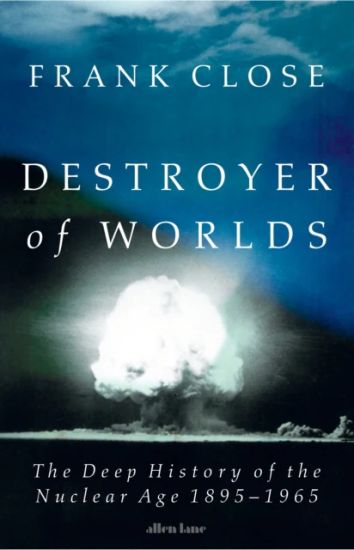
Destroyer of Worlds

Destroyer of Worlds

Frank Close

PENGUIN BOOKS LTD
2026
pokkari
Henry Becquerel’s accidental discovery, in Paris in 1896, of a faint smudge on a photographic plate sparked a chain of discoveries which would unleash the atomic age. Destroyer of Worlds is the story of how pursuit of this hidden source of nuclear power, which began innocently and collaboratively, was overwhelmed by the politics of the 1930s, and following devastation of Hiroshima and Nagasaki opened the way to a still more terrible possibility: a thermonuclear bomb, the so-called “backyard weapon”, that could destroy all life on earth – from anywhere. Spanning decades and continents, the story moves from Becquerel to Ernest Rutherford, Enrico Fermi, Otto Hahn, Lise Meitner and the Joliot-Curies, and on to the appearance of Robert Oppenheimer before climaxing with increasingly horrifying developments in the USA and USSR. It re-evaluates the important role played by three remarkable women – Lise Meitner, Ida Noddack and Irene Curie – and provides new insights into the work of Ettore Majorana, who mysteriously disappeared in 1938. This is the remarkable story of how knowledge is often advanced by personal convictions and relationships, an indeed by chance.
Destroyer of Worlds: The Deep History of the Nuclear Age
The thrilling and terrifying seventy-year story--"kinetic, dramatic, and compulsively readable" (Patchen Barss)--of the physicists that deciphered the atom and created the hydrogen bomb Although Henri Becquerel didn't know it at the time, he changed history in 1896 when he left photographic plates and some uranium rocks in a drawer. The rocks emitted something that exposed the plates: it was the first documented evidence of spontaneous radioactivity. So began one of the most exciting and consequential efforts humans have ever undertaken. As Frank Close recounts in Destroyer of Worlds, scientists confronting Becquerel's discovery had three questions: What was this phenomenon? Could it be a source of unlimited power? And (alas), could it be a weapon? Answering them was an epic journey of discovery, with Ernest Rutherford, Enrico Fermi, Irene Joliot-Curie, and many others jockeying to decipher the dance of particles in a decaying atom. And it was a terrifying journey as well, as Edward Teller and others pressed on from creating atom bombs to hydrogen bombs so powerful that they could destroy all life on earth. The deep history of the nuclear age has never before been recounted so vividly. Centered on an extraordinary cast of characters, Destroyer of Worlds charts the course of nuclear physics from simple curiosity to potential Armageddon.
Destroyer of Worlds

Destroyer of Worlds

Frank Close

PENGUIN BOOKS LTD
2025
sidottu
From the award-winning science writer, a new history of the development of nuclear power and the extraordinary minds behind itHenry Becquerel’s accidental discovery, in Paris in 1896, of a faint smudge on a photographic plate sparked a chain of discoveries which would unleash the atomic age.Destroyer of Worlds is the story of how pursuit of this hidden source of nuclear power, which began innocently and collaboratively, was overwhelmed by the politics of the 1930s, and following devastation of Hiroshima and Nagasaki opened the way to a still more terrible possibility: a thermonuclear bomb, the so-called “backyard weapon”, that could destroy all life on earth – from anywhere.The story spans decades and continents, moving from Becquerel to Ernest Rutherford, the Cambridge-based, New Zealand scientist who first split the atom, expands to include Enrico Fermi in Rome, Otto Hahn and Lise Meitner in Berlin and the Joliot-Curies in Paris, leading to the appearance of Robert Oppenheimer before climaxing with increasingly horrifying developments in the USA and USSR. The roles of three remarkable women – Lise Meitner, Ida Noddack and Irene Curie – are re-evaluated, and there are new insights into the work of Ettore Majorana, Fermi’s mercurial but brilliant assistant, who mysteriously disappeared in 1938, possibly after foreseeing the explosive power of nuclear energy. Above all, this is a story of how knowledge is often advanced by personal convictions and relationships, an indeed by chance, in a remarkable way.
Particle Physics

Particle Physics

Frank Close

Oxford University Press
2023
nidottu
Very Short Introductions: Brilliant, Sharp, Inspiring Following the discovery of the Higgs boson, Frank Close has produced this major revision to his classic and compelling introduction to the fundamental particles that make up the universe. Frank Close takes us on a journey into the atom to examine known particles such as quarks, electrons, and the ghostly neutrino, and explains the key role and significance of the Higgs boson. Along the way he provides fascinating insights into how discoveries in particle physics have actually been made, and discusses how our picture of the world has been radically revised in the light of these developments. He concludes by looking ahead to new ideas about the mystery of antimatter and massive neutrinos, and to what the next 50 years of research might reveal about the nature of the Higgs field which moulds the fundamental particles and forces. ABOUT THE SERIES: The Very Short Introductions series from Oxford University Press contains hundreds of titles in almost every subject area. These pocket-sized books are the perfect way to get ahead in a new subject quickly. Our expert authors combine facts, analysis, perspective, new ideas, and enthusiasm to make interesting and challenging topics highly readable.
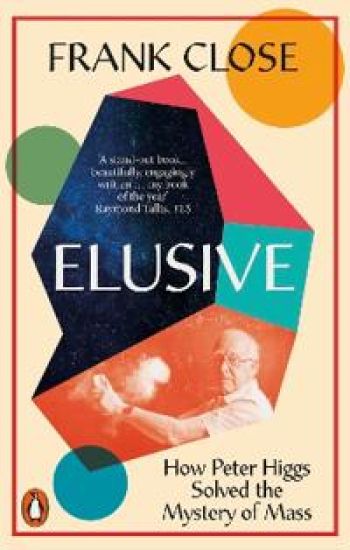
Elusive: How Peter Higgs Solved the Mystery of Mass
*A New York Times Book Review Editor's Choice Selection* The first major biography of Peter Higgs, revealing how a short burst of work changed modern physics On July 4, 2012, the announcement came that one of the longest-running mysteries in physics had been solved: the Higgs boson, the missing piece in understanding why particles have mass, had finally been discovered. On the rostrum, surrounded by jostling physicists and media, was the particle's retiring namesake--the only person in history to have an existing single particle named for them. Why Peter Higgs? Drawing on years of conversations with Higgs and others, Close illuminates how an unprolific man became one of the world's most famous scientists. Close finds that scientific competition between people, institutions, and states played as much of a role in making Higgs famous as Higgs's work did. A revelatory study of both a scientist and his era, Elusive will remake our understanding of modern physics.
Trinity

Trinity

Frank Close

Penguin
2020
pokkari
"Trinity" was the codename for the test explosion of the atomic bomb in New Mexico on 16 July 1945. Trinity is now also the extraordinary story of the bomb's metaphorical father, Rudolf Peierls; his intellectual son, the atomic spy, Klaus Fuchs, and the ghosts of the security services in Britain, the USA and USSR.Against the background of pre-war Nazi Germany, the Second World War and the following Cold War, the book traces how Peierls brought Fuchs into his family and his laboratory, only to be betrayed. It describes in unprecedented detail how Fuchs became a spy, his motivations and the information he passed to his Soviet contacts, both in the UK and after he went with Peierls to join the Manhattan Project at Los Alamos in 1944. Frank Close is himself a distinguished nuclear physicist: uniquely, the book explains the science as well as the spying.Fuchs returned to Britain in August 1946 still undetected and became central to the UK's independent effort to develop nuclear weapons. Close describes the febrile atmosphere at Harwell, the nuclear physics laboratory near Oxford, where many of the key players were quartered, and the charged relationships which developed there. He uncovers fresh evidence about the role of the crucial VENONA signals decryptions, and shows how, despite mistakes made by both MI5 and the FBI, the net gradually closed around Fuchs, building an intolerable pressure which finally cracked him.The Soviet Union exploded its first nuclear device in August 1949, far earlier than the US or UK expected. In 1951, the US Congressional Committee on Atomic Espionage concluded, 'Fuchs alone has influenced the safety of more people and accomplished greater damage than any other spy not only in the history of the United States, but in the history of nations'. This book is the most comprehensive account yet published of these events, and of the tragic figure at their centre.
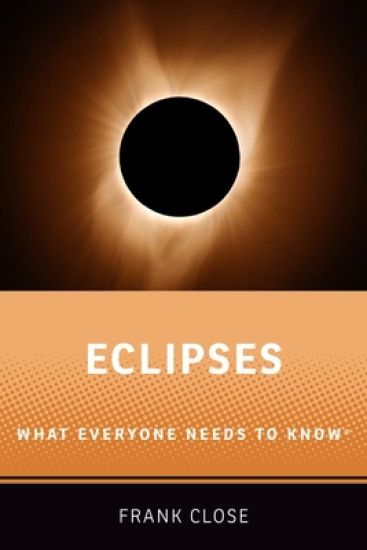
Eclipses

Eclipses

Frank Close

Oxford University Press Inc
2019
nidottu
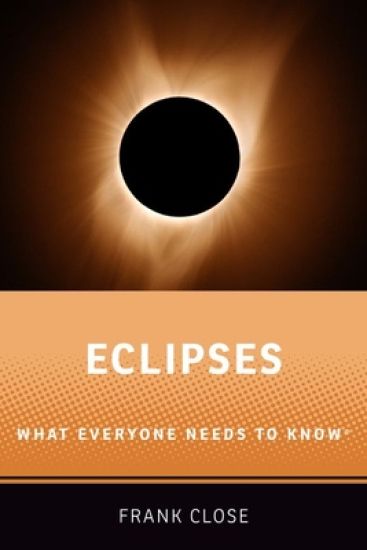
"Have you ever seen a total solar eclipse?" If the question caused you to search your memory, the correct answer would have been "no." A common response is: "Yes--I saw one, it was about 90% partial eclipse where I lived." A 90% partial eclipse is indeed a remarkable phenomenon, but true totality leaves all else in the shade, in all senses of the phrase. Ask the question of anyone who has experienced the full sensation of being obliterated by the moon's shadow, and they will reply "yes"--without hesitation--and continue with a monologue describing the overwhelming experiences and unique phenomena that ensued. On 21 August 2017 millions of people across the United States witnessed "The Great American Eclipse" of the Sun. The moment it was over, people around the world were asking questions: what caused the weird shadows and colors in the build up to totality? Were those ephemeral bands of shadows gliding across the ground in the seconds before totality real or an optical illusion? Why this, what that, but above all: where and when can I see a total solar eclipse again? Eclipses: What Everyone Needs to Know helps explain the profound differences between a 99.99% partial eclipse and true totality, and inform readers how to experience this most beautiful natural phenomenon successfully. It covers eclipses of sun, moon, and other astronomical objects, and their applications in science, as well as their role in history, literature, and myth. It describes the phenomena to expect at a solar eclipse and the best ways to record them--by camera, video, or by simple handmade experiments. The book covers the timetable of upcoming eclipses, where the best locations will be to see them, and the opportunities for using them as vehicles for inspiration and education. As a veteran of seven total solar eclipses, physicist Frank Close is an expert both on the theory and practice of eclipses. Eclipses: What Everyone Needs to Know is a popular source of information on the physics of eclipses.
Eclipses

Eclipses

Frank Close

Oxford University Press Inc
2019
sidottu
"Have you ever seen a total solar eclipse?" If the question caused you to search your memory, the correct answer would have been "no." A common response is: "Yes--I saw one, it was about 90% partial eclipse where I lived." A 90% partial eclipse is indeed a remarkable phenomenon, but true totality leaves all else in the shade, in all senses of the phrase. Ask the question of anyone who has experienced the full sensation of being obliterated by the moon's shadow, and they will reply "yes"--without hesitation--and continue with a monologue describing the overwhelming experiences and unique phenomena that ensued. On 21 August 2017 millions of people across the United States witnessed "The Great American Eclipse" of the Sun. The moment it was over, people around the world were asking questions: what caused the weird shadows and colors in the build up to totality? Were those ephemeral bands of shadows gliding across the ground in the seconds before totality real or an optical illusion? Why this, what that, but above all: where and when can I see a total solar eclipse again? Eclipses: What Everyone Needs to Know helps explain the profound differences between a 99.99% partial eclipse and true totality, and inform readers how to experience this most beautiful natural phenomenon successfully. It covers eclipses of sun, moon, and other astronomical objects, and their applications in science, as well as their role in history, literature, and myth. It describes the phenomena to expect at a solar eclipse and the best ways to record them--by camera, video, or by simple handmade experiments. The book covers the timetable of upcoming eclipses, where the best locations will be to see them, and the opportunities for using them as vehicles for inspiration and education. As a veteran of seven total solar eclipses, physicist Frank Close is an expert both on the theory and practice of eclipses. Eclipses: What Everyone Needs to Know is a popular source of information on the physics of eclipses.
Antimatter

Antimatter

Frank Close

Oxford University Press
2018
nidottu
Antimatter explores a strange mirror world, where particles have identical yet opposite properties to those that make up the familiar matter we encounter everyday; where left becomes right, positive becomes negative; and where, should matter and antimatter meet, the two annihilate in a blinding flash of energy that makes even thermonuclear explosions look feeble by comparison. It is an idea long beloved of science-fiction stories--but here, renowned science writer Frank Close shows that the reality of antimatter is even more fascinating than the fiction itself. We know that once, antimatter and matter existed in perfect counterbalance, and that antimatter then perpetrated a vanishing act on a cosmic scale that remains one of the greatest mysteries of the universe. Today, antimatter does not exist normally, at least on Earth, but we know that it is real for scientists are now able to make small pieces of it in particle accelerators, such as that at CERN in Geneva. Looking at the remarkable prediction of antimatter and how it grew from the meeting point of relativity and quantum theory in the early 20th century, at the discovery of the first antiparticles, at cosmic rays, annihilation, antimatter bombs, and antiworlds, Close separates the facts from the fiction about antimatter, and explains how its existence can give us profound clues about the origins and structure of the universe. Oxford Landmark Science books are 'must-read' classics of modern science writing which have crystallized big ideas, and shaped the way we think.
30-Second Quantum Theory

30-Second Quantum Theory

Brian Clegg; Frank Close; Leon Clifford; Philip Ball; Sophie Hebden

Icon Books Ltd
2017
nidottu
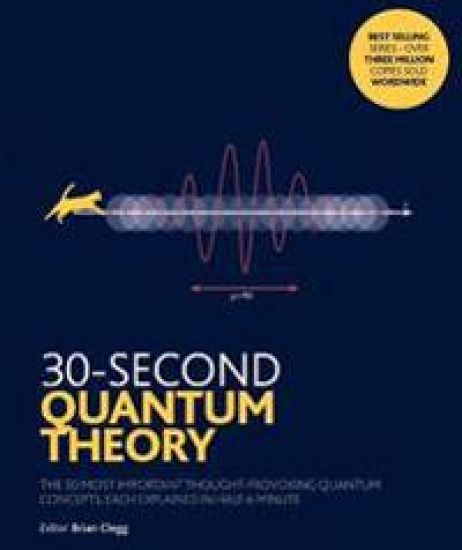
The bestselling 30-Second... series takes a revolutionary approach to learning about those subjects you feel you should really understand.Each title selects a popular topic and dissects it into the 50 most significant ideas at its heart. Each idea, no matter how complex, is explained in 300 words and one picture, all digestible in 30 seconds.30-Second Quantum Theory tackles a mindbendingly mysterious area of physics, introducing the 50 most significant quantum quandaries and ideas. In a world where the quantum physics of electronics is an everyday essential and new quantum developments make headline news, you will visit Parallel Worlds, ride Wave Theory, and learn just enough to talk with certainty about Uncertainty Theory and to untangle the mysteries of quantum entanglement.
The New Cosmic Onion

The New Cosmic Onion

Frank Close

CRC Press
2017
sidottu
Not since Newton?s apple has there been a physics phenomenon as deliciously appealing to the masses as Frank Close?s Cosmic Onion. Widely embraced by scientists and laypersons alike, the book quickly became an international bestseller. Translated into seven languages, it propelled the author to become a worldwide celebrity as well as an inspiration to a generation of scientists. The book?s title itself has entered popular usage as a metaphor for the layers that can be peeled away to understand the foundations of the physical world, from dimensions and galaxies, to atoms and quarks. ?Close is a lucid, reliable, and enthusiastic guide to the strange and wonderful microcosmic world that dwells deep within reality? ? Frank Wilczek, Herman Feshbach Professor of Physics, MIT, 2004 Nobel Prize in Physics NEW Material Explains the principles behind the Hadron Collider as well as the potential it presents Considers the recent development of the Electroweak Theory as a law of nature Explores the mysteries uncovered and the ones that may be in store with regard to top and bottom quarks Keeping still-pertinent contents from the original volume that caught the world?s attention in 1983, this fresh edition of the Cosmic Onion includes extensive new material to reflect new views of the
Eclipse -- Journeys to the Dark Side of the Moon

Eclipse -- Journeys to the Dark Side of the Moon

Frank Close

Oxford University Press
2017
sidottu
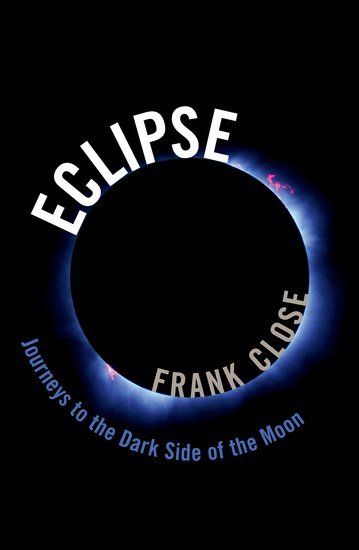
On 21 August 2017, over 100 million people will gather in a narrow belt across the USA to witness the most watched total solar eclipse in history. Eclipse - Journeys to the Dark Side of the Moon, written by the widely read popular science author Frank Close, describes the spellbinding allure of this most beautiful natural phenomenon. The book explains why eclipses happen, reveals their role in history, literature and myth, and focuses on eclipse chasers, who travel with ecstatic fervour to some of the most inaccessible places on the globe to be present at the moment of totality. The book includes the author's quest to solve a 3000 years old mystery: how did the moon move backwards during a total solar eclipse, as claimed in the Book of Joshua? It is an inspirational tale: how a teacher and an eclipse inspired the author, aged eight, to a life in science, and a love affair with eclipses, which takes him to a war zone in the Western Sahara, to the South Pacific and the African bush. The tale comes full circle with another eight-year old boy - the author's grandson - at the 2017 great American eclipse. Readers of all ages will be drawn to this inspirational chronicle of the mesmerizing experience of total solar eclipse.
Too Hot to Handle

Too Hot to Handle

Frank Close

Princeton University Press
2016
sidottu
Frank Close, a leading physicist and talented popular science writer, reveals the true story of the cold fusion controversy--a story ignored until now in spite of the glare of publicity surrounding Martin Fleischmann and Stanley Pons. On March 23, 1989, these two Utah scientists held an astonishing press conference, maintaining that they had succeeded, working in secret, in harnessing atomic fusion. What was the basis for their claims to have achieved cold fusion in a test tube in a basement laboratory, while other scientists--using magnets as big as houses and temperatures hotter than those in the center of the sun--were failing to produce as much power as they were using? Why did Fleischmann and Pons proclaim their "discovery" at a news conference, when first announcements of scientific results are almost always made within the scientific community? Why did the full-blown media event inspired by their initial report cause governments to reorient their research programs in hopes of cornering the "new technology"? And why did some scientists recklessly abandon their traditional painstaking methods in haste to be first to prove or discredit the experiment? Acquainted at first hand with investigations of cold fusion on two continents, Close is uniquely qualified to probe the motivations behind Fleischmann's and Pons's startling assertions and to explore the intellectual and political turmoil that surrounded the cold fusion debate.Originally published in 1991.The Princeton Legacy Library uses the latest print-on-demand technology to again make available previously out-of-print books from the distinguished backlist of Princeton University Press. These editions preserve the original texts of these important books while presenting them in durable paperback and hardcover editions. The goal of the Princeton Legacy Library is to vastly increase access to the rich scholarly heritage found in the thousands of books published by Princeton University Press since its founding in 1905.
Half Life

Half Life

Frank Close

Oneworld Publications
2015
pokkari
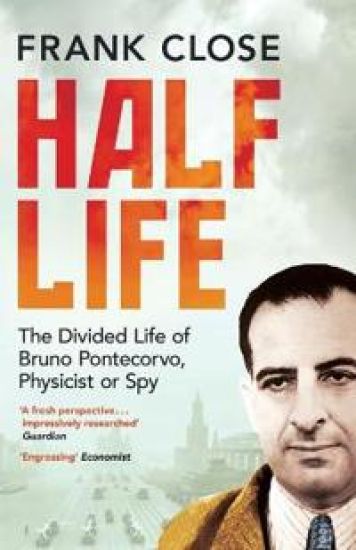
The memo landed on Kim Philby's desk in Washington, DC, in July 1950. Three months later, Bruno Pontecorvo, a physicist at Harwell, Britain's atomic energy lab, disappeared without a trace. When he re-surfaced six years later, he was on the other side of the Iron Curtain. One of the most brilliant scientists of his generation, Pontecorvo was privy to many secrets: he had worked on the Anglo-Canadian arm of the Manhattan Project, and quietly discovered a way to find the uranium coveted by nuclear powers. Yet when he disappeared MI5 insisted he was not a threat. Now, based on unprecedented access to archives, letters, surviving family members and scientists, award-winning writer and physics professor Frank Close exposes the truth about a man irrevocably marked by the advent of the atomic age and the Cold War.
Nuclear Physics

Nuclear Physics

Frank Close

Oxford University Press
2015
nidottu
Nuclear physics began long before the identification of fundamental particles, with J. J. Thomson's discovery of the electron at the end of the 19th century, which implied the existence of a positive charge in the atom to make it neutral. In this Very Short Introduction Frank Close gives an account of how this area of physics has progressed, including the recognition of how heavy nuclei are built up in the cores of stars and in supernovae, the identification of quarks and gluons, and the development of quantum chromodynamics (QCD). Exploring key concepts such as the stability of different configurations of protons and neutrons in nuclei, Frank Close shows how nuclear physics brings the physics of the stars to Earth and provides us with important applications, particularly in medicine. ABOUT THE SERIES: The Very Short Introductions series from Oxford University Press contains hundreds of titles in almost every subject area. These pocket-sized books are the perfect way to get ahead in a new subject quickly. Our expert authors combine facts, analysis, perspective, new ideas, and enthusiasm to make interesting and challenging topics highly readable.
30-Second Quantum Theory

30-Second Quantum Theory

Brian Clegg; Frank Close; Leon Clifford; Philip Ball; Sophie Hebden

Icon Books Ltd
2014
sidottu
The bestselling 30-Second... series takes a revolutionary approach to learning about those subjects you feel you should really understand.Each title selects a popular topic and dissects it into the 50 most significant ideas at its heart. Each idea, no matter how complex, is explained in 300 words and one picture, all digestible in 30 seconds.30-Second Quantum Theory tackles a mindbendingly mysterious area of physics, introducing the 50 most significant quantum quandaries and ideas. In a world where the quantum physics of electronics is an everyday essential and new quantum developments make headline news, you will visit Parallel Worlds, ride Wave Theory, and learn just enough to talk with certainty about Uncertainty Theory and to untangle the mysteries of quantum entanglement.
Too Hot to Handle

Too Hot to Handle

Frank Close

Princeton University Press
2014
pokkari
Frank Close, a leading physicist and talented popular science writer, reveals the true story of the cold fusion controversy--a story ignored until now in spite of the glare of publicity surrounding Martin Fleischmann and Stanley Pons. On March 23, 1989, these two Utah scientists held an astonishing press conference, maintaining that they had succeeded, working in secret, in harnessing atomic fusion. What was the basis for their claims to have achieved cold fusion in a test tube in a basement laboratory, while other scientists--using magnets as big as houses and temperatures hotter than those in the center of the sun--were failing to produce as much power as they were using? Why did Fleischmann and Pons proclaim their "discovery" at a news conference, when first announcements of scientific results are almost always made within the scientific community? Why did the full-blown media event inspired by their initial report cause governments to reorient their research programs in hopes of cornering the "new technology"? And why did some scientists recklessly abandon their traditional painstaking methods in haste to be first to prove or discredit the experiment? Acquainted at first hand with investigations of cold fusion on two continents, Close is uniquely qualified to probe the motivations behind Fleischmann's and Pons's startling assertions and to explore the intellectual and political turmoil that surrounded the cold fusion debate.Originally published in 1991.The Princeton Legacy Library uses the latest print-on-demand technology to again make available previously out-of-print books from the distinguished backlist of Princeton University Press. These editions preserve the original texts of these important books while presenting them in durable paperback and hardcover editions. The goal of the Princeton Legacy Library is to vastly increase access to the rich scholarly heritage found in the thousands of books published by Princeton University Press since its founding in 1905.
The Infinity Puzzle

The Infinity Puzzle

Frank Close

Basic Books
2013
pokkari
Speculation is rife that by 2012 the elusive Higgs boson will be found at the Large Hadron Collider. If found, the Higgs boson would help explain why everything has mass. But there's more at stake,what we're really testing is our capacity to make the universe reasonable. Our best understanding of physics is predicated on something known as quantum field theory. Unfortunately, in its raw form, it doesn't make sense,its outputs are physically impossible infinite percentages when they should be something simpler, like the number 1. The kind of physics that the Higgs boson represents seeks to renormalize" field theory, forcing equations to provide answers that match what we see in the real world. The Infinity Puzzle is the story of a wild idea on the road to acceptance. Only Close can tell it.