Kirjojen hintavertailu. Mukana 12 595 353 kirjaa ja 12 kauppaa.

Kirjailija

Frank Voehl

Kirjat ja teokset yhdessä paikassa: 18 kirjaa, julkaisuja vuosilta 1995-2023, suosituimpien joukossa The Lean Six Sigma Black Belt Handbook. Vertaile teosten hintoja ja tarkista saatavuus suomalaisista kirjakaupoista.

18 kirjaa

Kirjojen julkaisuhaarukka 1995-2023.

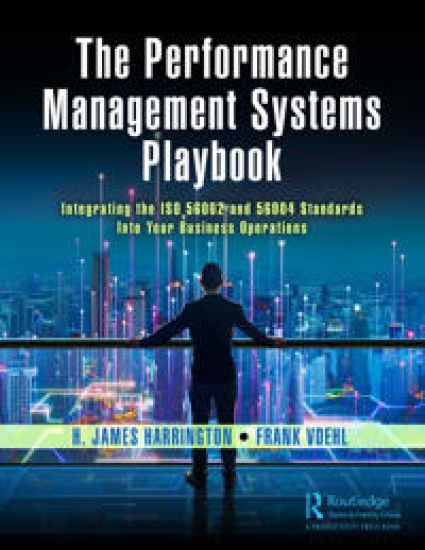
The Performance Management Systems Playbook

The Performance Management Systems Playbook

H. James Harrington; Frank Voehl

TAYLOR FRANCIS LTD
2023
sidottu
The objective of the ISO 56002 standard is to provide a framework on how to build an innovation ecosystem that can be sustained over time. Similar to the quality management system that ISO established decades ago, this standard provides instructions related to best practices on how to establish an Innovative Management System within an organization. However, it does not provide guidance on how to implement and/or use the standard. The ISO Standard 56004 Innovation Management Assessment was designed to define the maturity level of an organization's Innovation Management System. The primary purpose of most Innovative Management Systems is to process a continuous flow of new and highly creative outputs that will meet external customers’ needs and expectations. The users of ISO 56002 and 56004 know that they are "what to do" documents. This book, however, shows you how to do it! Both ISO Standard 56002 and 56004 are focused on improving the organization's innovative management system. This book focuses on how to train employees on how to use the system to add value to the organization’s stakeholders. There are no books out on the subject – this book greatly assists managers, business leaders, entrepreneurs, and consultants seeking help in using the innovation management system effectively and efficiently. Essentially, this book presents an effective marriage between the innovative management system and how it will operate when it becomes part of the operating procedures.
The Performance Management Systems Playbook

The Performance Management Systems Playbook

H. James Harrington; Frank Voehl

TAYLOR FRANCIS LTD
2023
nidottu
The objective of the ISO 56002 standard is to provide a framework on how to build an innovation ecosystem that can be sustained over time. Similar to the quality management system that ISO established decades ago, this standard provides instructions related to best practices on how to establish an Innovative Management System within an organization. However, it does not provide guidance on how to implement and/or use the standard. The ISO Standard 56004 Innovation Management Assessment was designed to define the maturity level of an organization's Innovation Management System. The primary purpose of most Innovative Management Systems is to process a continuous flow of new and highly creative outputs that will meet external customers’ needs and expectations. The users of ISO 56002 and 56004 know that they are "what to do" documents. This book, however, shows you how to do it! Both ISO Standard 56002 and 56004 are focused on improving the organization's innovative management system. This book focuses on how to train employees on how to use the system to add value to the organization’s stakeholders. There are no books out on the subject – this book greatly assists managers, business leaders, entrepreneurs, and consultants seeking help in using the innovation management system effectively and efficiently. Essentially, this book presents an effective marriage between the innovative management system and how it will operate when it becomes part of the operating procedures.
The Innovation Systems Cycle

The Innovation Systems Cycle

H. James Harrington; Frank Voehl

CRC Press
2019
nidottu
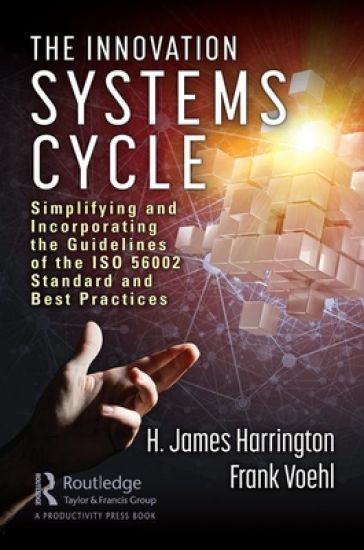
Currently, the prime focus for US business plans should not be on the manufacturing process design and delivery processes, but on greatly improving innovation leadership, design engineering capability, and sales and marketing innovation. These three areas have been sadly lacking significant performance improvement during the past 20 years. The magic word for US business is "simplification." Most of the books written to date focus on the solution development aspect of the Innovation System Cycle, which is less than 15% of the total innovative system. Focusing on solution development is only the start -- the rest of the innovation system cycle is what turns an idea into a profitable business. The techniques in this book are directed at key tasks across the innovative process, such as maximizing quality, productivity, maintainability, usability, and reliability, while focusing on reducing the product cycle time and costs within the innovative process. This book uses more than 50 different approaches/concepts, which leads the reader in a very simple method for understanding, establishing, and effectively using an innovative system to provide a significant marketing advantage. Previous books have focused on what to do; however, this book focuses on how to do it. It transforms a complicated complex system into easy-to-use and understand methodology.
The Innovation Systems Cycle

The Innovation Systems Cycle

H. James Harrington; Frank Voehl

CRC Press
2019
sidottu
Currently, the prime focus for US business plans should not be on the manufacturing process design and delivery processes, but on greatly improving innovation leadership, design engineering capability, and sales and marketing innovation. These three areas have been sadly lacking significant performance improvement during the past 20 years. The magic word for US business is "simplification." Most of the books written to date focus on the solution development aspect of the Innovation System Cycle, which is less than 15% of the total innovative system. Focusing on solution development is only the start -- the rest of the innovation system cycle is what turns an idea into a profitable business. The techniques in this book are directed at key tasks across the innovative process, such as maximizing quality, productivity, maintainability, usability, and reliability, while focusing on reducing the product cycle time and costs within the innovative process. This book uses more than 50 different approaches/concepts, which leads the reader in a very simple method for understanding, establishing, and effectively using an innovative system to provide a significant marketing advantage. Previous books have focused on what to do; however, this book focuses on how to do it. It transforms a complicated complex system into easy-to-use and understand methodology.
The Framework for Innovation

The Framework for Innovation

Frank Voehl; H. James Harrington; Rick Fernandez; Brett Trusko

Apple Academic Press Inc.
2018
sidottu
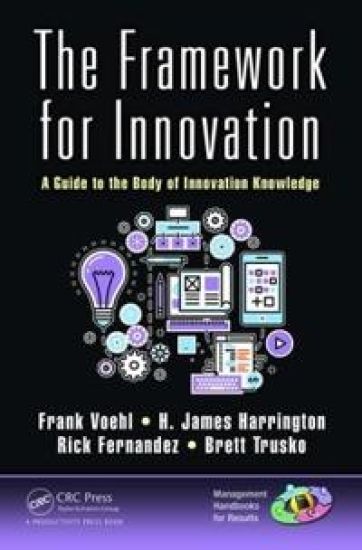
The innovation infrastructure and master plan described in this book offers a detailed and comprehensive approach to one of the most difficult and challenging problems facing entrepreneurs involved in innovation at any scale enterprise: the problem of how to govern your organization’s innovation initiatives in the middle of turbulent change. Progress in any field requires the development of a framework, a structure that organizes the accumulating knowledge, enables people to master it, and unifies the key discoveries into a set of principles thatmakes them understandable and actionable. For starters, successful innovation requires an integrated design process, beginning with integration in the design of the enterprise, the design of the product, along with the design and implementation of new technologies. Such an integrated design effort requires good collaboration and management of the design framework, and should be supported by efficient knowledge management techniques and tools; If innovation is to help a business grow and improve its competitiveness, it is also important to plan the innovation carefully. This book provides a holistic, multidisciplinary framework that will enable your organization and its leaders to take a strategic approach to innovation. The framework combines non-traditional,creative approaches to business innovation with conventional strategy development models. The framework model brings together perspectives from many complementary disciplines: the non-traditional approaches to innovation found in the business creativity movement; multiple-source strategy consulting; the new product development perspective of many leading industrial design firms; qualitative consumer/customer research; future-based research found in think tanks and traditional scenario planning; and organizational development (OD) practices that examine the effectiveness of an organization’s culture, processes, and structure.Though some ideas may just "fall from the sky" or "come out of the blue", an organization should also have a strategic vision of how the business and the enterprise will successfully develop. It should not just wait for the innovation to arrive arbitrarily, but rather proactively plan for innovation incorporating market trends, the competitive landscape, new technology availability, and changes in customer preferences and trends in order to create a flexible in-house innovation process. Such an enterprise will also pro-actively manage the knowledge supply chain that supports innovation, as outlined in this book #7 of Management Handbook for Results series. The framework outlined in this handbook consists of a well-integrated cohesive set of practices that inspires imaginative innovation teams to look beyond the obvious and explore a broad range of possibilities to identify significant opportunities and make informed decisions about the most promising paths to pursue. The goal is to create a shared vision for growth, along with defining pragmatic action plans that bridge from the future back to the present, while attempting to align the organization around the requirements for success.
Change Management

Change Management

Frank Voehl; H. James Harrington

CRC Press
2017
sidottu
Change Management: Manage Change or It Will Manage You represents a substantial core guidance effort for Change Management practitioners. Organizations currently contend with increasingly higher levels of knowledge-driven competition. Many attempt to meet the challenge by investing in expensive knowledge-driven change management systems. Such systems are useless, and sometimes even harmful, for making strategic decisions because they do not distinguish between what is strategically relevant and what is not. This Management-for-Results Handbook focuses on identifying and managing the specific, critical knowledge assets that your organization needs to disrupt your competitors, including tacit experience of key employees, a deep understanding of customers needs, valuable patents and copyrights, shared industry practices, and customer- and supplier-generated innovations. The authors present two aspects of Change Management: (1) traditional Change Management as it impacts the project management team‘s activities and (2) a suggested new approach to Change Management directed at changing the culture. The focus is to prepare the people impacted by the project and change activities to accept and adapt to the new/changed working conditions. The first half of the book deals with traditional Change Management, which covers the topics of remembering, understanding, and applying. The second half presents the authors new approach to changing the culture, which deals with analyzing, evaluating, and creating.
Making the Case for Change

Making the Case for Change

Christopher F. Voehl; H. James Harrington; Frank Voehl

CRC Press
2017
sidottu
The best time to stop projects or programs that will not be successful is before they are ever started. Research has shown that the focused use of realistic business case analysis on proposed initiatives could enable your organization to reduce the amount of project waste and churn (rework) by up to 40 percent, potentially avoiding millions of dollars lost on projects, programs, and initiatives that would fail to produce the desired results. This book illustrates how to develop a strong business case which links investments to program results and, ultimately, with the strategic outcomes of the organization. In addition, the book provides a template and example case studies for those seeking to fast-track the development of a business case within their organization.Making the Case for Change: Using Effective Business Cases to Minimize Project and Innovation Failures provides executive teams and change agents with the information required to make better business case decisions. This book can be used throughout the life cycle of the project to assist with gaining a better understanding of the following key knowledge areas for developing a business case: Understanding the present problem/improvement opportunity Documenting how the project, program, or initiative will add value to the organization Validating the data and the assumptions that the projected improvements are based upon Calculating the level of confidence that can be placed upon the conclusions that are reached Assessing the alternative solutions that were considered Weighing the costs vs. the benefits of the proposed initiative Analyzing and mitigating the risks to completing 100 percent of the project‘s goals Eliciting and prioritizing the requirements of key stakeholders and subject matter experts Identifying the key people that are involved in the proposed project and the skil
The Innovation Tools Handbook, Volume 2

The Innovation Tools Handbook, Volume 2

H. James Harrington; Frank Voehl

Productivity Press
2016
sidottu
In today’s fast-moving, high-technology environment, the focus on quality has given way to a focus on innovation. From presidents of the United States to presidents of Fortune 500 companies, it is clear that everyone thinks innovation is extremely important. The challenge is that few people stop to define why innovation is important—to understand what’s driving the need for more innovation. We all agree that more frequent innovation is important, even necessary.There is actually a growing body of evidence that indicates that looking outside of your company (rather than purely looking internally) and to customers’ needs, using the tools in this Handbook, will lead to more innovative ideas. Responding to customers’ needs is the key to a successful business. You can use these tools to talk to customers—satisfied ones, unsatisfied ones, potential customers, people who would never buy your product or service, and also people you have never considered as a potential customer. In addition, these tools will help you ask your competitors’ customers about what makes them happy with the current businesses and offerings in the industry, why they buy or do not buy from you, your competitors, and other industries. These tools will help you understand the steps in the customer journey they need to take, what delights and frustrates them, and what their pain points are.The three volumes of The Innovation Tools Handbook cover 76 top-rated tools and methods, from the hundreds available, that every innovator must master to be successful. Covering evolutionary and/or improvement innovative tools and methodologies, Volume 2 presents 23 tools/methodologies related to innovative evolutionary products, processes, and services, or the improvement of existing ones.For each tool, the book provides a definition, identifies the user of the tool, explains what phases of the innovation process the tool is used, describes how the tool is used, supplies examples of the outputs from the tool, identifies software that can maximize its effectiveness, and includes references and suggestions for further reading. Ideation is about developing ideas on how to seize identified opportunities. What are the possible answers to your breakthrough questions? Having a deep understanding about the customer, their needs and pain points, as well as the existing solutions (i.e. business models in the industry) will naturally lead to new ideas. How seriously you do your discovery homework using the tools in these Handbooks will determine not only how fast you create ideas, but about how likely these ideas are to succeed.Tools and methodologies covered include: 5 why questions, Affinity diagrams, attribute listing, brainwriting 6–3–5, cause-and-effect diagrams, creative problem solving model, design for tools, flowcharting, force field analysis, Kano analysis, nominal group technique, plan–do–check–act, reengineering/redesign, reverse engineering, robust design, SCAMPER, simulations, six thinking hats, social networks, solution analysis diagrams, statistical analysis, tree diagram, and value analysis.The authors believe that by making effective use of the tools and methodologies presented in this book, your organization can increase the percentage of creative/innovative ideas by five to eight times its present performance level.
Change Management

Change Management

Frank Voehl; H. James Harrington

Apple Academic Press Inc.
2016
nidottu
Change Management: Manage Change or It Will Manage You represents a substantial core guidance effort for Change Management practitioners. Organizations currently contend with increasingly higher levels of knowledge-driven competition. Many attempt to meet the challenge by investing in expensive knowledge-driven change management systems. Such systems are useless, and sometimes even harmful, for making strategic decisions because they do not distinguish between what is strategically relevant and what is not.This Management-for-Results Handbook focuses on identifying and managing the specific, critical knowledge assets that your organization needs to disrupt your competitors, including tacit experience of key employees, a deep understanding of customers’ needs, valuable patents and copyrights, shared industry practices, and customer- and supplier-generated innovations. The authors present two aspects of Change Management: (1) traditional Change Management as it impacts the project management team’s activities and (2) a suggested new approach to Change Management directed at changing the culture. The focus is to prepare the people impacted by the project and change activities to accept and adapt to the new/changed working conditions.The first half of the book deals with traditional Change Management, which covers the topics of remembering, understanding, and applying. The second half presents the authors’ new approach to changing the culture, which deals with analyzing, evaluating, and creating.
Making the Case for Change

Making the Case for Change

Christopher F. Voehl; H. James Harrington; Frank Voehl

CRC Press Inc
2014
nidottu
The best time to stop projects or programs that will not be successful is before they are ever started. Research has shown that the focused use of realistic business case analysis on proposed initiatives could enable your organization to reduce the amount of project waste and churn (rework) by up to 40 percent, potentially avoiding millions of dollars lost on projects, programs, and initiatives that would fail to produce the desired results. This book illustrates how to develop a strong business case which links investments to program results and, ultimately, with the strategic outcomes of the organization. In addition, the book provides a template and example case studies for those seeking to fast-track the development of a business case within their organization.Making the Case for Change: Using Effective Business Cases to Minimize Project and Innovation Failures provides executive teams and change agents with the information required to make better business case decisions. This book can be used throughout the life cycle of the project to assist with gaining a better understanding of the following key knowledge areas for developing a business case:Understanding the present problem/improvement opportunityDocumenting how the project, program, or initiative will add value to the organizationValidating the data and the assumptions that the projected improvements are based uponCalculating the level of confidence that can be placed upon the conclusions that are reachedAssessing the alternative solutions that were consideredWeighing the costs vs. the benefits of the proposed initiativeAnalyzing and mitigating the risks to completing 100 percent of the project’s goalsEliciting and prioritizing the requirements of key stakeholders and subject matter expertsIdentifying the key people that are involved in the proposed project and the skills needed to implement the proposed changeObtaining consensus on the decision to move forward, as well as on the methods used and the conclusions specified in the analysisIdeal for executives and project/initiative managers seeking approval of an activity, initiative, program, or project, the book presents proven tips, advice, suggestions, and recommended courses of action for developing effective business cases. In addition, suggestions for recruiting a responsible senior officer or sponsor for the project and for engaging an audience are provided.The authors combine their own experience in business case development with approaches used by world-class organizations. They provide a general range of assessment criteria that can be applied to almost any type of project business cases.The text discusses each of the 8 activities and the 35 tasks that make up the business case development process. This process supplies you with a proven approach for creating comprehensive and well-constructed business case evaluations that will either ensure the success of your project, or eliminate unsuccessful projects, programs, and initiatives before they start.
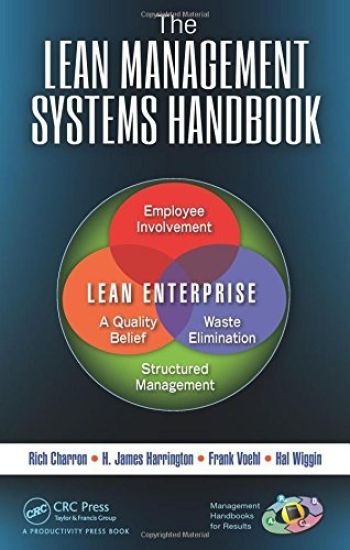
The Lean Management Systems Handbook

The Lean Management Systems Handbook

Rich Charron; H. James Harrington; Frank Voehl; Hal Wiggin

CRC Press Inc
2014
sidottu
Performance management, the primary focus of a Lean organization, occurs through continuous improvement programs that focus on education, belief systems development, and effective change management. Presenting a first-of-its-kind approach, The Lean Management Systems Handbook details the critical components required for sustainable Lean management.Positioning Lean as a management operational philosophy far beyond the traditional set of improvement tools, the book explains how managers at all levels of the organization can integrate Lean into their daily management activities. It defines the Lean philosophy as well as the beliefs and behaviors required to develop a thriving Lean company culture.The book captures the essence of Lean learning and Lean doing and illustrates practical applications of Lean management. It begins by covering the basics that encompass Lean management and leadership in two critical areas: maintenance/control and improvement.After reading this book, you will better understand how to see waste, measure waste, eliminate waste, and develop an active change improvement workplace. You will also gain the practical understanding required to determine which Lean tool is best suited to your particular need for supporting an organization-wide management system.Expounding on essential Lean concepts, this is an ideal guide to help new managers and leaders make the transition from theory to successful application in the field. Complete with brief summaries and examples of the most important tools in Lean management systems development in each chapter, the book provides a reliable roadmap for deploying a Lean management system across your organization, and subsequently across your entire value stream.
The Lean Six Sigma Black Belt Handbook

The Lean Six Sigma Black Belt Handbook

Frank Voehl; H. James Harrington; Chuck Mignosa; Rich Charron

CRC Press Inc
2013
sidottu
Although Lean and Six Sigma appear to be quite different, when used together they have shown to deliver unprecedented improvements to quality and profitability. The Lean Six Sigma Black Belt Handbook: Tools and Methods for Process Acceleration explains how to integrate these seemingly dissimilar approaches to increase production speed while decreasing variations and costs in your organization.Presenting problem-solving tools you can use to immediately determine the sources of the problems in your organization, the book is based on a recent survey that analyzed Six Sigma tools to determine which are the most beneficial. Although it focuses on the most commonly used tools, it also includes coverage of those used a minimum of two times on every five Six Sigma projects.Filled with diagrams of the tools you’ll need, the book supplies a comprehensive framework to help you for organize and process the vast amount of information currently available about Lean, quality management, and continuous improvement process applications. It begins with an overview of Six Sigma, followed by little-known tips for using Lean Six Sigma (LSS) effectively. It examines the LSS quality system, its supporting organization, and the different roles involved.Identifying the theories required to support a contemporary Lean system, the book describes the new skills and technologies that you need to master to be certified at the Lean Six Sigma Black Belt (LSSBB) level. It also covers the advanced non-statistical and statistical tools that are new to the LSSBB body of knowledge.Presenting time-tested insights of a distinguished group of authors, the book provides the understanding required to select the solutions that best fit your organization's aim and culture. It also includes exercises, worksheets, and templates you can easily customize to create your own handbook for continuous process improvement.Designed to make the methodologies you choose easy to follow, the book will help Black Belts and Senseis better engage their employees, as well as provide an integrated and visual process management structure for reporting and sustaining continuous improvement breakthroughs and initiatives.
The Organizational Master Plan Handbook

The Organizational Master Plan Handbook

H. James Harrington; Frank Voehl

Productivity Press
2012
sidottu
Written for organizational leaders, planners, facilitators, and consultants, this book defines how the four different planning activities used to manage and improve an organization should be merged to maximize effectiveness. Stating that the four plans for organization improvement are the business plan, strategic business plan, strategic improvement plan, and operating plan, it defines each and explains how to link them together to reduce cost and cycle times. The text incorporates sufficient flexibility so readers can adapt and revise, based on changing business needs and marketplace opportunities.
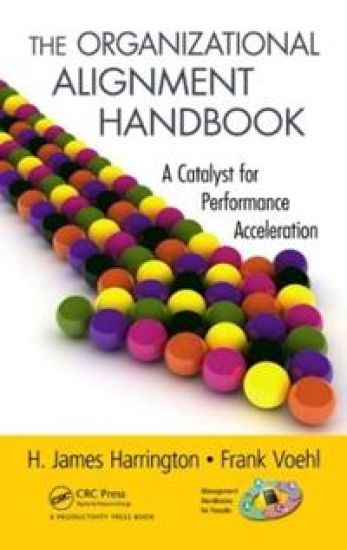
The Organizational Alignment Handbook

The Organizational Alignment Handbook

H. James Harrington; Frank Voehl

Productivity Press
2011
sidottu
In the same way that a well-defined approach is needed to develop an effective strategic plan, an equally well-designed approach is needed to support the alignment of your organization's structure, management concepts, systems, processes, networks, knowledge nets, training, hiring, and reward systems. Examining top-down, bottom-up, and core planning and execution processes, The Organizational Alignment Handbook: A Catalyst for Performance Acceleration provides a systematic approach for establishing the infrastructure needed to support a successful transformation and make your strategic plan a reality.Bridging the gap between macro and micro approaches with a single unified theory, the book provides the understanding needed to assess the effectiveness of your organization’s current management system. It explains how to identify potential projects, introduce new practices, plan for resource allocation, and define and recommend decision governance. Identifying the capability constraints you must resolve in order for your company to thrive in an increasingly competitive business environment, the book explains: How the organizational master plan fits into alignment activities How strategic planning process and outcomes can be made part of the performance plan for individuals How to use controllable factors as the foundation for your master planHow to develop a set of vision statements that defines how your organization will function in the futureThe management skills your organization currently possesses might be effective in today’s environment, but are they the skills needed to meet strategic objectives in the future? This book outlines a step-by-step approach for achieving organization-wide alignment of processes, applications, and systems, and to ensure acceptance of the results by all stakeholders. It includes examples of organizations implementing the strategies discussed as well as a review of the activities you need to follow to minimize the time it takes to reach your performance objectives today and in the future.
The Six SIGMA Yellow Belt Handbook

The Six SIGMA Yellow Belt Handbook

Frank Voehl; H. James Harrington

Paton Professional
2009
nidottu
The Six Sigma Yellow Belt Handbook is a comprehensive, practical guide to becoming a Six Sigma Yellow Belt. Whether you're just starting down the path toward becoming a Yellow Belt, an experienced Yellow Belt, or if you're the person responsible for your organization's Six Sigma process, you'll find this handbook to be an invaluable addition to your Six Sigma library. It's a wealth of information for anyone who wants to learn new ways of using statistical improvement to improve his or her organization Legendary quality guru H. James Harrington and co-author Frank Voehl have distilled their decades of knowledge about Six Sigma into this helpful handbook.Chapters include: * You, as a Yellow Belt. Learn what a Yellow Belt is, what skills are required, and how you can contribute to your organization's Six Sigma effort.* Basic Yellow Belt Skills. What s the best tool for the job? Included are comprehensive descriptions and applications of commonly used Six Sigma skills.* Statistical Tools for Yellow Belts. Lean how to use basic statistical tools to breath new life into your Six Sigma program.* DMAIC Overview. Learn the heart of the Six Sigma concept: the define-measure-analyze-improve-control process.The Six Sigma Yellow Belt Handbook also includes chapters on each of the DMAIC steps: define, measure, analyze, improve and control, as well as a full glossary of Six Sigma terms, and a list of Six Sigma s body of knowledge. This is a must-read for any Six Sigma practitioner
Macrologistics Management

Macrologistics Management

Martin Stein; Frank Voehl

CRC Press Inc
1997
sidottu
Macrologistics Management defines the term "Macrologistics" as a means for designing a catalyst for change in any organization. The "macro" approach means seeing the big picture-to use time and place strategies for competitive advantage. It is a "breakthrough" strategy because it prioritizes "logistics" selection as a key factor in developing customer satisfaction and market penetration. Traditional management approaches the product and cost savings as key factors in their strategy. This book demonstrates how new approaches can be even more effective and more profitable-it will help you achieve complete transformation in your organization through a systematic process for managing change and by using carefully prioritized change management strategies. The framework for change, as explained in this book, is one where continuous monitoring is facilitated by a relevant and responsive information system, workers and managers are empowered and rewarded for innovation, and leaders encourage a passion for change. With Macrologistics Management you will learn how to unleash new sources of synergy-ways for various groups involved with the organization to work together-that help promote creativity and motivate an effective and rapid revolution in your workplace!
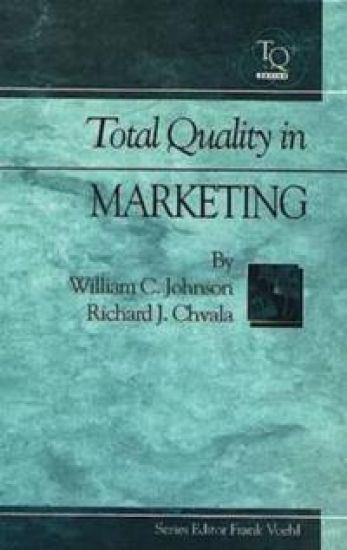
Total Quality in Marketing

Total Quality in Marketing

William C. Johnson; Richard Chvala; Frank Voehl

CRC Press Inc
1995
sidottu
Total Quality in Marketing integrates the two areas of marketing and quality management and demonstrates how they are mutually compatible and complementary. Its primary focus is to assist managers in applying total quality principles to the overall marketing management process-preparing for a more highly competitive marketplace. Practical guidelines and processes are offered on how quality initiatives impact planning, organization, implementation, and quality control. This unique and valuable book presents a systems approach to quality-how to operationalize in the context of both the management and marketing cycles. It demonstrates how to establish effective team-based practices as well as describes the pitfalls of quality programs that are introduced as stand-alone programs without any linkage to overall strategy. This useful new book serves as a teaching tool and comprehensive reference source for integrating total quality. Case studies, exercises and chapter profiles also provide excellent support materials.
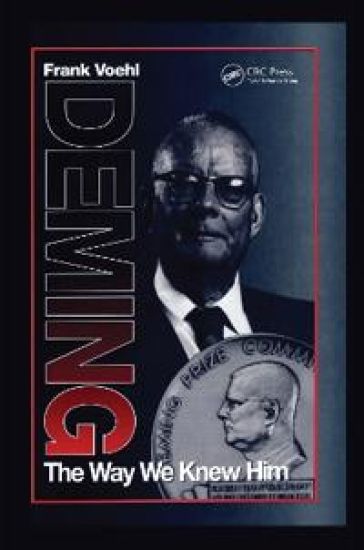
Deming The Way We Knew Him

Deming The Way We Knew Him

Frank Voehl

CRC Press Inc
1995
sidottu
Perhaps no other person in the history of modern business has so profoundly affected the methods of quality improvement in industry than W. Edwards Deming. The subject of many books, articles, and television documentaries, Dr. Deming has become the world-recognized leader of the quality movement in industry.