Kirjojen hintavertailu. Mukana 12 189 041 kirjaa ja 12 kauppaa.

Kirjailija

Frank Waters

Kirjat ja teokset yhdessä paikassa: 30 kirjaa, julkaisuja vuosilta 1949-2021, suosituimpien joukossa The Water Lily. Vertaile teosten hintoja ja tarkista saatavuus suomalaisista kirjakaupoista.

30 kirjaa

Kirjojen julkaisuhaarukka 1949-2021.

The Woman at Otowi Crossing

The Woman at Otowi Crossing

Frank Waters

Swallow Press
1987
pokkari
Based on the real life of Edith Warner, who ran a tearoom at Otowi Crossing, just below Los Alamos, The Woman at Otowi Crossing is the story of Helen Chalmer, a person in tune with her adopted environment and her neighbors in the nearby Indian pueblo and also a friend of the first atomic scientists. The secret evolution of atomic research is a counterpoint to her psychic development. In keeping with its tradition of allowing the best of its list to thrive, Ohio University Press/Swallow Press is particularly proud to reissue The Woman at Otowi Crossing by best-selling author Frank Waters. This new edition features an introduction by Professor Thomas J. Lyon and a foreword by the author's widow, Barbara Waters. The story is quintessential Waters: a parable for the potentially destructive materialism of the mid-twentieth century. The antidote is Helen Chalmer's ability to understand a deeper truth of her being; beyond the Western notion of selfhood, beyond the sense of a personality distinct from the rest, she experiences a new and wider awareness. The basis for an opera of the same name, The Woman at Otowi Crossing is the powerful story of the crossing of cultures and lives: a fable for our times.
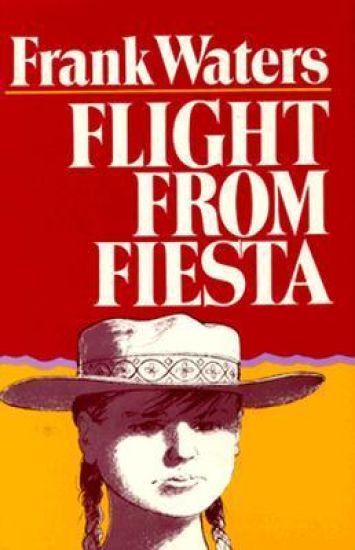
Flight from Fiesta

Flight from Fiesta

Frank Waters

Swallow Press
1987
sidottu
Frank Waters, whose work has spanned half a century, has continually attempted to depict the reconciliation of opposites, to heal the national wounds of polarization. Flight From Fiesta, Waters' first novel in nearly two decades, is testimony to that aspiration, emerging as a moving and masterfully–told story of two characters who must discover the potential for common ground between their personalities. Set in Santa Fe in the mid–fifties, the story itself is deceptively simple. Elsie, a spoiled, self–centered ten–year–old Anglo tourist girl, has come to the annual Fiesta with her divorced mother and her mother's lover. When Elsie runs away from her hotel, she encounters Inocencio, an old alcoholic Pueblo Indian now reduced to selling pottery beneath the portal of the Palace of the Governors. With childish cunning she maneuvers Inocencio into taking her away with him. In the wake of the child's disappearance, as the local posse–mentality intensifies and Inocencio is suspected of kidnapping and perhaps molesting her, the frightened Indian flees to the hills, taking Elsie with him on a week–long odyssey through the mountains, towns, and pueblos of New Mexico. Waters' eye is precise, providing sharp visual detail on very page. His ear is flawless, especially in his rendering of the laconic and stolid Indian speech patterns. All through his book there is an immediacy and a feel for place and culture that cannot be fabricated but must be gained, as Waters himself has gained it, through a lifetime among these people, these towns, and these mountains. The reconciliation of the two fugitives of Flight From Fiesta serves to point, not didactically or allegorically, but emotionally and spiritually, but emotionally and spiritually, to the possibility of the grander reconciliation that Waters envisions.
Colorado

Colorado

Frank Waters

Swallow Press
1985
nidottu
The vast Colorado River collects water from the highest Rocky Mountain peaks and traverses the widest plateaus, the deepest canyons, and the lowest deserts before emptying into the delta of northern Mexico. This austere land and mighty river resist exploration, settlement, and description. But in the hands of one of the West's great writers, Frank Waters, the history and lore of its past make irresistible reading and a resounding case for mankind's respect for the environment.
The Lizard Woman

The Lizard Woman

Frank Waters

Swallow Press
1985
pokkari
"The novel was begun in 1926, when I was twenty-four years old and working as a telephone engineer in Imperial Valley, on the California-Baja California border. During my stay there I made a horseback trip down into the little-known desert interior of Lower California. After having lived all of my early years in the high Rockies of California, I was unprepared for the vast sweep of sunstruck desert with its flat wastes, clumps of cacti, and barren parched-rock ranges. Its emotional impact was so profound, I was impelled to give voice to it with pencil and paper." — Frank Waters First published in 1930 under the title Fever Pitch, The Lizard Woman is Frank Waters' first novel. It foreshadows a theme central to Waters' later work: that we must attune our spirits to the land to fully understand our places in the natural order.
The Earp Brothers of Tombstone

The Earp Brothers of Tombstone

Frank Waters

Bison Books
1976
pokkari
The Earp Brothers of Tombstone and the famous fight at the O. K. Corral are well known to American history and even better known to American legend. This composite biography of Wyatt, Morgan, Virgil, James, and Warner Earp is based on the recollections of Mrs. Virgil Earp, dictated to the author in the 1930s, and amplified by documents he unearthed in 1959. In his review of the book for Library Journal, W. S. Wallace stated that he considered The Earp Brothers of Tombstone "the most authoritative account ever to be published on the subject."
Pumpkin Seed Point

Pumpkin Seed Point

Frank Waters

Swallow Press
1973
pokkari
Frank Waters lived for three years among the Hopi people of Arizona and was quickly drawn into their culture. Pumpkin Seed Point is a beautifully written personal account of Waters's inner and outer experiences among the Hopi.
Midas of the Rockies

Midas of the Rockies

Frank Waters

Swallow Press
1972
pokkari
This reprint makes available again Frank Waters' dramatic and colorful 1937 biography of Winfield Scott Stratton, the man who struck it rich at the foot of Pike's Peak and turned Cripple Creek into the greatest gold camp on earth. More than regional history, Midas of the Rockies is a story so fabulously impossible and yet so painfully true that it commends itself to the whole of America, the only earth, the only people who could have created it.
The Yogi of Cockroach Court

The Yogi of Cockroach Court

Frank Waters

Swallow Press
1970
pokkari
In this novel of the mestizo, or mixed-blood, Frank Waters completes the Southwestern canvas begun in The Man Who Killed the Deer and People of the Valley. Set in a violent Mexican border town, the story centers on Barby, a tormented mestizo, Guadalupe, the mestiza "percentage-girl," and Tai-Ling, the serene yogi. Their fates mingle though each remains alone—Barby bound to the brute rages of the night; Guadalupe unconscious of all save the sun of her sexuality; Tai-Ling believing it is possible to transcend completely the flow of life.
Masked Gods

Masked Gods

Frank Waters

Swallow Press
1950
pokkari
Masked Gods is a vast book, a challenging and profoundly original account of the history, legends, and ceremonialism of the Navajo and Pueblo Indians of the Southwest. Following a brief but vivid history of the two tribes through the centuries of conquest, the book turns inward to the meaning of Native American legends and ritual—Navajo songs, Pueblo dances, Zuni kachina ceremonies. Enduring still, these rituals and ceremonies express a view of life, of man's place in the creation, which is compared with Taoism and Buddhism—and with the aggressive individualism of the Western world.
The Man Who Killed the Deer

The Man Who Killed the Deer

Frank Waters

Swallow Press
1949
pokkari
The story of Martiniano, The Man Who Killed the Deer, is a timeless story of Pueblo Indian sin and redemption, and of the conflict between Indian and white laws; written with a poetically charged beauty of style, a purity of conception, and a thorough understanding of Native American values.