Kirjojen hintavertailu. Mukana 12 595 353 kirjaa ja 12 kauppaa.

Kirjailija

Fred Dallmayr

Kirjat ja teokset yhdessä paikassa: 56 kirjaa, julkaisuja vuosilta 1996-2023, suosituimpien joukossa Marc Chagall. Vertaile teosten hintoja ja tarkista saatavuus suomalaisista kirjakaupoista.

56 kirjaa

Kirjojen julkaisuhaarukka 1996-2023.

Marc Chagall

Marc Chagall

Fred Dallmayr

Routledge India
2020
nidottu
This book follows Chagall’s life through his art and his understanding of the role of the artist as a political being. It takes the reader through the different milieus of the nineteenth and twentieth centuries – including the World Wars and the Holocaust – to present a unique understanding of Chagall’s artistic vision of peace in an age of extremes. At a time when all identities are being subsumed into a “national” identity, this book makes the case for a larger understanding of art as a way of transcending materiality. The volume explores how Platonic notions of truth, goodness, and beauty are linked and mutually illuminating in Chagall’s work. A “spiritual-humanist” interpretation of his life and work renders Chagall’s opus more transparent and accessible to the general reader.It will be essential reading for students of art and art history, political philosophy, political science, and peace studies.
Marc Chagall

Marc Chagall

Fred Dallmayr

Routledge India
2020
sidottu
This book follows Chagall’s life through his art and his understanding of the role of the artist as a political being. It takes the reader through the different milieus of the nineteenth and twentieth centuries – including the World Wars and the Holocaust – to present a unique understanding of Chagall’s artistic vision of peace in an age of extremes. At a time when all identities are being subsumed into a “national” identity, this book makes the case for a larger understanding of art as a way of transcending materiality. The volume explores how Platonic notions of truth, goodness, and beauty are linked and mutually illuminating in Chagall’s work. A “spiritual-humanist” interpretation of his life and work renders Chagall’s opus more transparent and accessible to the general reader.It will be essential reading for students of art and art history, political philosophy, political science, and peace studies.
Truth and Politics

Truth and Politics

Fred Dallmayr

STATE UNIVERSITY OF NEW YORK PRESS
2023
pokkari
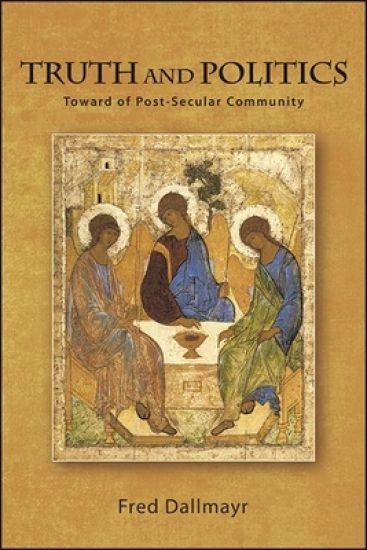
Endorses the pursuit of paradigm shifts in our understandings of faith, truth, and nature to remedy the "underside" of modernity and thus to inaugurate a post-modern (but not anti-modern) and post-secular (but not anti-secular) view of the world.Oppositions found in nearly every element of society readily give way to antagonism and hostility and, ultimately, to war and destruction. Both historically and analytically, this condition can be traced to an outlook called "the modern paradigm," launched by Descartes' "cogito ergo sum." The paradigm shift explored in this study is proposed on three levels: faith, society, and ecology. On the faith (human-divine relations) level, Fred Dallmayr suggests a shift where faith and world are seen in symbiosis rather than set against each other in the dualism that modernity has caused. On the societal (inter-human relations) level, he suggests a shift that would repair modernity's trend of sundering individuals from any communal background, which has caused people to increasingly act (solely) in their own interests. On the ecology (man-nature relations) level, Dallmayr explores how nature has responded to human exploitation and constant intervention, underscoring the need for a paradigm shift here as well. Truth and Politics seeks to remedy the "underside" of modernity and thus to inaugurate a "postmodern" (not anti-modern") and "post-secular" (not anti-secular) perspective.
Truth and Politics

Truth and Politics

Fred Dallmayr

STATE UNIVERSITY OF NEW YORK PRESS
2022
sidottu
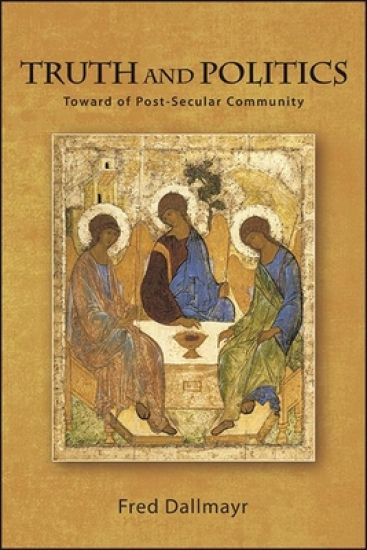
Endorses the pursuit of paradigm shifts in our understandings of faith, truth, and nature to remedy the "underside" of modernity and thus to inaugurate a post-modern (but not anti-modern) and post-secular (but not anti-secular) view of the world.Oppositions found in nearly every element of society readily give way to antagonism and hostility and, ultimately, to war and destruction. Both historically and analytically, this condition can be traced to an outlook called "the modern paradigm," launched by Descartes' "cogito ergo sum." The paradigm shift explored in this study is proposed on three levels: faith, society, and ecology. On the faith (human-divine relations) level, Fred Dallmayr suggests a shift where faith and world are seen in symbiosis rather than set against each other in the dualism that modernity has caused. On the societal (inter-human relations) level, he suggests a shift that would repair modernity's trend of sundering individuals from any communal background, which has caused people to increasingly act (solely) in their own interests. On the ecology (man-nature relations) level, Dallmayr explores how nature has responded to human exploitation and constant intervention, underscoring the need for a paradigm shift here as well. Truth and Politics seeks to remedy the "underside" of modernity and thus to inaugurate a "postmodern" (not anti-modern") and "post-secular" (not anti-secular) perspective.
Horizons of Difference

Horizons of Difference

Fred Dallmayr

University of Notre Dame Press
2020
sidottu
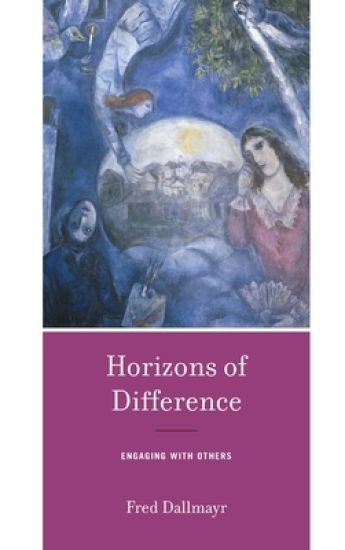
In his latest book, Horizons of Difference: Engaging with Others, Fred Dallmayr argues that the dialogue between religious and secular commitments, between faith and reason, is particularly important in our time because both faith and reason can give rise to dangerous and destructive types of extremism, fanaticism, or idolatry. In this interdisciplinary and cross-cultural synthesis of philosophy, religious thought, and political theory, Dallmayr neither accepts the "clash of cultures" dichotomy nor denies the reality of cultural tensions. Instead, operating from the standpoint of philosophical hermeneutics, he embraces cultural difference as a necessary condition and opportunity for mutual cross-cultural dialogue and learning. In part 1, "Relationality and Difference," Dallmayr explores the emergence of diverse loyalties and attachments in different social and cultural contexts. The assumption is not that different commitments are necessarily synchronized or "naturally" compatible but rather that they are held together precisely by their difference and potential antagonism. Part 2, "Engagement through Dialogue and Interaction," dwells on the major means of mediating between the alternatives of radical separation and radical sameness: dialogue and hermeneutical interpretation of understanding. In this respect, the emphasis shifts to leading philosophers of dialogue such as Hans-Georg Gadamer, Bernhard Waldenfels, and Maurice Merleau-Ponty. In a world where the absolutizing of the ego encourages selfish egotism that can lead to aggressive warmongering, Horizons of Difference shows how the categories of "difference" and "relationality" can be used to build a genuine and peaceful democracy based on dialogue and interaction instead of radical autonomy and elitism.
Horizons of Difference

Horizons of Difference

Fred Dallmayr

University of Notre Dame Press
2020
nidottu
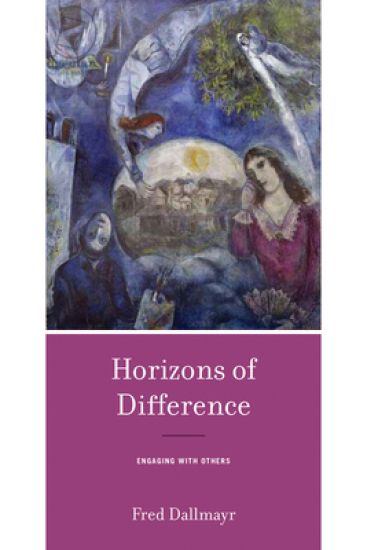
In his latest book, Horizons of Difference: Engaging with Others, Fred Dallmayr argues that the dialogue between religious and secular commitments, between faith and reason, is particularly important in our time because both faith and reason can give rise to dangerous and destructive types of extremism, fanaticism, or idolatry. In this interdisciplinary and cross-cultural synthesis of philosophy, religious thought, and political theory, Dallmayr neither accepts the "clash of cultures" dichotomy nor denies the reality of cultural tensions. Instead, operating from the standpoint of philosophical hermeneutics, he embraces cultural difference as a necessary condition and opportunity for mutual cross-cultural dialogue and learning. In part 1, "Relationality and Difference," Dallmayr explores the emergence of diverse loyalties and attachments in different social and cultural contexts. The assumption is not that different commitments are necessarily synchronized or "naturally" compatible but rather that they are held together precisely by their difference and potential antagonism. Part 2, "Engagement through Dialogue and Interaction," dwells on the major means of mediating between the alternatives of radical separation and radical sameness: dialogue and hermeneutical interpretation of understanding. In this respect, the emphasis shifts to leading philosophers of dialogue such as Hans-Georg Gadamer, Bernhard Waldenfels, and Maurice Merleau-Ponty. In a world where the absolutizing of the ego encourages selfish egotism that can lead to aggressive warmongering, Horizons of Difference shows how the categories of "difference" and "relationality" can be used to build a genuine and peaceful democracy based on dialogue and interaction instead of radical autonomy and elitism.
Post-Liberalism

Post-Liberalism

Fred Dallmayr

Oxford University Press Inc
2019
sidottu
Liberal democracy is the dominant political ideology in the West today. Taken at face value it suggests an equivalency between its two central components--liberalism and democracy--but as Fred Dallmayr argues here, the two operate in very different registers. The two frequently conflict, endangering our public life.This is evident in the rise of self-centered neo-liberalism as well as autocratic movements in our world today. More specifically, the conflict within liberal democracy is between the pursuit of individual or coporate interest, on the one hand, and a "people" increasingly fractured by economic and cultural clashes, on the other. Dallmayr asks whether there is still room for genuine privacy and authentic democracy when all public goods, from schools to parks, police, and armies, have been made the target of privatization. In this book, Dallmayr sets out to rescue democracy as a shared public and post-liberal regime. Nonetheless, "post-liberalism" does not involve the denial of human freedom nor does it suggest the endorsement of illiberal collectivism or nationalism. Drawing on a wide range of contemporary political, religious, and secular thought, Dallmayr charts a possible path to a liberal socialism that is devoid of egalitarian imperatives and a private sphere free from acquisitiveness.
Spiritual Guides

Spiritual Guides

Fred Dallmayr

University of Notre Dame Press
2017
sidottu
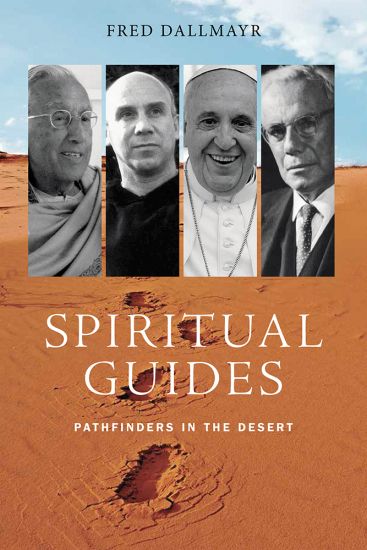
In Spiritual Guides: Pathfinders in the Desert, Fred Dallmayr challenges the "desert character" of modern culture. Political and economic corruption, incessant warmongering, spoliation of natural resources, and, above all, mindless consumerism and greedy self-satisfaction are all symptoms of what he contends is an expanding wasteland or desert where everything creative and nourishing decays and withers. Through an alternative interpretation of Nietzsche's saying "the desert grows," this book calls for spiritual renewal, invoking in particular four prominent guides or pathfinders in the desert: Paul Tillich, Raimon Panikkar, Thomas Merton, and Pope Francis. What links all four guides together is the view of spiritual life as an itinerarium, a pathway along difficult and often uncharted roads. Dallmayr begins by drawing a connection between Nietzsche's characterization of the desert in Thus Spoke Zarathustra and the present culture of consumerism, in which a nearly-exclusive emphasis on productivity, efficiency, profitability, and the transformation of everything valuable into a useful resource prevails over all other goals. He also draws attention to another sense of "desert," namely, as a place of solitude, meditation, and retreat from affliction. Aptly defined, it becomes a place where spirituality arises from a painful "turning-about": a wrenching effort to extricate human life from the decay of late modernity. Spirituality is not a possession or property but rather the contemplation and radical mindfulness that we develop through engaged practices as we search for pathways to recovery. Spirituality becomes critical in the dominant political and cultural wasteland because it provides a bond linking humanity together. In the spirit of global ecumenism, Spiritual Guides also includes a discussion of Muslim, Hindu, and Buddhist forms of spirituality. This book will interest students and scholars of philosophy, political theory, and religion.
Democracy to Come

Democracy to Come

Fred Dallmayr

Oxford University Press Inc
2017
sidottu
In this book Fred Dallmayr, one of the progenitors of comparative political theory, lays the groundwork for a new understanding of modern democracy. Dallmayr rejects the idea that democracy is a stable system that develops primarily through its horizontal spread; most expressly, he rejects the idea that democracy can be fostered through regime change and the unidirectional transfer of concepts of popular sovereignty and the public good from the West to autocracies. In fact, he argues that a major danger in modern history has been the tendency of Western leaders to appeal to the "will of the people". The "people" are not a fixed entity, and by invoking it, for example via militant populist movements, we go down the road to totalitarianism, messianism, or millenarianism. Rather than traveling horizontally from one society to others, democracy must be relational. Democracy to Come argues that democracy has to be nurtured by different societies and cultures from within, with their own resources. In order to provide a model of his vision of democracy, Dallmayr challenges the dominant liberal conception anchored in egocentrism, voluntarism, and individual or collective self-interest, and draws from ideas of modern democracy in Latin American / Christian, Middle Eastern / Muslim, Chinese / Confucianist, and Indian / Hindu societies. In turn, the book asserts that democracy can never be a finished project, but will always be about its potential, a democracy to come. It is only in this manner that a general global "ecumene" can come into being. This will be a cosmopolitan community governed not by one force, psychology, theology or society, but by the spirit of equality.
On the Boundary

On the Boundary

Fred Dallmayr

Hamilton Books
2017
nidottu
The book records the author’s personal and intellectual maturation over a period of nine decades. This maturation was never purely self-propelled, but always occurred in response to teachings and experiences. Situated as a “being-in-the-world”, the author’s experiences reach from World War II via the Cold War to recent “terror wars.” Intellectually, he participated in and reacted to a number of major perspectives: from phenomenology, existentialism, and critical theory to hermeneutics, postmodernism, and post-secularism. Exchanges with multiples interlocutors helped to shape his distinctive outlook or profile; which privileges self-other contacts over the ego, dialogue over monologue, and dialogical cosmopolitanism over chauvinistic power politics. Implicit in this emerging profile is a preference for potentiality over actuality and of relationality over static identity. Shunning doctrinal formulas or finished “systems”, the author’s life thus is shown to be simply a journey, an adventure to what comes, an itinerary (mentis in Deum).
Small Wonder

Small Wonder

Fred Dallmayr

Rowman Littlefield Publishers
2005
nidottu
Small Wonder presents the dangers of the 'underside of modernity': the unleashing of unlimited lust for (global) power and wealth. Relying on leading critical intellectuals, Dallmayr offers a critique of the self-deceptions of our age, arguing in favor of the cultivation of the 'small wonder' of everyday life.
Peace Talks—Who Will Listen?

Peace Talks—Who Will Listen?

Fred Dallmayr

University of Notre Dame Press
2004
sidottu
In his Complaint of Peace, the great sixteenth-century humanist Erasmus allows "Peace" to talk. Peace speaks as a plaintiff, protesting her shabby treatment at the hands of humankind and our ever-ready inclination to launch wars. Against this lure of warfare, Erasmus pits the higher task of peace-building, which can only succeed through the cultivation of justice and respect for all human life. First articulated in 1517, the complaint of peace has echoed through subsequent centuries and down to our age—an age convulsed by world wars, holocausts, and ethnic cleansings. Distinguished political scientist Fred Dallmayr traces this complaint from the writings of Erasmus through the evolution of the "law of nations" to recent and contemporary co-plaintiffs in the West. He also highlights the role of non-Western thinkers and teachings in giving voice to "Peace." In addition to Erasmus, Dallmayr engages major thinkers such as Francisco de Vitoria, Hugo Grotius, Immanuel Kant, Hannah Arendt, Martin Heidegger, Mahatma Ghandi, the Dalai Lama, John Rawls, and Martha Nussbaum. This timely book urgently pleads for greater attentiveness to peace's complaint as an antidote to the prevailing culture of violence and the escalating danger of nuclear catastrophe. Dallmayr offers not only a compelling historical narrative, but powerful ethical and religious arguments vindicating the primacy of peace over violence and war.
Achieving Our World

Achieving Our World

Fred Dallmayr

Rowman Littlefield Publishers
2001
nidottu
In an age marked by global hegemony and festering civilization clashes, Fred Dallmayr's Achieving Our World charts a path toward a cosmopolitan democracy respectful of local differences. Dallmayr draws upon and develops insights from a number of fields: political theory, the study of international politics, recent Continental philosophy, and an array of critical cultural disciplines to illustrate and elucidate his thesis. In Achieving Our World, Dallmayr contends that a genuinely global and plural democracy and 'civic culture' is the only viable and promising path for humankind in the new millennium.
Alternative Visions

Alternative Visions

Fred Dallmayr

Rowman Littlefield
1998
nidottu
Globalization is often seen as a process of universal standardization under the auspices of market economics, technology, and hegemonic power. Resisting this process without endorsing parochial self-enclosure, Fred Dallmayr explores alternative visions that are rooted in distinct vernacular traditions and facilitate cross-cultural learning in an open-ended global arena. Dallmayr charts a 'grassroots' approach to the global village, an approach that relies on ethical and religious traditions and popular beliefs as launching pads for cross-cultural learning, dialogue, and self-transformation. Truly interdisciplinary in nature, Alternative Visions combines general philosophy, the philosophy of religion, and political, cultural, and post-colonial theory. It is an important book for students and scholars in all of these areas of study.
Beyond Orientalism

Beyond Orientalism

Fred Dallmayr

State University of New York Press
1996
pokkari
Explores some steps toward non-assimilative encounters in the "global village."Beyond Orientalism explores the confluence of contemporary Western (especially Continental) philosophy, with its focus on otherness and difference, and the ongoing process of globalization or the emergence of the "global village." The basic question raised in the book is: What will be the prevailing life-form or discourse of the global village? Will it be the discourse of Western science, industry, and metaphysics which, under the banner of modernization and development, seeks to homogenize the world in its image? In Said's work, this strategy was labeled "Orientalism." Or will it be possible to move "beyond Orientalism" in the direction neither of global uniformity nor radical fragmentation?After discussing the broad range of possible "modes of cross-cultural encounter" in a historical perspective, the book develops as a preferred option the notion of a deconstructive dialogue or a "hermeneutics of difference" which respects otherness beyond assimilation. This hermeneutics is illustrated in chapters examining several bridge-builders between cultures, primarily the Indian philosophers Radhakrishnan and J. L. Mehta and the Indologist Halbfass. The remaining chapters are devoted to more concrete social-political problems, including issues of modernization, multiculturalism, and the prospects of a globalized democracy which bids farewell to Orientalism and Eurocentrism.