Kirjojen hintavertailu. Mukana 12 478 809 kirjaa ja 12 kauppaa.

Kirjailija

Fred R. Myers

Kirjat ja teokset yhdessä paikassa: 5 kirjaa, julkaisuja vuosilta 1991-2024, suosituimpien joukossa Six Paintings from Papunya. Vertaile teosten hintoja ja tarkista saatavuus suomalaisista kirjakaupoista.

5 kirjaa

Kirjojen julkaisuhaarukka 1991-2024.

Six Paintings from Papunya

Six Paintings from Papunya

Fred R. Myers; Terry Smith

DUKE UNIVERSITY PRESS
2024
pokkari
In the early 1970s at Papunya, a remote settlement in the Central Australian desert, a group of Indigenous artists decided to communicate the sacred power of their traditional knowledge to the wider worlds beyond their own. Their exceptional, innovative efforts led to an outburst of creative energy across the continent that gave rise to the contemporary Aboriginal art movement that continues to this day. In their new book, anthropologist Fred Myers and art critic Terry Smith discuss six Papunya paintings featured in a 2022 exhibition in New York. They draw on several discourses that have developed around First Nations art-notably anthropology, art history, and curating as practiced by Indigenous and non-Indigenous interpreters. Their focus on six key paintings enables unusually close and intense insight into the works’ content and extraordinary innovation. Six Paintings from Papunya also includes a reflection by Indigenous curator and scholar Stephen Gilchrist, who considers the nature and significance of this rare transcultural conversation.
Six Paintings from Papunya

Six Paintings from Papunya

Fred R. Myers; Terry Smith

DUKE UNIVERSITY PRESS
2024
sidottu
In the early 1970s at Papunya, a remote settlement in the Central Australian desert, a group of Indigenous artists decided to communicate the sacred power of their traditional knowledge to the wider worlds beyond their own. Their exceptional, innovative efforts led to an outburst of creative energy across the continent that gave rise to the contemporary Aboriginal art movement that continues to this day. In their new book, anthropologist Fred Myers and art critic Terry Smith discuss six Papunya paintings featured in a 2022 exhibition in New York. They draw on several discourses that have developed around First Nations art-notably anthropology, art history, and curating as practiced by Indigenous and non-Indigenous interpreters. Their focus on six key paintings enables unusually close and intense insight into the works’ content and extraordinary innovation. Six Paintings from Papunya also includes a reflection by Indigenous curator and scholar Stephen Gilchrist, who considers the nature and significance of this rare transcultural conversation.
Painting Culture

Painting Culture

Fred R. Myers

Duke University Press
2002
pokkari
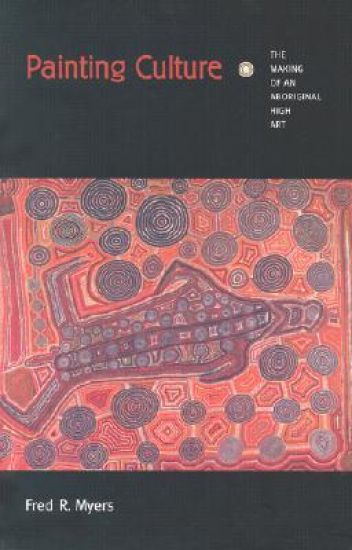
Painting Culture tells the complex story of how, over the past three decades, the acrylic "dot" paintings of central Australia were transformed into objects of international high art, eagerly sought by upscale galleries and collectors. Since the early 1970s, Fred R. Myers has studied-often as a participant-observer-the Pintupi, one of several Aboriginal groups who paint the famous acrylic works. Describing their paintings and the complicated cultural issues they raise, Myers looks at how the paintings represent Aboriginal people and their culture and how their heritage is translated into exchangeable values. He tracks the way these paintings become high art as they move outward from indigenous communities through and among other social institutions-the world of dealers, museums, and critics. At the same time, he shows how this change in the status of the acrylic paintings is directly related to the initiative of the painters themselves and their hopes for greater levels of recognition. Painting Culture describes in detail the actual practice of painting, insisting that such a focus is necessary to engage directly with the role of the art in the lives of contemporary Aboriginals. The book includes a unique local art history, a study of the complete corpus of two painters over a two-year period. It also explores the awkward local issues around the valuation and sale of the acrylic paintings, traces the shifting approaches of the Australian government and key organizations such as the Aboriginal Arts Board to the promotion of the work, and describes the early and subsequent phases of the works’ inclusion in major Australian and international exhibitions. Myers provides an account of some of the events related to these exhibits, most notably the Asia Society’s 1988 "Dreamings" show in New York, which was so pivotal in bringing the work to North American notice. He also traces the approaches and concerns of dealers, ranging from semi-tourist outlets in Alice Springs to more prestigious venues in Sydney and Melbourne. With its innovative approach to the transnational circulation of culture, this book will appeal to art historians, as well as those in cultural anthropology, cultural studies, museum studies, and performance studies.
Painting Culture

Painting Culture

Fred R. Myers

Duke University Press
2002
sidottu
Painting Culture tells the complex story of how, over the past three decades, the acrylic "dot" paintings of central Australia were transformed into objects of international high art, eagerly sought by upscale galleries and collectors. Since the early 1970s, Fred R. Myers has studied-often as a participant-observer-the Pintupi, one of several Aboriginal groups who paint the famous acrylic works. Describing their paintings and the complicated cultural issues they raise, Myers looks at how the paintings represent Aboriginal people and their culture and how their heritage is translated into exchangeable values. He tracks the way these paintings become high art as they move outward from indigenous communities through and among other social institutions-the world of dealers, museums, and critics. At the same time, he shows how this change in the status of the acrylic paintings is directly related to the initiative of the painters themselves and their hopes for greater levels of recognition. Painting Culture describes in detail the actual practice of painting, insisting that such a focus is necessary to engage directly with the role of the art in the lives of contemporary Aboriginals. The book includes a unique local art history, a study of the complete corpus of two painters over a two-year period. It also explores the awkward local issues around the valuation and sale of the acrylic paintings, traces the shifting approaches of the Australian government and key organizations such as the Aboriginal Arts Board to the promotion of the work, and describes the early and subsequent phases of the works’ inclusion in major Australian and international exhibitions. Myers provides an account of some of the events related to these exhibits, most notably the Asia Society’s 1988 "Dreamings" show in New York, which was so pivotal in bringing the work to North American notice. He also traces the approaches and concerns of dealers, ranging from semi-tourist outlets in Alice Springs to more prestigious venues in Sydney and Melbourne. With its innovative approach to the transnational circulation of culture, this book will appeal to art historians, as well as those in cultural anthropology, cultural studies, museum studies, and performance studies.
Pintupi Country, Pintupi Self

Pintupi Country, Pintupi Self

Fred R. Myers

University of California Press
1991
pokkari
The Pintupi, a hunting-and-gathering people of Australia's Western Desert, were among the last Aborigines to come into contact with white society. Despite their extended relocation in central Australian settlements, they have managed to preserve much of their traditional culture and social organization. This book presents a comprehensive ethnographic interpretation of the ways in which Pintupi politics, cosmology, kinship systems, nomadic patterns, and social values reinforce and sometimes contradict each other.